

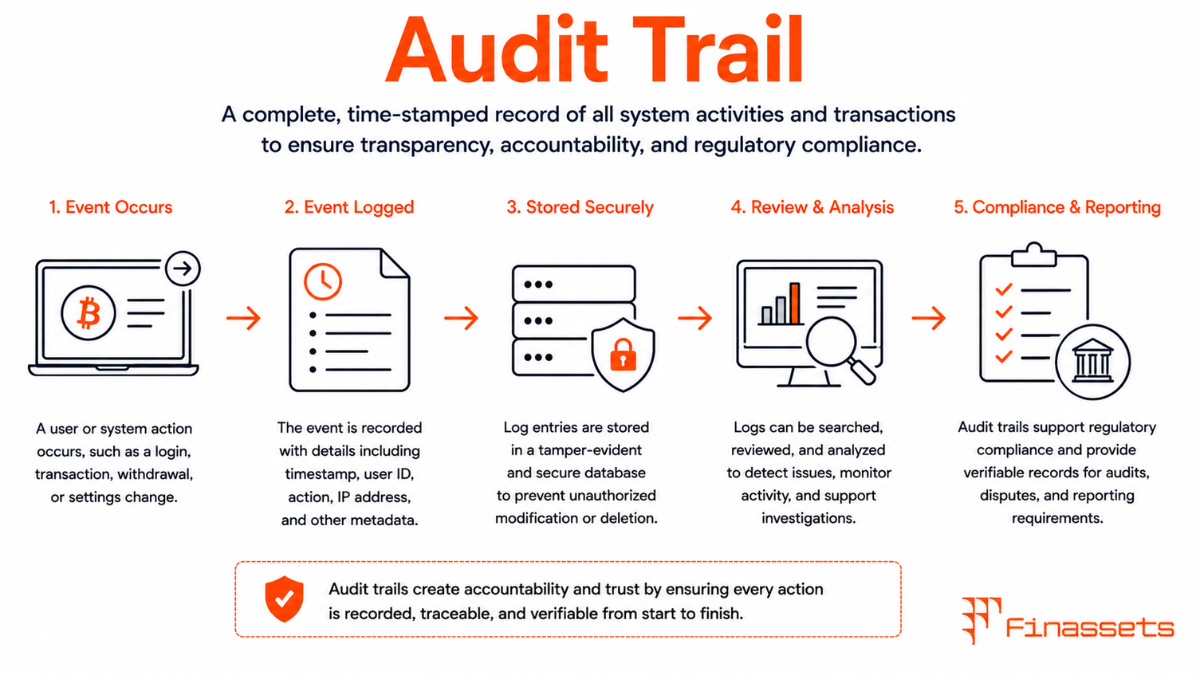
What Must Be Captured in a Payment Gateway Audit Trail
A complete audit trail for a crypto payment gateway must capture two categories of events: transactional events (what happened to money) and operational events (what happened in the system). Regulators and auditors need both to assess whether the gateway operated as documented and whether funds moved as authorised.
Transactional events include: every incoming payment detected, confirmed, or flagged; every conversion executed and the rate applied; every settlement initiated and completed; every refund processed; and every payout authorised and disbursed. Operational events include: every user login and session; every API key created, modified, or revoked; every account setting change; every compliance decision (KYB approvals, risk tier changes, transaction reviews); and every system configuration change.
Each event record must include: the event type, the timestamp (to millisecond precision), the actor (which user, system, or API key initiated the event), the subject (which account, wallet, or transaction was affected), the specific data changed (before and after values for setting changes), and the source IP address for human-initiated events.
On-Chain vs. Off-Chain Audit Trails
Crypto payment gateways benefit from two complementary audit trails that serve different purposes. The on-chain record — the blockchain itself — provides a cryptographically immutable, publicly verifiable record of every fund movement. No party can alter an on-chain transaction record without invalidating the entire blockchain from that point forward. This makes on-chain records the strongest possible evidence of fund transfers.
Off-chain gateway logs record the business context that on-chain data cannot: who authorised a payment, which merchant the funds were received for, which compliance decision was made about a flagged transaction, and who changed which account settings. Off-chain logs are stored by the gateway and are subject to potential manipulation if the gateway's logging infrastructure is compromised. Gateways with high security requirements use tamper-evident logging systems — append-only log stores with cryptographic chaining — to make retroactive alteration detectable.
Regulatory Retention Requirements
|
Jurisdiction |
Record Type |
Retention Period |
Authority |
|
EU (MiCA/AMLD) |
Transaction records; customer identification |
5 years minimum |
National competent authorities |
|
US (Bank Secrecy Act) |
Transaction records; SAR records |
5 years |
FinCEN |
|
UK (MLR 2017) |
Customer due diligence; transaction records |
5 years |
FCA |
|
Singapore (PSA) |
Transaction and customer records |
5 years |
MAS |
|
General best practice |
All operational and security logs |
5–7 years |
Internal policy + regulatory minimum |
Using Audit Trails in Compliance Investigations
When a transaction is flagged for suspicious activity review — by automated risk scoring, a blockchain analytics alert, or external notification — the audit trail is the primary tool for reconstructing the full context of the transaction. The compliance officer needs to know: who onboarded this merchant and what KYB documents were collected; what risk tier was assigned and on what basis; what the transaction history looks like for this merchant; and whether any prior suspicious activity was noted.
A well-maintained audit trail makes this investigation productive — all information is searchable, timestamped, and linked to the relevant accounts and transactions. A poorly maintained audit trail means investigators must piece together information from multiple disconnected systems, often finding gaps where events were not logged or where log retention has lapsed. The quality of the audit trail directly determines how quickly and effectively the gateway can respond to regulatory inquiries, which is increasingly a criterion in licensing assessments.
Compliance Note: This glossary entry is provided for general educational purposes only and does not constitute financial, investment, legal, or tax advice. Industry terminology may vary across jurisdictions and providers; definitions herein may not directly reflect the specific features, terms, or specifications of Finassets' services. For details on Finassets' offerings, please refer to official product documentation or contact our team directly.