

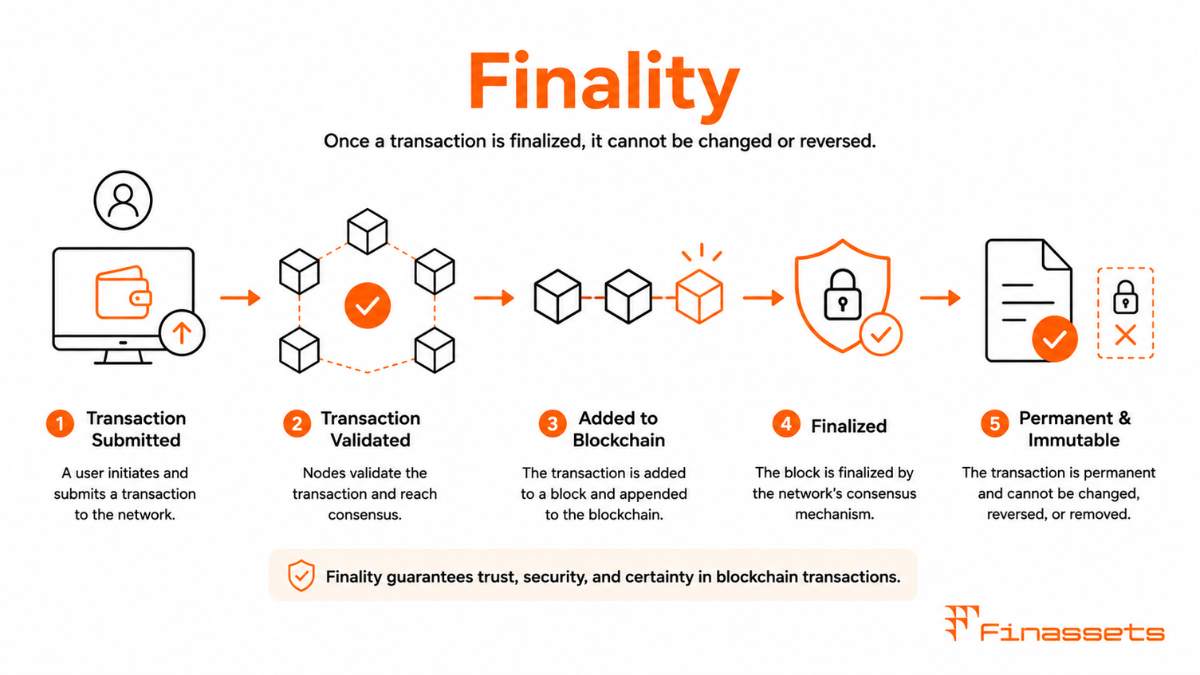
Probabilistic vs. Deterministic Finality
Not all blockchains achieve finality in the same way. Proof of Work chains like Bitcoin use probabilistic finality: transactions become increasingly difficult to reverse with each new confirmation, but theoretically remain reversible as long as an attacker controls enough hash rate. The probability of reversal after 6 confirmations is negligible in practice, but not mathematically zero.
Proof of Stake chains increasingly use deterministic finality: once a supermajority of validators have attested to a block, the protocol mathematically prevents that block from being reverted without slashing the stake of one-third of all validators — an economically catastrophic event. Ethereum achieves deterministic finality roughly every 12 minutes through its checkpoint mechanism. Solana aims for near-instant deterministic finality per slot.
For payment gateways, the practical consequence is that waiting for 3–6 Bitcoin confirmations achieves comparable security to a single deterministically final block on a PoS chain.
Finality Times Across Payment-Relevant Networks
|
Network |
Finality Model |
Practical Finality Time |
|
Bitcoin |
Probabilistic (6 confirmations) |
~60 minutes |
|
Ethereum |
Deterministic (checkpoint) |
~12 minutes |
|
Solana |
Optimistic / deterministic |
~0.4–2 seconds |
|
Tron |
Delegated PoS |
~1–2 minutes |
|
BNB Chain |
Delegated PoS |
~15–45 seconds |
|
Lightning (Bitcoin) |
Off-chain / instant |
< 1 second |
Why Finality Matters More Than Confirmation Speed
Block time and finality are often conflated. A blockchain can produce blocks every second but still have long finality times if forks are frequent and the chain needs many confirmations to settle. Conversely, a chain with 10-minute blocks can achieve practical finality quickly if double-spend attacks are economically impossible given the hash rate.
For merchants, the operational question is not 'how fast are blocks produced?' but 'when can I safely release goods?' A payment gateway that releases funds at one confirmation on a low-security network exposes the merchant to race attacks. A gateway that waits for finality before releasing funds is trading speed for security. Most production gateways allow merchants to configure their own confirmation threshold based on transaction value: higher-value orders require more confirmations.
Finality and the Chargeback Problem
Traditional card payment chargebacks can be initiated up to 120 days after a transaction in many card networks, and disputes may take months to resolve. A merchant who ships goods immediately after a card payment faces the risk of losing both the goods and the revenue if a chargeback succeeds.
Once a crypto transaction reaches finality, it cannot be reversed by the payer, their bank, a payment network, or any court order — it can only be refunded voluntarily by the merchant sending a new transaction. This eliminates the chargeback category entirely for the merchant. Fraudulent chargeback claims — which card industry data consistently attributes to a significant share of all chargebacks — are structurally impossible for finalized crypto transactions.
What Finality Does Not Protect Against
Transaction finality confirms that funds moved on-chain as recorded. It does not confirm that the payment was made in error, under duress, or to the wrong address. If a merchant generates an incorrect payment address, a customer pays it, and the transaction achieves finality, the funds are permanently unrecoverable. This makes address generation accuracy a critical upstream dependency of finality's commercial benefit. Payment gateways mitigate this by generating addresses programmatically, reducing human error to near zero.
Compliance Note: This glossary entry is provided for general educational purposes only and does not constitute financial, investment, legal, or tax advice. Industry terminology may vary across jurisdictions and providers; definitions herein may not directly reflect the specific features, terms, or specifications of Finassets' services. For details on Finassets' offerings, please refer to official product documentation or contact our team directly.