

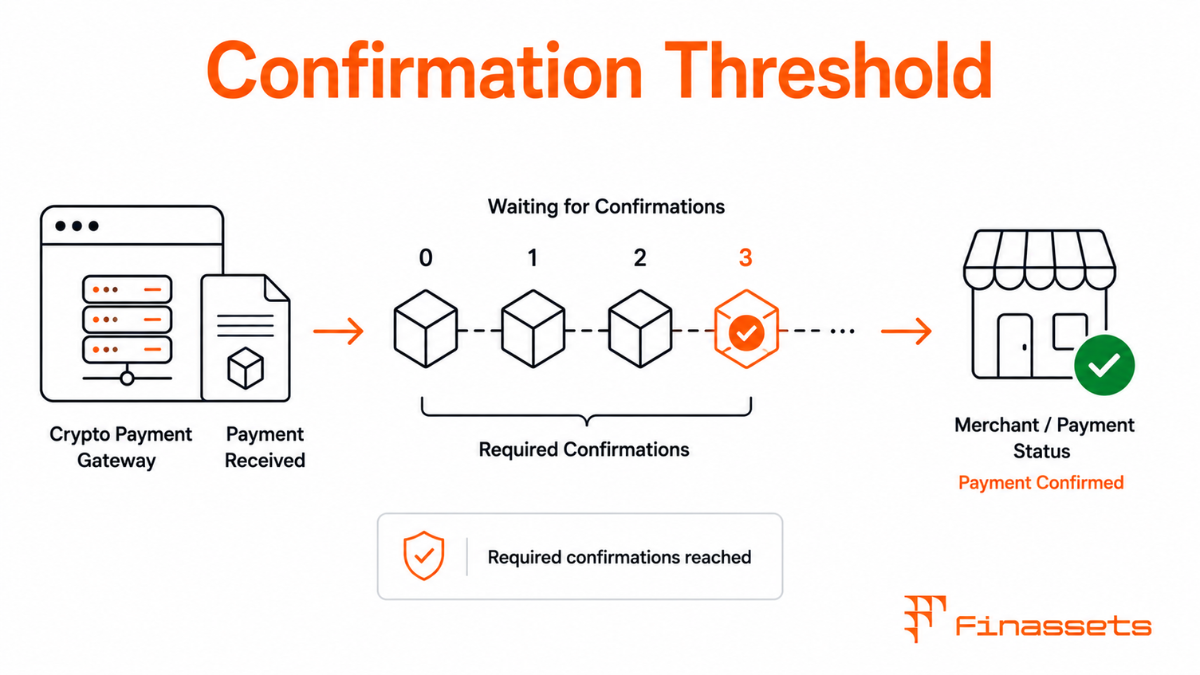
What a Blockchain Confirmation Actually Means
Each block added to a blockchain after the block containing a transaction adds one confirmation. A transaction with three confirmations means three blocks have been mined on top of it. The security implication is probabilistic on Proof of Work chains: to reverse a transaction with N confirmations, an attacker would need to reconstruct N+1 blocks faster than the honest network is producing new blocks. The cost of this attack scales exponentially with N because the attacker must permanently outpace an increasingly longer chain.
On Proof of Stake chains with deterministic finality, confirmation counts relate differently to finality. Ethereum reaches finality at checkpoints approximately every 12 minutes, after which reversion requires slashing one-third of all staked ETH — an economically catastrophic event. In practice, Ethereum transactions are treated as final well before the formal checkpoint, because the economic cost of reversal becomes prohibitive after just a few blocks.
Standard Confirmation Thresholds by Network
|
Network |
Typical Gateway Threshold |
Block Time |
Time to Threshold |
Security Model |
|
Bitcoin (BTC) |
3–6 confirmations |
~10 minutes |
30–60 minutes |
Probabilistic PoW; 6-conf is industry standard |
|
Ethereum (ETH) |
12–32 confirmations |
~12 seconds |
2–6 minutes |
Near-deterministic; 32-conf ensures finality |
|
Tron (TRX/USDT-TRC20) |
20 confirmations |
~3 seconds |
~1 minute |
DPoS; fast but fewer validators |
|
BNB Chain (BEP-20) |
15 confirmations |
~3 seconds |
~45 seconds |
DPoS; similar to Tron |
|
Solana (SOL) |
1–32 slots |
~0.4 seconds |
< 15 seconds |
Deterministic; very fast finality |
|
Litecoin (LTC) |
6–12 confirmations |
~2.5 minutes |
15–30 minutes |
PoW; similar model to Bitcoin |
|
Bitcoin Cash (BCH) |
1–3 confirmations |
~10 minutes |
10–30 minutes |
PoW; 0-conf safer than BTC due to no RBF |
Risk-Based Threshold Configuration
A fixed confirmation threshold applied to all transactions regardless of value is a blunt instrument. A 6-confirmation requirement adds an hour's wait for a €1 coffee payment — an experience no customer will tolerate. A 1-confirmation threshold for a €50,000 equipment purchase exposes the merchant to meaningful double-spend risk. Professional gateways support value-based threshold tiers: fewer confirmations for low-value payments where the cost of a double-spend attack exceeds the gain, more confirmations for high-value payments where the attack is more attractive.
A practical tiered approach for Bitcoin might be: 0–1 confirmations for amounts below €10 (risk accepted for convenience), 3 confirmations for €10–€1,000, and 6 confirmations for amounts above €1,000. The merchant configures these tiers based on their average transaction value and fraud risk tolerance. Gateways that do not support configurable thresholds force merchants to choose between universal convenience (low threshold, higher fraud risk) or universal security (high threshold, poor customer experience for small payments).
Chain Reorganisations and Threshold Safety
A blockchain reorganisation (reorg) occurs when the network temporarily follows a longer chain that disagrees with the current canonical chain, causing previously confirmed transactions to become unconfirmed. Shallow reorgs — one or two blocks — occur naturally and occasionally even in healthy networks due to near-simultaneous block discovery. Deep reorgs are rare on large PoW networks but more likely on smaller ones with less hash rate.
Confirmation thresholds exist partly to absorb shallow reorgs: a transaction with 3 confirmations is not invalidated by a 1-block reorg. Payment gateways should have monitoring for deep reorg events on supported networks and a documented procedure for handling merchant credits that are later reversed by a reorg — rare but requiring a clear customer communication and refund policy.
Compliance Note: This glossary entry is provided for general educational purposes only and does not constitute financial, investment, legal, or tax advice. Industry terminology may vary across jurisdictions and providers; definitions herein may not directly reflect the specific features, terms, or specifications of Finassets' services. For details on Finassets' offerings, please refer to official product documentation or contact our team directly.