

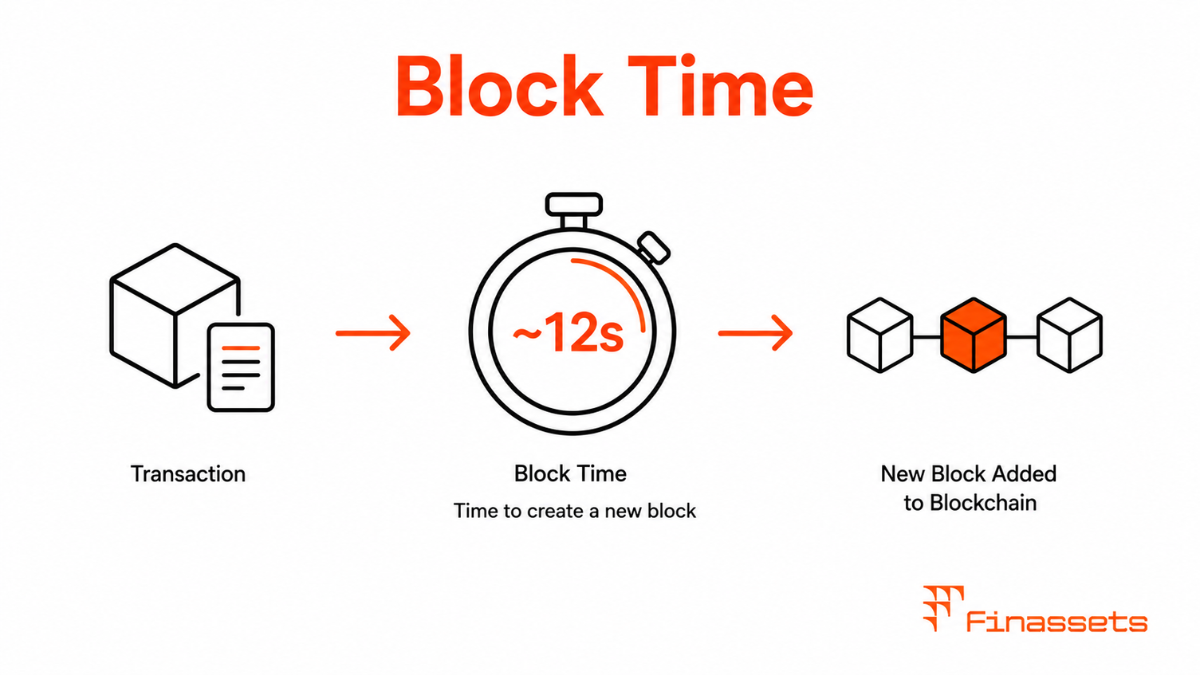
What Block Time Means and Why It Varies
Block time is the average time between successive blocks being appended to a blockchain. It is not a fixed constant but a statistical average produced by the protocol's difficulty adjustment mechanism (in Proof of Work) or block proposal schedule (in Proof of Stake). Bitcoin targets approximately 10-minute block times by adjusting mining difficulty every 2016 blocks — when the network's total hash rate increases, difficulty increases to keep average block time near 10 minutes. Ethereum targets 12-second slots in its Proof of Stake system, with validators proposing blocks at each slot boundary.
Real-world block times vary around the average. Bitcoin blocks arrive anywhere from seconds to over an hour apart — the Poisson distribution of mining means that any individual interval is unpredictable. In a worst case, a merchant could wait 40 minutes for a Bitcoin payment's first confirmation because a long inter-block gap happens to coincide with their customer's checkout. This variability is a user experience challenge that payment gateways must communicate clearly.
Block Time Across Payment-Relevant Networks
|
Network |
Target Block Time |
Actual Range |
First Confirmation Wait |
Payment UX Impact |
|
Bitcoin (BTC) |
~10 minutes |
Seconds to 90+ minutes |
10 min average; highly variable |
Significant — customers need clear expectation-setting |
|
Ethereum (ETH) |
12 seconds |
12–24 seconds |
~12 seconds |
Minimal — near-instant first confirmation |
|
Tron (TRX/USDT) |
~3 seconds |
2–5 seconds |
~3 seconds |
Negligible — effectively instant for retail |
|
BNB Chain |
~3 seconds |
2–5 seconds |
~3 seconds |
Negligible |
|
Solana |
~0.4 seconds (slot) |
0.4–1 second |
< 1 second |
Negligible — sub-second |
|
Litecoin (LTC) |
~2.5 minutes |
30 seconds to 15 min |
~2.5 min average |
Moderate — better than BTC but still noticeable |
|
Bitcoin Lightning |
< 1 second |
Milliseconds |
Instant (HTLC-based) |
Zero — instant for all payment values |
How Block Time Affects Gateway Design
Block time has downstream effects on several gateway design decisions. Payment expiry windows must account for block time: a 10-minute expiry with Bitcoin is likely to catch a first confirmation in time during normal mempool conditions, but not if the customer's transaction enters the mempool shortly after a block was just found, creating a potential 10-minute wait before the next block plus mempool processing time. Gateways typically set Bitcoin payment windows to 20–30 minutes to account for this variability.
Customer communication must also account for block time. A checkout page that says 'payment will be confirmed instantly' is misleading for Bitcoin payments. Gateways serving multiple networks should display network-specific confirmation time estimates — something like 'Bitcoin payments typically confirm in 10–30 minutes; Tron payments confirm in under 1 minute' — alongside the payment details. Managing customer expectations accurately reduces support tickets from customers who send a payment and then wonder why their order has not been fulfilled three minutes later.
Block Time Variability and Reliability Implications
The statistical variability of Proof of Work block times creates a reliability distribution rather than a guarantee. Approximately 63% of Bitcoin blocks arrive within 10 minutes of the previous block; about 37% take longer. About 14% take more than 20 minutes, and around 5% take more than 30 minutes. For a merchant with a 20-minute payment window, a 5% chance per transaction of the first confirmation arriving after expiry represents a meaningful incidence rate at scale — a gateway processing 10,000 Bitcoin transactions monthly can expect approximately 500 expiry-due-to-long-block-time events that require support intervention.
Proof of Stake networks with deterministic slot schedules dramatically reduce this variability. Ethereum validators propose blocks at 12-second slots; if a validator misses their slot, the next slot produces a block. The practical variability in Ethereum block times is much smaller than Bitcoin's — block times are almost always within 12–24 seconds. For payment gateways, Ethereum's predictable block production makes timing-sensitive payment operations significantly more reliable.
Compliance Note: This glossary entry is provided for general educational purposes only and does not constitute financial, investment, legal, or tax advice. Industry terminology may vary across jurisdictions and providers; definitions herein may not directly reflect the specific features, terms, or specifications of Finassets' services. For details on Finassets' offerings, please refer to official product documentation or contact our team directly.