

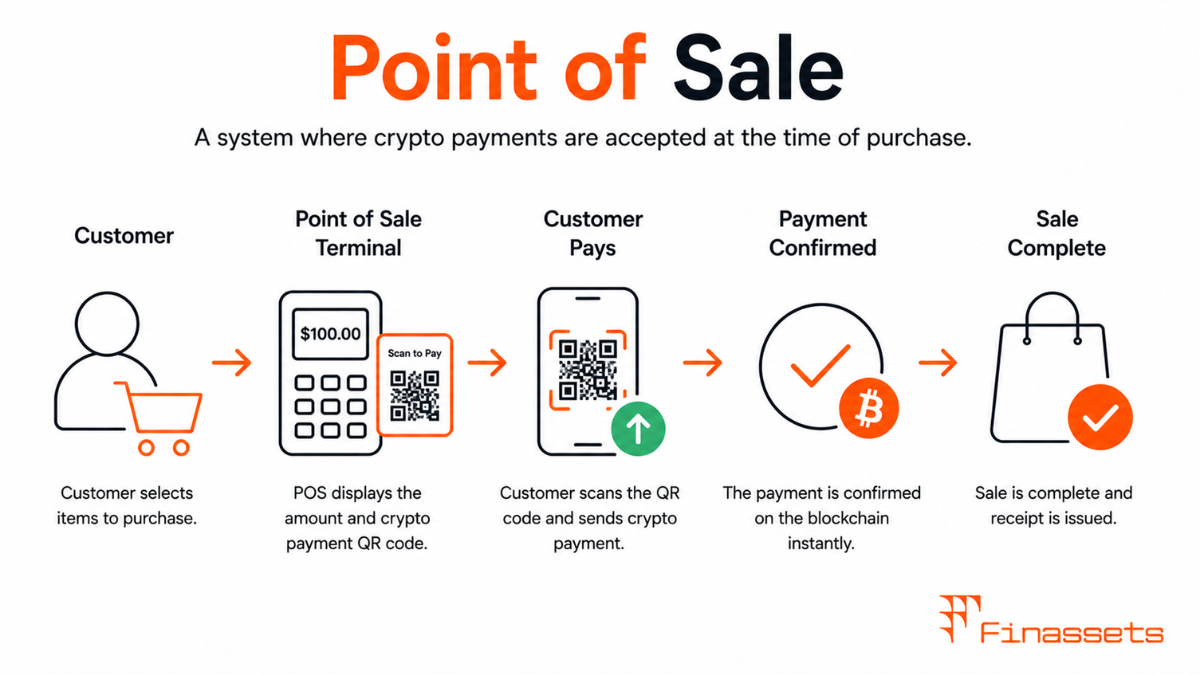
How POS Crypto Payments Differ From Online Payments
In an online checkout, a customer has unlimited time to open their wallet, copy a payment address, verify an amount, and confirm a transaction. The process can take several minutes without disrupting the purchase flow. In a physical retail environment, a customer standing at a counter with other customers waiting behind them needs to complete a payment in under 30 seconds — the same timeframe as a contactless card payment.
This time constraint drives almost every design decision in a POS crypto solution: network selection (must have fast confirmation or accept 0-conf), conversion timing (instant to avoid volatility during the transaction), display format (QR code or NFC, never manual address entry), and fallback procedures (what happens when the customer's wallet does not support the payment method).
Hardware Options for POS Crypto Acceptance
|
Hardware |
Description |
Best For |
|
Tablet app |
Standard tablet running a crypto POS app; displays QR code |
Cafés, retail counters, market stalls |
|
Smartphone app |
Merchant's phone doubles as POS; generates QR codes |
Mobile vendors, pop-up retail |
|
Dedicated POS terminal |
Hardware terminal from gateway provider or integrator |
High-volume retail; existing POS ecosystem |
|
Integrated legacy POS |
Crypto added to existing EPOS system via plugin/API |
Retailers with existing EPOS infrastructure |
|
NFC-enabled terminal |
Contactless card terminal adapted for crypto tap-to-pay |
Fast-casual food, ticketing |
Network Selection Is Critical for POS
A merchant using Bitcoin for POS payments faces a fundamental tension: Bitcoin's 10-minute block time is incompatible with the sub-30-second experience retail requires. Solutions include accepting zero-confirmation payments (with small double-spend risk for low-value transactions), using the Lightning Network for instant Bitcoin settlement, or switching to a higher-throughput network (Ethereum, Solana, or Tron USDT) for POS contexts.
Most POS crypto deployments for everyday retail use stablecoins on fast networks — particularly TRC-20 USDT or Solana USDC — because the combination of near-instant confirmation, fee predictability, and price stability removes the three main operational risks of retail crypto acceptance: slow confirmation, unpredictable fees, and price volatility.
Instant Conversion at the Point of Payment
For brick-and-mortar merchants who have no interest in holding crypto, instant auto-conversion is essential. When the customer pays in cryptocurrency, the gateway confirms receipt and immediately converts it to the merchant's local fiat currency. The merchant's accounting system records a fiat revenue figure, not a crypto asset. The entire crypto exposure exists only during the seconds between payment broadcast and gateway confirmation — a window so short that meaningful price movement is unlikely.
This model allows any merchant to accept crypto without crypto knowledge, without wallet management, and without exposure to price volatility. The customer pays in crypto from their preferred wallet; the merchant receives local currency in their bank account at their next settlement date. The gateway handles everything in between.
Reconciliation in a POS Environment
Crypto POS payments generate on-chain transaction records that are more detailed and permanent than card payment records. Each POS transaction has a TXID, a precise timestamp, an exact amount received, the wallet address it came from, and the exchange rate at conversion. Gateways provide this data in CSV exports and API endpoints, making reconciliation against end-of-day cash register totals straightforward.
A POS environment with mixed payment methods — cash, card, and crypto — should ensure that the crypto gateway's transaction export format is compatible with the store's accounting software. Most modern accounting packages can import CSV files; some have direct integrations with major crypto gateway providers.
Compliance Note: This glossary entry is provided for general educational purposes only and does not constitute financial, investment, legal, or tax advice. Industry terminology may vary across jurisdictions and providers; definitions herein may not directly reflect the specific features, terms, or specifications of Finassets' services. For details on Finassets' offerings, please refer to official product documentation or contact our team directly.