

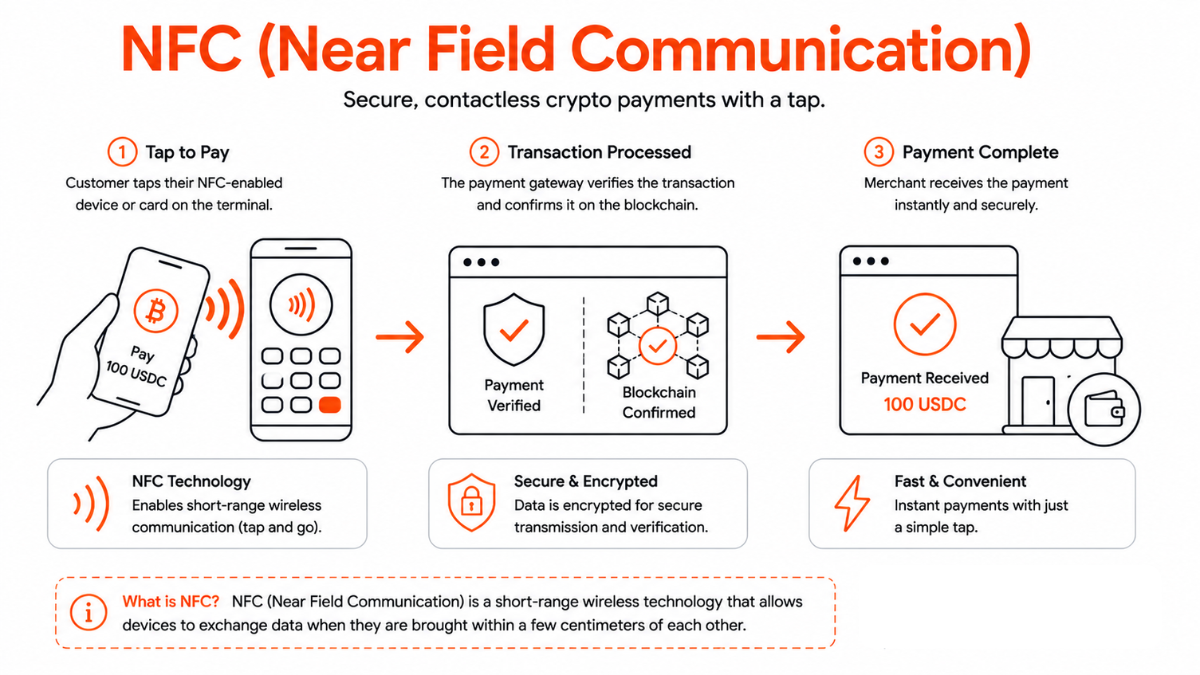
How NFC Technology Works in Payments
NFC (Near Field Communication) is a short-range wireless communication standard operating at 13.56 MHz that enables data exchange between devices within approximately 4 centimetres. In payments, NFC enables tap-to-pay: the customer's NFC-capable device (smartphone, smartwatch, or NFC card) communicates with a compatible terminal by entering the terminal's radio field and exchanging a cryptographic payment credential in under 50 milliseconds. The experience is the fastest in-person payment method available — faster than inserting a chip card and typically faster than scanning a QR code.
Traditional NFC payments (Apple Pay, Google Pay, contactless cards) route through card networks — NFC is the communication layer, while Visa and Mastercard provide the authorization, clearing, and settlement infrastructure. Crypto NFC payments use the same communication layer but replace the card network rails with blockchain settlement, either directly (the NFC device initiates a blockchain transaction) or via an intermediary (the NFC credential authorizes a payment through a crypto payment processor that handles blockchain execution).
Implementation Approaches for Crypto NFC Payments
|
Approach |
How It Works |
Crypto Exposure |
Best For |
|
Crypto debit card (Visa/MC) |
NFC card linked to crypto wallet; instant conversion at POS |
None — merchant receives fiat via card network |
Retail spending; maximum compatibility |
|
Direct NFC wallet |
Wallet app initiates blockchain transaction via NFC tap |
Full — customer sends crypto directly |
Merchant and customer both crypto-native |
|
NFC-enabled hardware wallet |
Hardware wallet with NFC capability signs and broadcasts transaction |
Full — direct on-chain settlement |
Security-conscious crypto-native users |
|
POS terminal with NFC + instant conversion |
Merchant terminal detects NFC tap, processes via gateway, converts to fiat |
None — merchant receives fiat |
Physical retail merchants wanting crypto + fiat simplicity |
NFC vs. QR Code in Physical Retail Crypto Acceptance
QR code scanning and NFC tap-to-pay represent two different user experience philosophies for in-person crypto payments. QR codes require the customer to open their wallet app, navigate to the scan function, point the camera at the displayed code, wait for it to parse, review the pre-filled transaction details, and confirm — a flow taking 15–30 seconds on average. NFC tap requires the customer to unlock their phone or bring their NFC card close to the terminal — a flow completing in under 5 seconds, comparable to a contactless card payment.
For high-throughput physical environments — coffee shops, transport, vending — the speed difference matters enormously. A 30-second QR code scan creates a queue at a busy counter; a 5-second NFC tap does not. However, NFC crypto requires compatible hardware on both sides (NFC-capable customer device and NFC-enabled merchant terminal), while QR code payments need only a screen displaying the code and a camera on the customer's device — significantly lower infrastructure requirements.
Adoption Limitations and the Hardware Requirement
Wide adoption of direct crypto NFC payments faces several constraints. Merchant NFC terminals must support custom payment app protocols beyond the standard EMV contactless specification — most existing card terminals do not. Consumer NFC wallets broadcasting blockchain transactions remain a small fraction of the overall wallet market. And the regulatory status of NFC-initiated blockchain transactions varies: some jurisdictions require NFC payment acceptance to route through licensed payment institutions, not directly to blockchain addresses.
The near-term most viable path for crypto NFC in physical retail is through crypto debit cards — Visa and Mastercard co-branded cards linked to crypto wallets that convert at the point of tap and route through card network infrastructure. These provide full NFC tap-to-pay compatibility with existing terminals and the full card network consumer protection framework, while allowing cardholders to spend crypto balances. The merchant receives fiat through normal card settlement; the crypto exposure is entirely on the cardholder side.
Compliance Note: This glossary entry is provided for general educational purposes only and does not constitute financial, investment, legal, or tax advice. Industry terminology may vary across jurisdictions and providers; definitions herein may not directly reflect the specific features, terms, or specifications of Finassets' services. For details on Finassets' offerings, please refer to official product documentation or contact our team directly.