

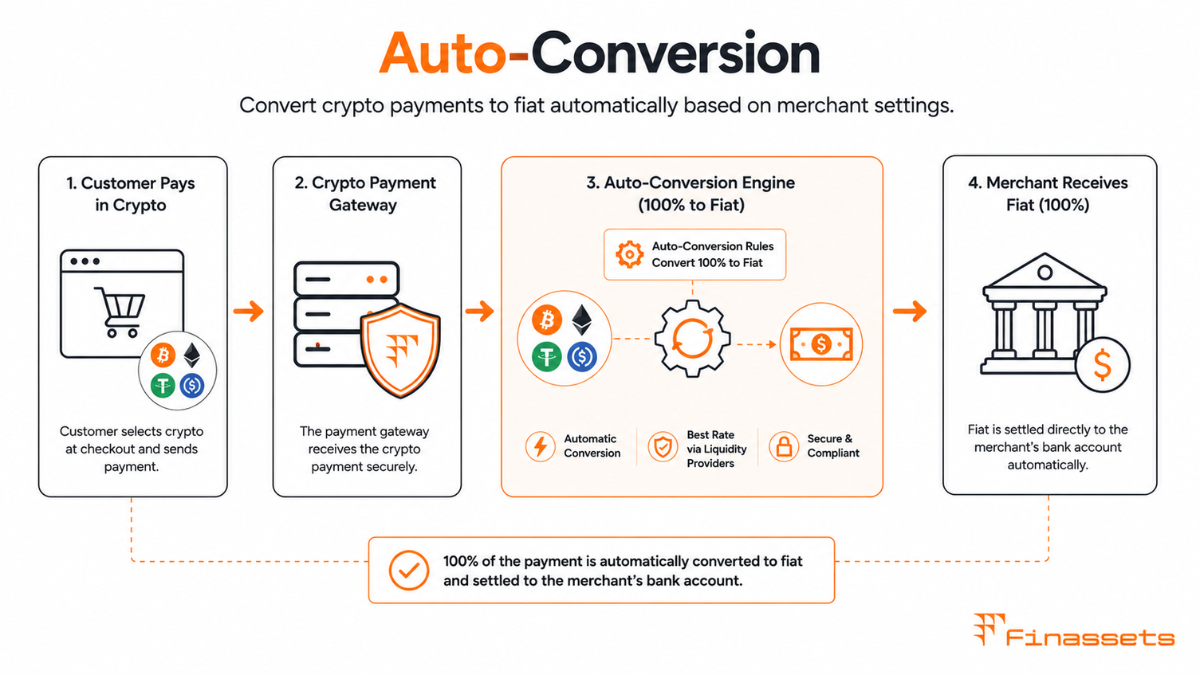
The Mechanics of Auto-Conversion
Auto-conversion is triggered by a payment reaching its required confirmation threshold on the blockchain. At that moment, the gateway's conversion engine calculates the mid-market rate for the cryptocurrency-to-fiat pair from its aggregated price feeds, applies the configured spread, and records the converted fiat amount against the merchant's settlement balance in the gateway's internal ledger. No funds move at this point — the fiat amount is credited internally. The actual bank transfer to the merchant occurs at the next scheduled settlement event.
The cryptocurrency received is held by the gateway in its operational or reserve wallet until the gateway's own liquidity management process converts it — either by selling on a liquidity partner's platform, unwinding a hedge position, or transferring to a prime broker. This separation between 'recording the conversion for the merchant' and 'executing the actual market conversion' is why gateways maintain liquidity infrastructure rather than simply passing each transaction through to an exchange.
Configuration Options for Auto-Conversion
Most enterprise payment gateways allow merchants to configure auto-conversion with granularity beyond a simple on/off toggle:
● Conversion ratio: What percentage of incoming payments to convert. A setting of 80% converts 80% of every incoming payment to fiat and retains 20% in the original cryptocurrency.
● Asset-specific rules: Different rules for different cryptocurrencies. For example, convert all Bitcoin to EUR but retain all USDT as-is.
● Threshold-based conversion: Only trigger auto-conversion once a minimum balance accumulates, reducing the number of conversion events and their associated fees.
● Target currency: The fiat or stablecoin currency that converted funds should be denominated in. EUR, USD, GBP, and major stablecoins are typically supported.
● Conversion schedule: Whether conversion happens immediately on confirmation or at a scheduled batch time (e.g., midnight UTC daily).
Auto-Conversion and Accounting Treatment
Auto-conversion simplifies crypto accounting by collapsing two separate events — receipt of cryptocurrency and disposal of cryptocurrency — into a near-simultaneous pair. The taxable income is the fiat value at conversion, and because conversion happens within minutes or seconds of receipt, the income figure matches the fiat amount actually received, leaving no meaningful difference to account for.
Some accounting standards (notably IFRS) treat crypto assets held even briefly as intangible assets requiring fair value measurement at each reporting date. For businesses using IFRS, even instant auto-conversion creates a brief period of crypto asset holding that must be assessed. In practice, most accountants treat instant auto-conversion as a single net transaction, but this should be confirmed with the business's auditors, particularly for entities with significant transaction volumes.
The Total Cost of Auto-Conversion
Auto-conversion is not free. The merchant pays the spread — the difference between the mid-market rate and the rate the gateway applies — plus any explicit conversion fee. For a €10,000 monthly volume with a 1% spread and no additional fee, the auto-conversion cost is approximately €100 per month. At 0.5%, it is €50. Comparing total conversion costs — not just headline transaction fees — is essential when evaluating competing gateway providers, because some quote low transaction fees but embed wide spreads that represent the actual revenue.
To determine the real cost of a gateway's auto-conversion, merchants should execute a test conversion and compare the received fiat amount against the mid-market rate at the exact same moment (available from CoinMarketCap, Coingecko, or a major exchange API). The percentage difference is the effective total spread being charged.
Compliance Note: This glossary entry is provided for general educational purposes only and does not constitute financial, investment, legal, or tax advice. Industry terminology may vary across jurisdictions and providers; definitions herein may not directly reflect the specific features, terms, or specifications of Finassets' services. For details on Finassets' offerings, please refer to official product documentation or contact our team directly.