

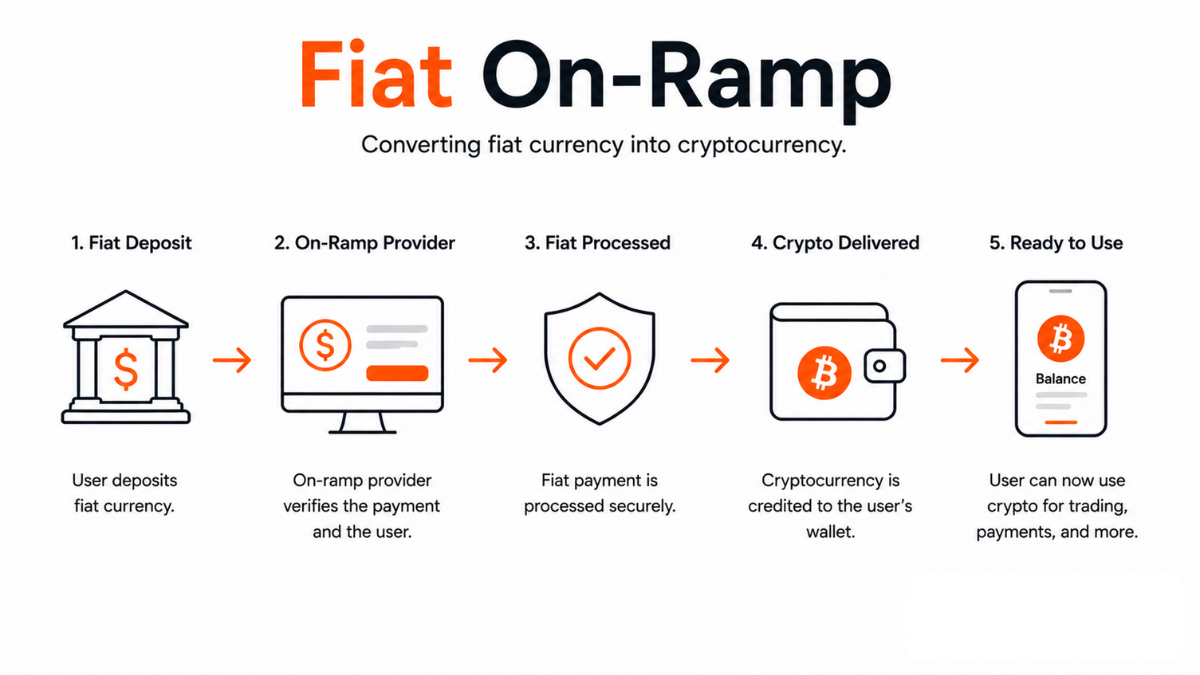
How Fiat On-Ramps Work
A fiat on-ramp accepts a user's fiat payment — via bank transfer, debit card, credit card, local payment method, or cash — and delivers cryptocurrency to a specified wallet address. The exchange rate is set at the time of the transaction, fees are deducted, and the net crypto amount is transferred on-chain within minutes to hours depending on the on-ramp provider and the fiat payment method used.
Bank transfer on-ramps typically offer the lowest fees (0.5–2%) but the slowest delivery — a SEPA transfer may take 1 business day before the crypto is released. Card on-ramps are faster (near-instant) but more expensive (2–5%) due to card processing costs and higher fraud rates. Local payment methods (iDEAL, Bancontact, PIX, UPI) offer a middle ground in markets where they are available.
On-Ramp vs. Exchange — The Practical Difference
A crypto exchange allows users to buy and sell multiple cryptocurrencies, manage a portfolio, and trade between asset pairs. A fiat on-ramp is focused on a single flow: converting fiat to crypto and delivering it to an external wallet. On-ramps typically do not hold user funds beyond the time needed to process the transaction, do not offer trading pairs, and are optimised for simplicity rather than feature depth.
From a regulatory perspective, this distinction matters: on-ramps that do not hold user balances may qualify as payment institutions rather than crypto asset service providers in some jurisdictions, affecting their licensing requirements. On-ramps that hold balances between fiat receipt and crypto delivery are more likely to be classified as VASPs.
KYC Requirements for Fiat On-Ramps
Fiat on-ramps are a primary vector for converting illicitly obtained cash into crypto, which means they face significant AML scrutiny. Most regulated on-ramps apply KYC to transactions above specific thresholds — commonly €150–€1,000 for individual transactions and stricter limits for monthly cumulative volumes. Below the threshold, simplified due diligence (SDD) may apply, requiring only basic identity information.
For business on-ramps — where a company uses an on-ramp to fund its treasury or operational wallets — KYB is typically required regardless of transaction size. The on-ramp needs to understand the source of the fiat funds, the business purpose, and the intended use of the crypto received.
On-Ramp Integration With Payment Gateway Infrastructure
Some payment gateway providers integrate fiat on-ramp functionality directly into their merchant dashboard, allowing businesses to fund their gateway's operational crypto balance (for outgoing settlements or mass payouts) without going through a separate exchange. This consolidated offering reduces the number of counterparties a business needs to manage and simplifies the compliance picture — a single KYB process covers both payment acceptance and treasury funding.
The on-ramp component of an integrated gateway typically uses the same banking relationships that fund fiat settlement payouts: the banking partner accepts inbound SEPA or SWIFT transfers, holds the fiat, executes the crypto purchase on the market, and delivers the assets to the gateway's operational wallet. Merchants benefit from the gateway's pooled volume pricing, which produces better rates than a single merchant could negotiate independently.
Risks Specific to Fiat On-Ramps
The primary operational risk in a fiat on-ramp is settlement timing mismatch: the fiat arrives (and may be held pending compliance checks) before the crypto is delivered, during which time the market rate may have moved. Most on-ramps address this through a rate lock at the time the fiat payment is initiated, similar to the price lock mechanism in merchant payment gateways. A secondary risk is payment fraud: stolen cards used to purchase crypto are a high-frequency attack, which is why card on-ramps typically charge higher fees and apply stricter limits.
Compliance Note: This glossary entry is provided for general educational purposes only and does not constitute financial, investment, legal, or tax advice. Industry terminology may vary across jurisdictions and providers; definitions herein may not directly reflect the specific features, terms, or specifications of Finassets' services. For details on Finassets' offerings, please refer to official product documentation or contact our team directly.