

Types of Limits and Their Purposes
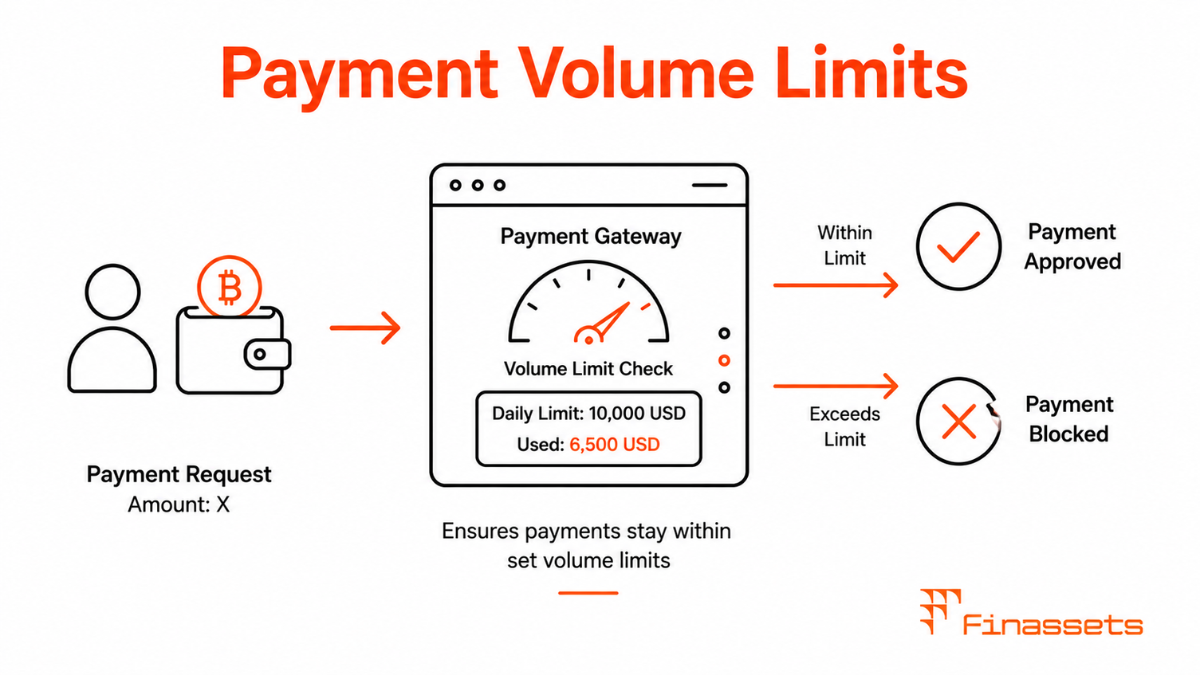
Payment volume limits in crypto gateways are applied at multiple granularities, each serving a distinct compliance or risk management purpose:
● Per-transaction limit: The maximum single payment the gateway will process. Prevents outsized single transactions from creating unmanageable AML exposure before the merchant's account has an established transaction history. A new account might have a €10,000 per-transaction limit; a verified high-volume account might have no per-transaction limit.
● Daily limit: The total volume the merchant can process within a calendar day. Protects against sudden volume spikes that exceed the gateway's settlement float or trigger automated AML monitoring alerts.
● Monthly limit: The cumulative volume permitted in a calendar month. Typically set relative to the merchant's expected monthly volume at onboarding, with a buffer. The most commonly referenced limit in merchant agreements.
● Annual cumulative limit: Less common but used in some jurisdictions or for regulated products to cap total yearly exposure.
● Single-recipient limit (for payouts): For mass payout users, a cap on the maximum single payout to any individual address. Prevents a single erroneous or fraudulent payout transaction from causing catastrophic fund loss.
How Volume Limits Are Set During Onboarding
Initial volume limits reflect the gateway's assessment of the merchant's risk profile and the documentation provided during KYB. A merchant who declares expected monthly volume of €50,000 and provides supporting evidence (existing revenue reports, bank statements, contractual order book) will receive a limit at or near that declared volume. A merchant with no trading history who declares €500,000 monthly volume without supporting evidence will receive a conservative lower limit with a clear path to increase upon demonstrating actual volume.
The documentation required to justify a higher limit tier varies by gateway but typically includes: the most recent 3–6 months of business bank statements or existing payment processor statements; audited or management accounts for the most recent financial year; a description of the customer base and expected transaction profile; and for very high limits, a legal opinion or compliance assessment from the merchant's own advisors. Preparing this documentation in advance of the conversation significantly accelerates the limit-setting process.
Requesting Limit Increases
Merchants who hit their processing limit — or anticipate hitting it before a settlement cycle closes — face a practical problem: new payment invoices may be rejected or queued until capacity is available. Avoiding this requires proactive limit management:
● Monitor approaching limits: Dashboard analytics or API balance endpoints should show the merchant's current period volume against their limit. Alerts at 70%, 85%, and 95% of limit give time to request increases before the limit is reached.
● Request increases before they are needed: Limit increase requests take time to review — typically 3–10 business days for standard increases, longer for significant jumps. A merchant expecting a seasonal volume spike in December should submit a limit increase request in November, not the first week of December when the spike has already begun.
● Provide context for volume changes: A limit increase request accompanied by an explanation ('we are launching a new product line and expect an additional €200,000 in monthly revenue') and supporting evidence is processed faster than an unexplained request.
Volume Limits as a Compliance Control
From the gateway's compliance perspective, volume limits are not just commercial friction — they are a compliance control that limits the amount of funds that can flow through a merchant account before the account's activity is fully understood. A merchant who spends three months processing €30,000/month at a limit of €50,000 has established a clear, monitorable transaction pattern. Raising that merchant to €500,000/month changes the risk profile significantly and warrants re-assessment before the increase is granted.
This is why sudden requests for very large limit increases — particularly when the merchant's actual historical volume has been far below the current limit — trigger compliance review regardless of how the request is framed. A merchant processing €10,000/month requesting a single increase to €2,000,000/month will face detailed questioning about the source of the anticipated volume and the commercial rationale for the step change, even if they have a legitimate business explanation.
Compliance Note: This glossary entry is provided for general educational purposes only and does not constitute financial, investment, legal, or tax advice. Industry terminology may vary across jurisdictions and providers; definitions herein may not directly reflect the specific features, terms, or specifications of Finassets' services. For details on Finassets' offerings, please refer to official product documentation or contact our team directly.