

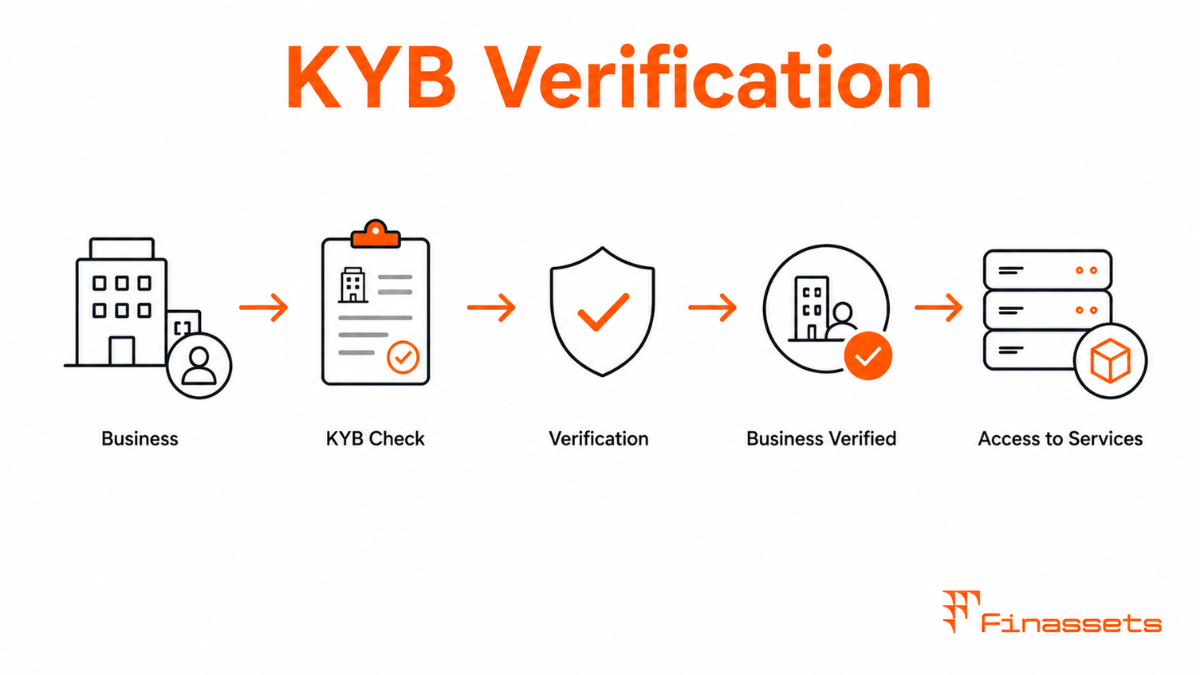
KYB vs. KYC — The Operational Difference
KYC (Know Your Customer) applies to natural persons — it verifies that an individual is who they claim to be, primarily through government-issued identity documents and liveness checks. KYB (Know Your Business) applies to legal entities — it verifies that a company exists, is lawfully incorporated, is not prohibited from receiving financial services, and is controlled by identified individuals who have themselves been KYC-verified.
KYB is inherently more complex than KYC because corporate structures can be multi-layered: a company may be owned by a holding company, which is owned by a trust, which is controlled by a person who is a director of yet another entity. Each layer must be documented and verified. This is why KYB for a simple sole trader operating through a single limited company may take one business day, while KYB for a multi-jurisdictional corporate group may take weeks.
Documents Typically Required for KYB
The specific documents required depend on the jurisdiction of incorporation and the gateway's own risk appetite, but a standard KYB package for a crypto payment gateway typically includes:
● Certificate of incorporation or equivalent company registration document.
● Memorandum and articles of association.
● Proof of registered address (utility bill, bank statement, or company registry extract, dated within 3 months).
● Government-issued photo ID for all directors and UBOs holding ≥25% ownership.
● A corporate structure chart identifying all entities in the ownership chain up to the natural person UBOs.
● Bank statements or equivalent financial documentation to evidence the source of business funds.
● Evidence of the business's operating activity (website, invoices, customer contracts, or proof of existing merchant relationships).
How Gateways Verify the Documents They Receive
Submitting documents is not the same as passing KYB. Regulated gateways apply verification steps that go beyond accepting scanned PDFs at face value. Company registration is cross-checked against official corporate registries where available — Companies House in the UK, the Registre du Commerce in France, the SEC's EDGAR system for US public companies. Director and UBO identity documents are verified through automated identity verification providers that detect document forgery and perform liveness checks to confirm the person presenting the document is a real individual.
Beneficial ownership chains are checked against sanctions lists and PEP databases, and the business itself is screened for adverse media. Many gateways also use open-source intelligence — social media presence, domain registration records, Wayback Machine snapshots — to corroborate or challenge the stated business activity.
What Happens After KYB Is Approved
A successful KYB approval activates the merchant account and sets the initial processing limits, supported currencies, and permitted payout methods. The approved KYB record is stored and becomes the baseline for ongoing monitoring: any subsequent change to the company's ownership structure, registered address, or business activity that materially differs from the KYB profile may trigger a re-verification request.
KYB approval also establishes the merchant's initial risk category, which determines how frequently transaction monitoring alerts are reviewed and whether any transaction types or destinations require pre-approval. Merchants in lower-risk categories may receive largely automated account management; higher-risk approvals come with more active relationship manager oversight.
KYB for International Businesses — Added Complexity
Companies incorporated in jurisdictions with limited public corporate registers, weak beneficial ownership transparency, or restricted access to official verification databases pose additional KYB complexity. Gateways may require certified translations of foreign-language documents, apostilles for documents from non-Hague Convention signatories, and additional documentation to compensate for gaps in publicly verifiable company data. Some gateways decline to onboard companies from certain high-risk jurisdictions entirely, citing the cost and reliability challenges of verification.
Compliance Note: This glossary entry is provided for general educational purposes only and does not constitute financial, investment, legal, or tax advice. Industry terminology may vary across jurisdictions and providers; definitions herein may not directly reflect the specific features, terms, or specifications of Finassets' services. For details on Finassets' offerings, please refer to official product documentation or contact our team directly.