

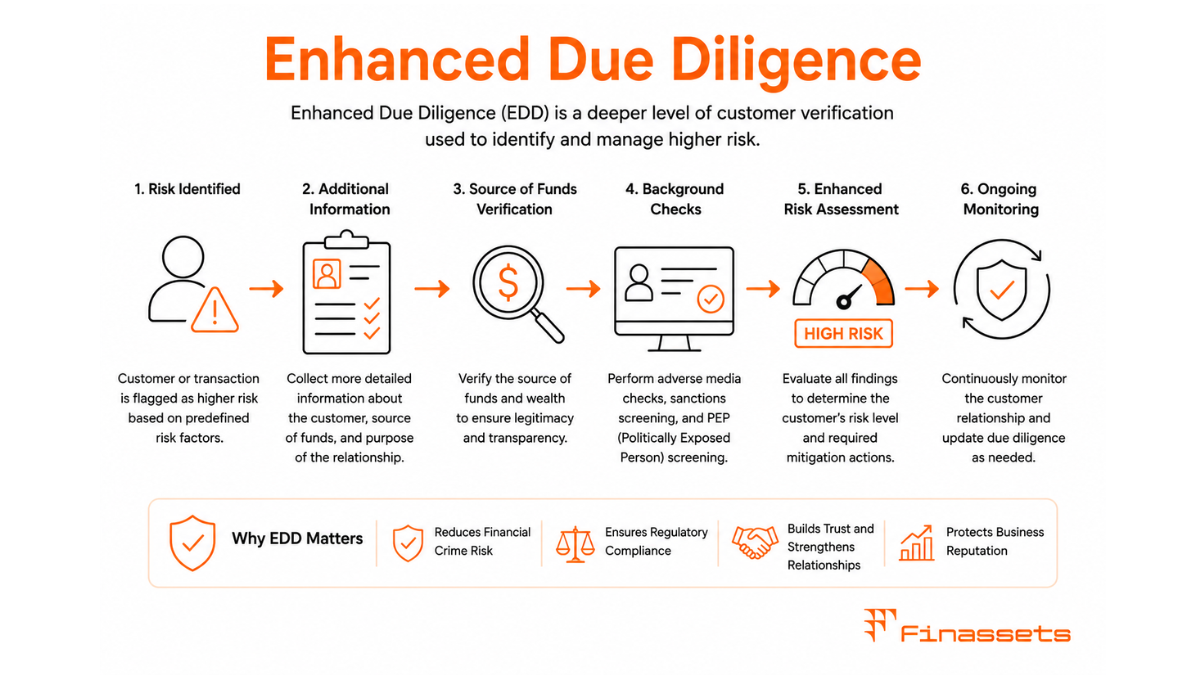
What EDD Involves Beyond Standard KYB
Standard KYB collects business registration documents, director identification, and a description of business activity. Enhanced Due Diligence goes further: it seeks to understand the origin of the funds a business will be receiving and paying with, the ultimate economic purpose of transactions, the nature of the business's customer relationships, and any political, geographic, or industry-specific risks associated with the entity.
In practice, EDD for a crypto payment gateway merchant might require audited financial statements, bank reference letters, proof of the source of initial operating capital, a list of major customers and their jurisdictions, and a detailed explanation of the expected transaction volumes and flow of funds. For businesses in high-risk sectors, site visits or video verification of physical premises are sometimes required.
Specific Triggers That Activate EDD
● PEP status: Any director, shareholder, or UBO who is or was a politically exposed person automatically triggers EDD under FATF Recommendation 12.
● High-risk jurisdiction: Businesses registered in or primarily operating in countries on the FATF Grey List or Black List require EDD.
● High transaction volumes: Merchants requesting processing limits above defined thresholds typically require EDD to justify the volume.
● Adverse media: Negative news coverage linking a business or its principals to financial crime, regulatory action, or reputational incidents triggers EDD review.
● Unusual business model: Payment flows that are complex, multi-jurisdictional, or do not align with the stated business purpose require deeper scrutiny.
● Cash-intensive or high-risk sector: Businesses in gambling, remittance, adult content, or defence-related industries are subject to EDD by default at many gateways.
EDD vs. Ongoing Monitoring — How They Interact
EDD is not a one-time check at onboarding. Under FATF guidelines and EU AML directives, businesses subject to EDD must also be subject to enhanced ongoing monitoring: transaction patterns are reviewed more frequently, the business must periodically re-confirm its beneficial ownership and risk status, and any significant change in transaction volume, business activity, or ownership structure triggers a re-review.
Payment gateways implement ongoing monitoring through transaction threshold alerts, periodic account reviews, and automated re-screening of principals against sanctions and PEP lists. A merchant who passed EDD at onboarding but whose transaction patterns later diverge significantly from the established profile will be placed back under active review.
How Long EDD Takes and What Delays It
Standard KYB can often be completed in 1–3 business days with automated document verification. EDD typically takes 5–15 business days for straightforward cases and can extend to 30 days or more for complex ownership structures, multi-jurisdictional entities, or cases requiring manual review of financial statements.
Common delays include incomplete UBO documentation, beneficial ownership chains that pass through jurisdictions with limited company registers, financial statements that are outdated or unaudited, and principals who appear on adverse media lists that require manual investigation. Gateways with dedicated compliance teams and strong regulatory technology can reduce EDD timelines significantly compared to those relying on manual processes.
What Merchants Can Do to Prepare for EDD
Merchants who anticipate triggering EDD criteria — such as those in gaming, adult content, or remittance — should prepare their documentation package before approaching a gateway. This means having a clear corporate structure chart, current audited accounts, a bank statement showing the source of initial operating funds, and a written description of the business model that explains the expected transaction flow. Gateways are more likely to complete EDD quickly and approve an application from a merchant who submits a complete, professional documentation package than from one who provides documents incrementally in response to each information request.
Compliance Note: This glossary entry is provided for general educational purposes only and does not constitute financial, investment, legal, or tax advice. Industry terminology may vary across jurisdictions and providers; definitions herein may not directly reflect the specific features, terms, or specifications of Finassets' services. For details on Finassets' offerings, please refer to official product documentation or contact our team directly.