

Why Overpayments Occur More Often in Crypto Than in Fiat
Card and bank transfer payments almost never result in overpayments because the amount is transmitted by the payment system and cannot be manually adjusted. Crypto payments are different: the customer must manually specify or confirm the amount in their wallet, creating multiple opportunities for overpayment. The most common causes are:
● Manual amount entry error: The customer types more than the required amount, especially when amounts involve multiple decimal places (e.g., entering 0.01 instead of 0.001 BTC).
● Network fee deduction: Some wallets by default send 'amount minus network fee', meaning the customer must send slightly more than the invoice amount to ensure the full amount arrives. Customers unaware of this may try to send a round number larger than the invoice total.
● Exchange withdrawal minimums: Exchanges that charge a withdrawal fee sometimes round up the withdrawal amount to a round number that exceeds the invoice total.
● Currency confusion: A customer expecting to pay in one network's token may inadvertently send a larger amount because they misjudged the denomination (e.g., confusing satoshis and BTC).
How Gateways Handle Overpayments
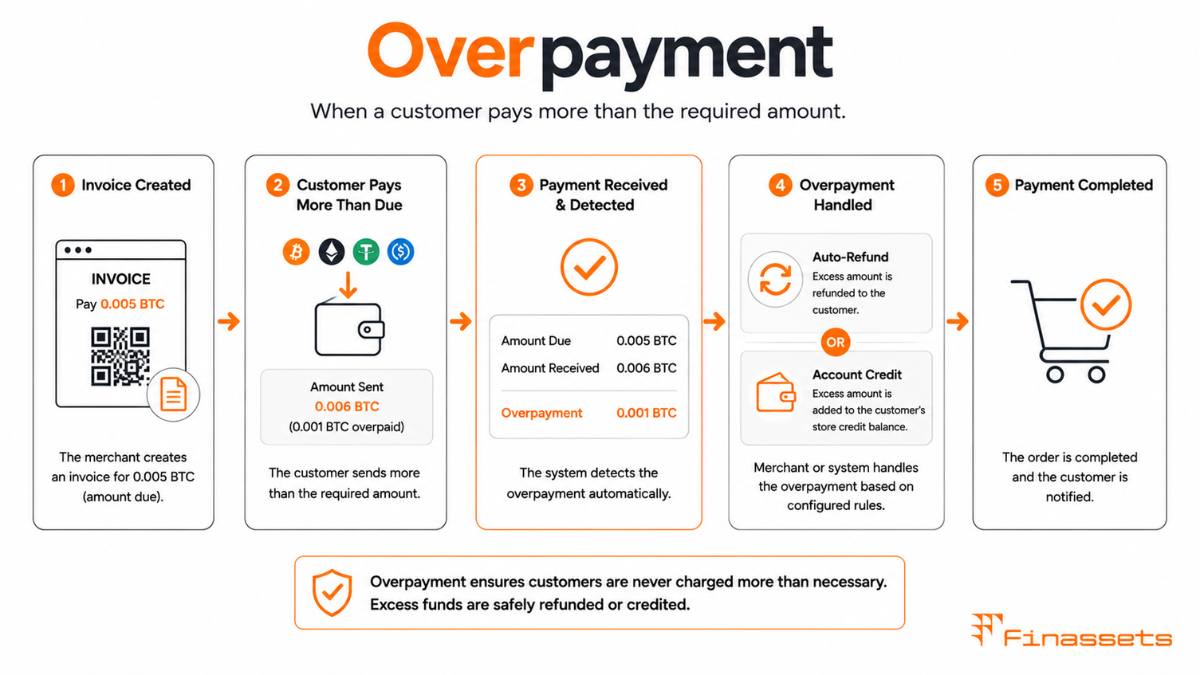
Payment gateways take one of three approaches to overpayments, and the chosen approach should be clearly defined in the merchant's payment terms before accepting crypto:
● Credit the full received amount: The merchant receives the entire overpaid amount. Simple operationally, but may create accounting complications if the merchant cannot issue a corrected invoice for the actual received amount.
● Credit the invoice amount, refund the excess: The gateway credits the merchant only the invoiced amount and automatically sends the overpaid portion back to the originating wallet. This is the cleanest outcome for both parties but requires the gateway to execute an additional outgoing transaction, incurring network fees.
● Hold for manual review: Flag overpayments above a defined tolerance threshold for merchant review. The merchant decides whether to retain the full amount, issue a partial refund, or apply the excess as a credit toward a future order.
Overpayment Tolerance Thresholds
Most gateways implement a configurable overpayment tolerance — a percentage above the invoiced amount that is considered acceptable and treated as a complete payment without triggering any overpayment process. A 5% overpayment tolerance means a €200 invoice will be considered fully paid if the customer sends up to €210 in crypto equivalent. Amounts above the tolerance trigger the overpayment handling workflow.
Tolerance thresholds serve two purposes: they absorb the rounding differences caused by exchange rate fluctuations between invoice generation and payment receipt, and they reduce operational noise from small overpayments caused by network fee rounding. The appropriate tolerance level depends on the merchant's typical transaction value — a 5% tolerance on a €10 payment is €0.50 and operationally negligible, while a 5% tolerance on a €10,000 payment is €500 and may require accounting treatment.
Accounting for Overpayments
If the merchant retains the overpaid amount, the excess should be recorded as income at the same fair market value rate as the original payment — it is effectively additional revenue. If the excess is refunded to the customer, the refund transaction represents a reduction of income for the period. Merchants must ensure their accounting software records the actual received cryptocurrency amount and the corresponding fiat value, not just the invoiced amount, to avoid understating revenue on overpaid transactions.
Compliance Note: This glossary entry is provided for general educational purposes only and does not constitute financial, investment, legal, or tax advice. Industry terminology may vary across jurisdictions and providers; definitions herein may not directly reflect the specific features, terms, or specifications of Finassets' services. For details on Finassets' offerings, please refer to official product documentation or contact our team directly.