

How the Price Lock Rate Is Calculated
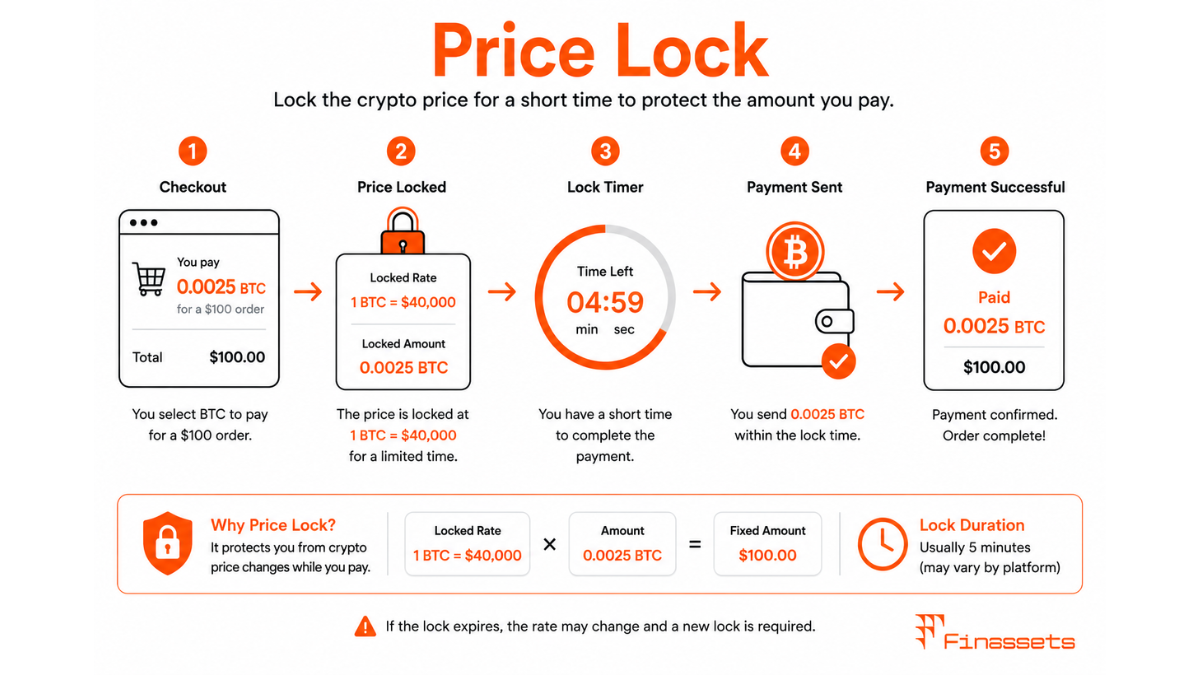
When a customer initiates a checkout, the payment gateway queries aggregated market price feeds — typically sourced from multiple major exchanges and weighted by trading volume — to calculate the mid-market rate for the relevant crypto-to-fiat pair at that exact moment. The gateway then adds its spread on top of the mid-market rate and divides the invoice fiat amount by the adjusted rate to arrive at the crypto amount the customer must send.
This calculation is stamped with a timestamp and held for the duration of the payment window. If Bitcoin is trading at €42,000 and the merchant's invoice is for €210, the gateway calculates 0.005 BTC as the required amount and displays that figure alongside the payment address and QR code. The rate is fixed for the window period regardless of what Bitcoin does in the market during those minutes.
What Happens When the Window Expires
Once the price lock window expires — typically 10 to 20 minutes after the invoice is generated — the rate is invalidated. Any payment received after expiry is handled according to the gateway's configuration. Most gateways queue the transaction for review and notify the merchant; the merchant can then choose to accept the payment at the new rate, reject it, or credit the difference.
The expiry window length is a balance between merchant protection and customer experience. A longer window reduces customer time pressure but increases the gateway's rate risk exposure during volatile markets. A shorter window minimises rate risk but can frustrate customers on congested networks where transaction confirmation itself takes several minutes. For Bitcoin payments, a 20-minute window accounts for typical mempool wait time while remaining short enough to limit volatility exposure.
Price Lock vs. No Price Lock — The Merchant's Revenue Risk
|
Scenario |
With Price Lock |
Without Price Lock |
|
Customer initiates €100 payment |
Gateway locks BTC amount at current rate |
Gateway monitors any BTC received |
|
BTC drops 5% during payment window |
Merchant still receives €100 equivalent |
Merchant receives €95 equivalent |
|
BTC rises 5% during payment window |
Merchant receives €100; customer paid less BTC |
Merchant receives €105 equivalent |
|
Customer sends payment late |
Expired; re-quoted at new rate |
Payment credited at received value |
Without price lock, a merchant accepting €100 invoices in a volatile market might receive between €85 and €115 depending on when the customer's transaction confirms. For businesses with thin margins, this variance can directly affect profitability on each transaction. Price lock converts the revenue risk from variable to predictable.
Where Gateways Source Their Exchange Rates
Most professional payment gateways use a volume-weighted average price (VWAP) calculated across multiple liquidity sources: major centralised exchanges, OTC desk quotes, and sometimes decentralised exchange pool prices. The aggregation prevents any single exchange's momentary illiquidity or anomalous spike from distorting the rate presented to the customer.
Gateways disclose their rate source methodology to varying degrees. Merchants who process high volumes should request their gateway's rate calculation method and compare it against reference market data during integration testing, particularly for high-value transactions where a half-percent rate discrepancy becomes material.
Price Lock Does Not Eliminate All Rate Risk
Price lock protects the merchant against movements during the payment window, but it does not protect against the spread itself, which represents an immediate value reduction from the true market mid-price. Nor does it protect merchants who hold received crypto rather than using auto-conversion: if a merchant accumulates Bitcoin over days before converting, price lock on individual invoices provides no protection against the accumulated holding risk.
Additionally, if a customer pays in a different cryptocurrency than the one the invoice was denominated in — for example, sending Ethereum when a Bitcoin invoice was generated — the price lock rate does not apply. Any cross-currency payments are handled outside the price lock mechanism and may be processed at prevailing market rates at the time of confirmation.
Compliance Note: This glossary entry is provided for general educational purposes only and does not constitute financial, investment, legal, or tax advice. Industry terminology may vary across jurisdictions and providers; definitions herein may not directly reflect the specific features, terms, or specifications of Finassets' services. For details on Finassets' offerings, please refer to official product documentation or contact our team directly.