

Why Partial Payments Occur
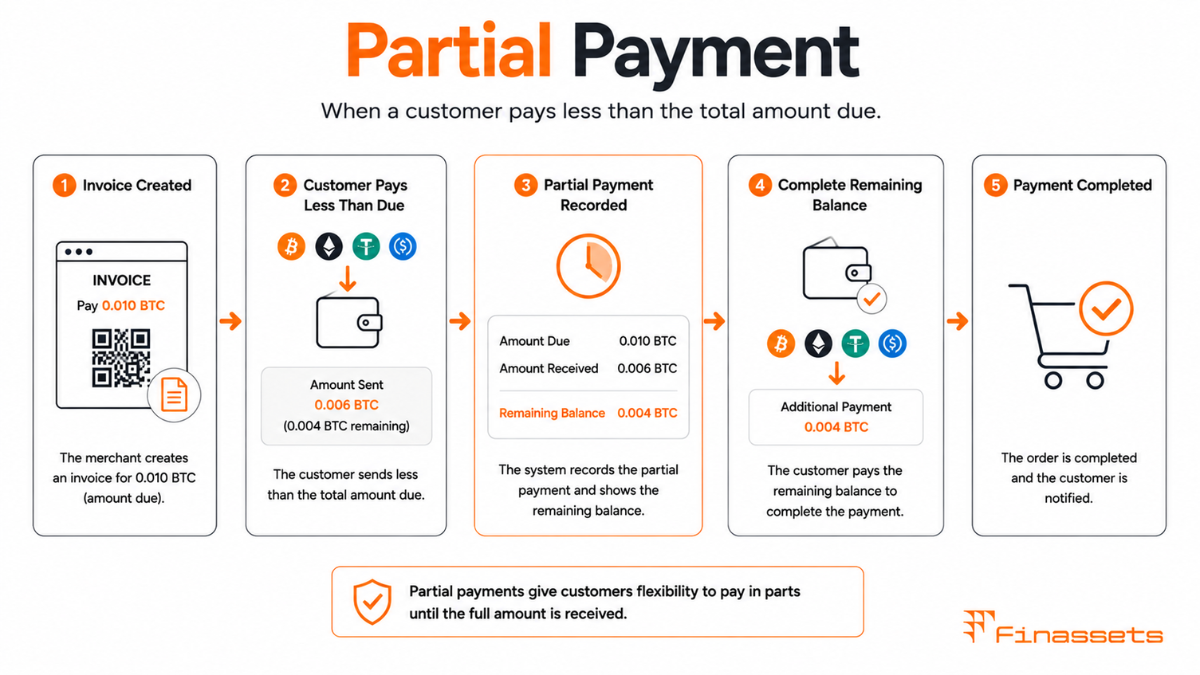
A partial payment arises when a customer intentionally pays less than the invoiced amount in a single transaction, or when they send multiple separate transactions intended to collectively fulfil one invoice. Intentional partial payments are common in B2B contexts where a buyer may split a large invoice into instalments — an established practice in traditional trade finance that some businesses expect to replicate with crypto payments. Unintentional partial payments occur when a customer's wallet holds less than the required amount, or when they misread the invoice and send a partial amount believing it to be correct.
Multi-Transaction Invoice Support
Not all payment gateways support multi-transaction invoice fulfilment, and this capability significantly affects the viability of partial payment workflows. In a crypto gateway that supports it, a single invoice can accept multiple incoming payments to the same address, accumulating the received amounts until the invoice total is reached. Each incoming transaction is logged separately with its own TXID, and the invoice status updates as payments accumulate.
Gateways that do not support multi-transaction fulfilment treat any amount below the invoice total as an underpayment — the invoice is never marked as complete, and the customer's partial payment sits as an unmatched credit requiring manual resolution. For merchants who want to support instalment payments, multi-transaction support is a mandatory gateway capability to verify during integration selection.
The Timeout Problem for Partial Payment Invoices
Partial payment invoices present a timeout challenge. A standard invoice expires after 10–20 minutes to protect the price lock. But a B2B instalment payment might arrive in two tranches over two business days. If the invoice expires after the first tranche but before the second, the second payment has no valid invoice to match against.
Gateways that support partial payments typically handle this by extending the invoice timeout for invoices with at least one confirmed partial payment received, keeping the invoice open until a configurable extended timeout (hours or days) rather than closing it after the standard expiry window. The extended period exposes the merchant to price risk for the remaining unpaid amount if the invoice is denominated in fiat, since the crypto equivalent of the remaining balance changes as prices move. For partial payment use cases, invoicing in crypto (specifying the total crypto amount due) rather than fiat eliminates this rate-change risk.
When to Enable and When to Disable Partial Payment Support
For consumer e-commerce, partial payment support is usually counterproductive: it creates ambiguity about whether an order is fulfilled and complicates fulfilment triggering. A standard e-commerce checkout should require full payment in a single transaction before processing the order.
Partial payment support is appropriate for: B2B invoicing where instalment terms are agreed in advance; high-value transactions where the buyer's wallet capacity may require splitting across multiple wallets; and marketplace contexts where sellers need flexible payment receipt timelines. Enabling partial payment support should be an explicit, configurable choice — not a gateway default — with corresponding merchant workflows in place to handle partially paid invoices without confusing the fulfilment system.
Compliance Note: This glossary entry is provided for general educational purposes only and does not constitute financial, investment, legal, or tax advice. Industry terminology may vary across jurisdictions and providers; definitions herein may not directly reflect the specific features, terms, or specifications of Finassets' services. For details on Finassets' offerings, please refer to official product documentation or contact our team directly.