

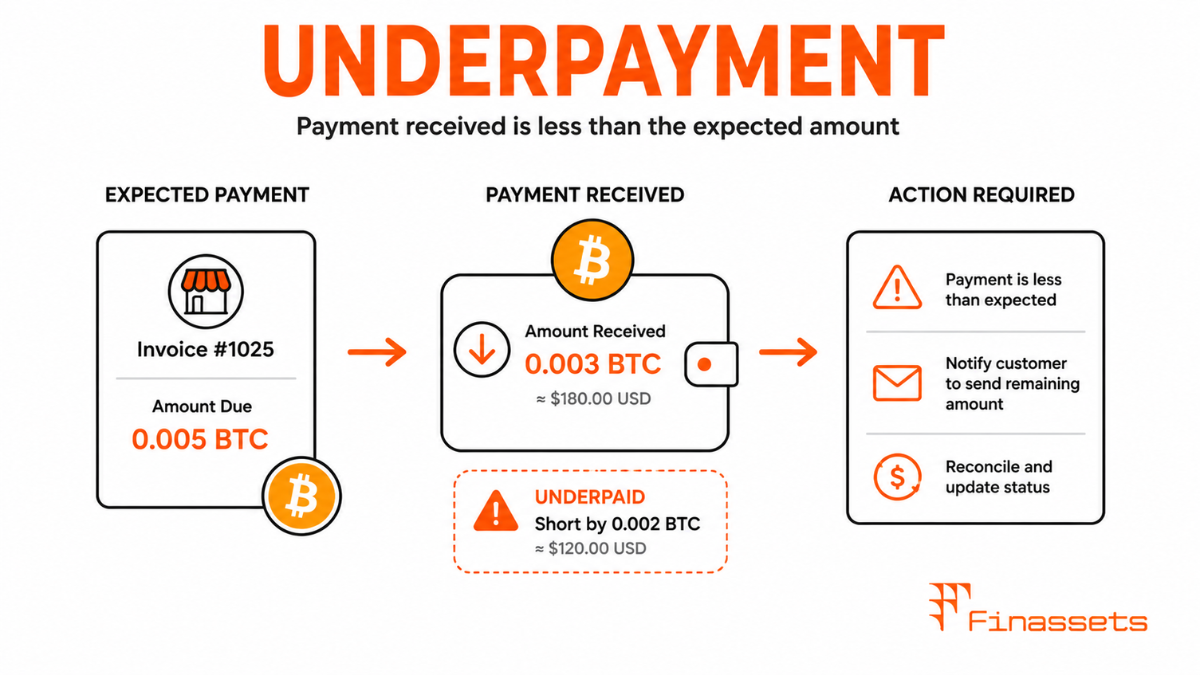
The Mechanics of How Underpayments Occur
Underpayments in crypto are more common than merchants expect, and they arise from several distinct technical causes that are not immediately obvious to customers unfamiliar with how crypto wallet software calculates transaction amounts. Understanding these causes helps merchants design better customer experiences and configure their gateway's underpayment handling appropriately.
The most technically nuanced cause is network fee deduction from sent amount. When a customer sends 'all available balance' or uses a wallet that deducts fees from the payment amount rather than from a separate balance, the network fee reduces the amount that actually arrives at the merchant's address. A customer attempting to pay 0.002 BTC whose wallet calculates a 0.0001 BTC miner fee and deducts it from the payment amount will deliver 0.0019 BTC — a 5% underpayment. The customer believes they sent the full amount; from the gateway's perspective, the invoice is underpaid.
|
Cause |
Frequency |
Preventable by Merchant? |
Resolution Path |
|
Network fee deducted from payment amount |
Very common |
Partially — clear UI guidance helps |
Tolerance threshold; top-up request |
|
Manual amount entry error |
Common |
Partially — pre-filled amounts reduce risk |
Tolerance threshold; top-up request |
|
Exchange withdrawal minimum deduction |
Moderate |
No — exchange policy |
Top-up request; manual credit |
|
Partial balance — customer short on funds |
Moderate |
No |
Partial payment support or top-up |
|
Decimal point error (e.g., 0.002 vs 0.0002) |
Less common |
Yes — clear amount display |
Top-up or full refund and repayment |
|
Multi-hop routing fee (Lightning) |
Rare in Lightning |
No — routing network |
Auto-resolution by Lightning protocol |
Configuring Underpayment Tolerance Thresholds
A tolerance threshold defines how much below the invoice amount the gateway will still treat as a complete payment. A 1% tolerance on a €100 invoice accepts anything above €99. A 2% tolerance accepts anything above €98. Setting the threshold requires balancing two competing risks: too low a threshold generates excessive underpayment flags for legitimate payments where network fee deductions cause small shortfalls; too high a threshold allows meaningful revenue shortfalls to pass undetected.
Practical guidance is to set tolerance at the typical network fee percentage for the assets the merchant accepts most frequently. For Bitcoin, network fees during normal conditions represent 0.5–2% of a typical €100 payment — a 2% tolerance absorbs most fee-related underpayments. For Tron USDT where fees are under $1 regardless of amount, a flat €1 tolerance rather than a percentage may be more appropriate. Merchants accepting multiple cryptocurrencies should configure asset-specific tolerances rather than applying a single universal threshold.
The Customer Communication Challenge
An underpayment creates an awkward customer experience gap. From the customer's perspective, they sent their payment and are waiting for order confirmation. From the gateway's perspective, the invoice shows a shortfall that prevents automatic confirmation. Without proactive communication, the customer will eventually contact support frustrated that their payment hasn't been processed despite the funds leaving their wallet.
Gateways with good underpayment handling provide merchants with a customer-facing underpayment notification: an automatic message sent to the customer (via email or the checkout page) explaining that a lower amount than expected was received, showing the shortfall amount, and providing a new payment link for the top-up. This communication should trigger within minutes of the underpayment being detected — before the customer reaches out — and should include the TXID of the received underpayment so the customer can verify that their original payment was actually received.
Preventing Underpayments Through UI Design
Many underpayments are preventable through checkout UI improvements. Gateways and merchants that display the crypto amount required in a copy-button format — allowing the customer to copy the exact amount to their wallet's send field rather than typing it — significantly reduce manual entry errors. Displaying the amount to all eight decimal places and clearly labelling which cryptocurrency to send prevents confusion. Some gateways display a warning when the wallet the customer appears to be using is known to deduct fees from payment amounts, proactively advising the customer to add a fee buffer.
Compliance Note: This glossary entry is provided for general educational purposes only and does not constitute financial, investment, legal, or tax advice. Industry terminology may vary across jurisdictions and providers; definitions herein may not directly reflect the specific features, terms, or specifications of Finassets' services. For details on Finassets' offerings, please refer to official product documentation or contact our team directly.