

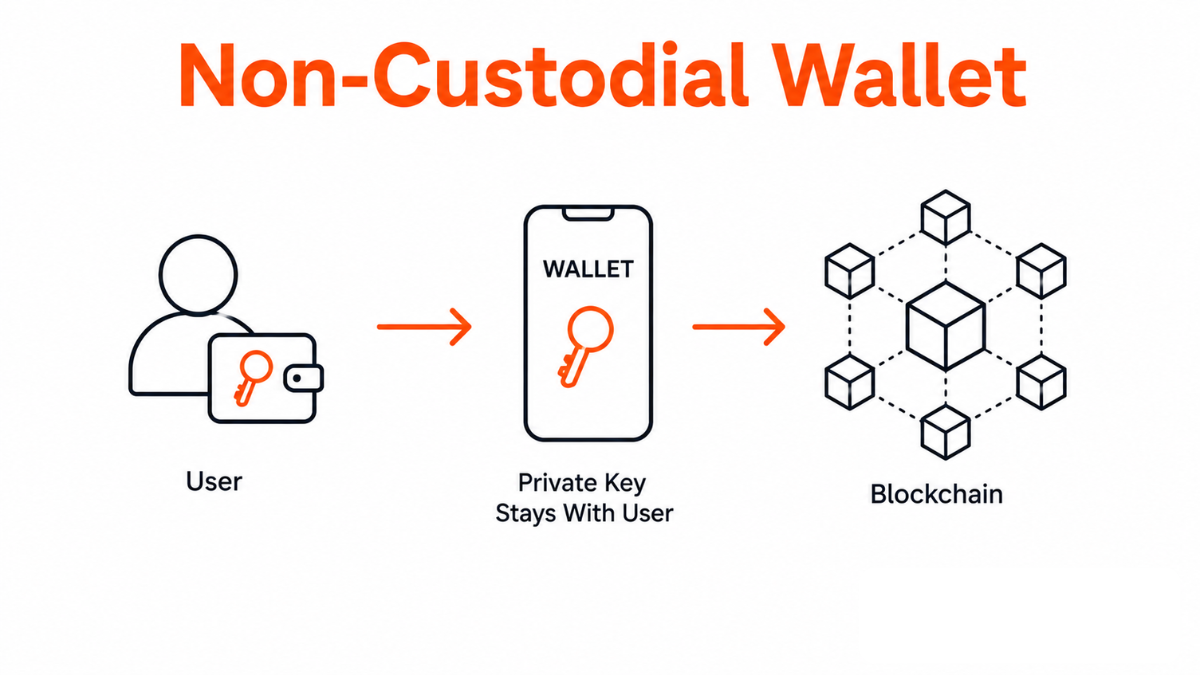
How Non-Custodial Wallets Work — Self-Sovereignty Explained
In a non-custodial wallet, the user generates and holds their own private keys — the cryptographic credentials that authorise transactions on the blockchain. The wallet software (whether a mobile app, browser extension, desktop application, or hardware device) never sends the private key to any server. All transaction signing happens locally on the user's device. The blockchain network validates the cryptographic signature, not the identity of the signer — there is no account holder verification, no password reset mechanism, and no recovery path through any institution.
The practical consequence is absolute: whoever controls the private key controls the funds, with no appeal mechanism and no recourse. A user who loses their private key and seed phrase permanently loses access to the wallet's contents. A user whose private key is stolen loses all funds to the thief with no possibility of reversal. This combination of complete control and complete responsibility is what 'self-custody' means in practice — it is neither safer nor more dangerous than custodial wallets in absolute terms, but it concentrates both risk and control in the user rather than distributing them across an institutional relationship.
Types of Non-Custodial Wallets
|
Wallet Type |
Where Keys Are Stored |
Internet Connected? |
Example Products |
|
Browser extension wallet |
Encrypted on device; browser memory during use |
Yes (hot) |
MetaMask, Phantom, Rabby |
|
Mobile software wallet |
Encrypted on device storage |
Yes (hot) |
Trust Wallet, Exodus, Coinbase Wallet |
|
Desktop software wallet |
Encrypted on computer disk |
Yes (hot) |
Electrum (Bitcoin), Exodus |
|
Hardware wallet |
Secure chip inside physical device; never exposed |
No (cold) — signs offline |
Ledger, Trezor, BitBox, Coldcard |
|
Smart contract wallet (ERC-4337) |
Keys managed by smart contract logic |
Varies |
Safe, Argent, Braavos |
|
Paper wallet |
Written/printed on physical medium |
No (cold) |
Self-generated from entropy |
|
Air-gapped computer wallet |
Isolated machine never connected to internet |
No (cold) |
Custom setup; Glacier Protocol |
Seed Phrases — the Root of Non-Custodial Recovery
Every non-custodial wallet that follows the BIP39 standard generates a seed phrase — a sequence of 12 or 24 words drawn from a standardised 2,048-word wordlist — that encodes the wallet's master private key in human-readable form. This seed phrase is the single most important piece of information associated with a non-custodial wallet: it can regenerate the complete key hierarchy for all addresses the wallet has ever used, on any BIP44-compatible wallet software, at any time.
The security model of non-custodial wallets therefore reduces entirely to the security of the seed phrase backup. A seed phrase stored in a text file on a cloud-synced drive, photographed on a smartphone, or written on a piece of paper in an unlocked drawer is effectively exposed. Best practices for seed phrase storage — metal plate backups, geographic distribution of copies, multi-share splitting using Shamir's Secret Sharing — mirror the cold wallet custody procedures used by institutional operators, because the same underlying risk applies whether to an individual holder or an enterprise treasury.
Custodial vs. Non-Custodial — Choosing the Right Tool for the Context
Neither custodial nor non-custodial wallets are universally superior — the choice depends on the user's priorities, technical competence, and risk tolerance:
|
Factor |
Custodial Wallet |
Non-Custodial Wallet |
|
Who controls the keys |
Third-party custodian |
User only |
|
Recovery if credentials lost |
Yes — through custodian account recovery |
No — seed phrase is the only recovery path |
|
Counterparty risk |
Custodian insolvency; regulatory action; hacking |
None — only user's own security matters |
|
User responsibility |
Low — custodian manages security |
High — user solely responsible for key security |
|
Regulatory protection |
Depends on custodian's licensing and safeguarding |
None — no regulated entity involved |
|
Transaction speed |
Instant within platform; on-chain when withdrawing |
On-chain speed for every transaction |
|
Best for |
Frequent traders; users prioritising convenience |
Long-term holders; privacy; self-sovereignty |
For merchants evaluating their settlement arrangements, the custodial vs. non-custodial choice most directly affects how they hold and manage their crypto treasury. Accepting payments through a gateway involves an inherently custodial relationship for the settlement period; what the merchant does with settled funds after withdrawal is their own choice between custodial (exchange account, institutional custody) and non-custodial (hardware wallet, self-managed software wallet) arrangements.
Compliance Note: This glossary entry is provided for general educational purposes only and does not constitute financial, investment, legal, or tax advice. Industry terminology may vary across jurisdictions and providers; definitions herein may not directly reflect the specific features, terms, or specifications of Finassets' services. For details on Finassets' offerings, please refer to official product documentation or contact our team directly.