

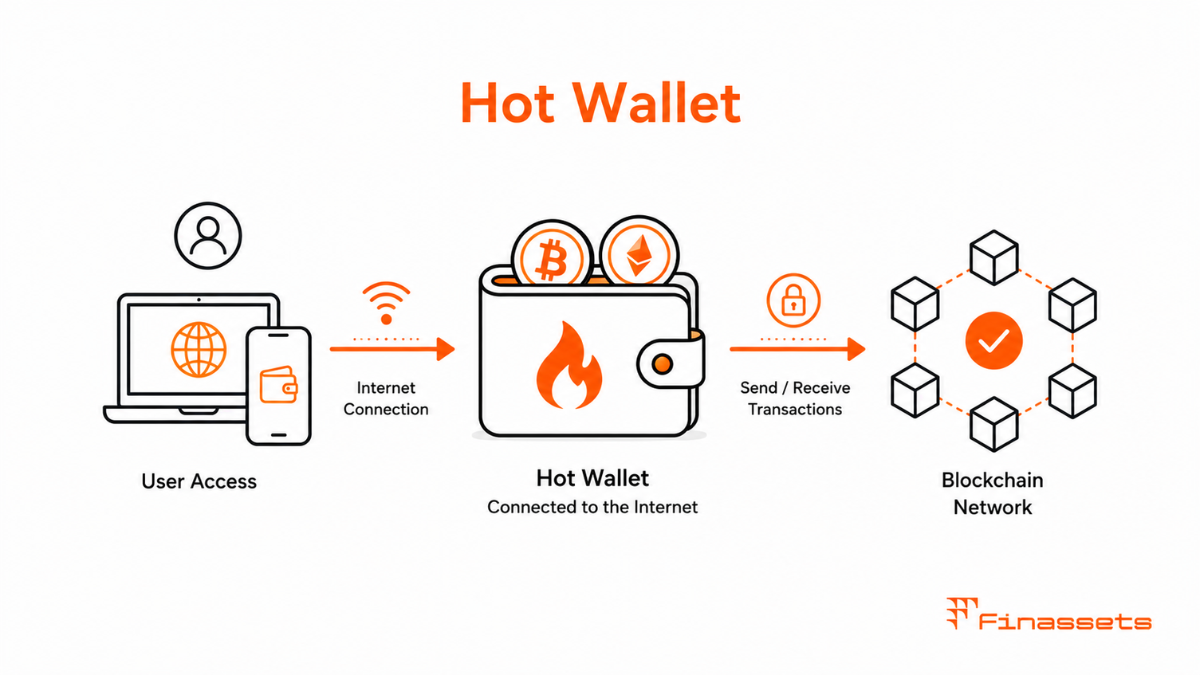
Types of Hot Wallets
Hot wallets exist in several forms, each suited to different operational contexts:
● Exchange-hosted wallets: Funds held on a centralized exchange's internal ledger. The exchange manages the private keys.
● Software wallets: Applications installed on a desktop or mobile device (e.g., Electrum, Trust Wallet, Exodus). The user holds the private keys, but the device is internet-connected.
● Browser extension wallets: Wallets that operate as browser plugins (e.g., MetaMask). Widely used for interacting with DeFi protocols and dApps.
● Mobile wallets: Smartphone apps that store keys locally on the device (e.g., Coinbase Wallet). Convenient for everyday payments and QR code scanning.
● Gateway operational wallets: Internet-connected wallets maintained by crypto payment gateways to receive incoming merchant payments and process outgoing settlements.
The common thread across all hot wallets is continuous internet connectivity, which introduces the attack surface that makes them higher-risk than cold storage.
Security Risks Specific to Hot Wallets
Because hot wallet private keys reside on or are accessible from internet-connected systems, they are exposed to a range of attack vectors that cold storage eliminates entirely:
● Server breaches: Attackers who compromise a gateway's servers may be able to extract hot wallet private keys stored in memory or on disk.
● API exploits: A vulnerability in a gateway's payment API could allow an attacker to craft requests that trigger unauthorized withdrawals.
● Malware and keyloggers: Software wallets on infected devices can have private keys extracted directly from memory.
● Phishing: Users can be tricked into entering seed phrases or signing malicious transactions.
● Insider threats: Employees with access to hot wallet infrastructure can exfiltrate keys if access controls are insufficient.
The most catastrophic exchange hacks in crypto history — including the 2014 Mt. Gox breach and multiple subsequent exchange failures — involved theft of hot wallet funds, not cold storage.
How Payment Gateways Limit Hot Wallet Exposure
Professional crypto payment gateways treat hot wallet size as a primary risk variable. Standard practice is to hold only enough funds in hot wallets to cover immediate operational needs — typically the expected settlement volume for the next 24 to 48 hours. Any excess above that threshold is automatically swept to cold storage.
Enterprise gateways further reduce hot wallet risk through:
● MPC (Multi-Party Computation): Private keys are never held in their complete form on any single server. Multiple parties must cooperate to authorize any transaction.
● Multisig configurations: Outgoing transactions require signatures from multiple keys held by different systems or individuals, preventing any single point of authorization.
● Hardware Security Modules (HSMs): Keys are generated and stored inside tamper-resistant hardware chips. Key material cannot be extracted even if the server is fully compromised.
● Rate limiting and velocity controls: Automated systems block or flag withdrawal requests that exceed volume or frequency thresholds.
What Is a Healthy Hot/Cold Wallet Ratio?
There is no universal standard, but the widely accepted practice among regulated crypto custodians and payment processors is to hold 5–10% of total assets in hot wallets and 90–95% in cold storage. Some institutions apply stricter ratios for higher-value assets.
Regulators and auditors increasingly examine hot/cold wallet ratios as part of custody due diligence. MiCA-regulated CASPs in the EU and regulated custodians in the US are expected to demonstrate that hot wallet exposure is minimized and that cold storage procedures are documented and auditable.
Hot Wallet vs. Custodial Wallet — Are They the Same?
Not necessarily. A hot wallet refers to the internet connectivity of the storage environment. A custodial wallet refers to who holds the private keys.
An exchange's hot wallet is both hot (internet-connected) and custodial (the exchange holds the keys). A MetaMask wallet is hot (internet-connected) but non-custodial (the user holds the keys). A hardware wallet connected to a computer to sign a transaction briefly becomes technically 'hot' during that session, but its keys are protected by the hardware chip throughout.
Merchants evaluating payment gateways should ask both questions: where are private keys stored, and is the environment internet-connected? The answers determine the gateway's true custody security posture.
When a Hot Wallet Is the Right Choice
Despite the risks, hot wallets are operationally necessary for any entity processing crypto payments at scale. Signing and broadcasting thousands of transactions per day from a cold wallet is impractical because cold wallet transactions require physical device access and manual authorization for each signing event.
The appropriate use of a hot wallet is not to eliminate it, but to minimize the funds it holds and maximize the security controls around it. For individual users making occasional transactions, a reputable non-custodial software wallet with strong device security is a reasonable hot wallet solution.
Compliance Note: This glossary entry is provided for general educational purposes only and does not constitute financial, investment, legal, or tax advice. Industry terminology may vary across jurisdictions and providers; definitions herein may not directly reflect the specific features, terms, or specifications of Finassets' services. For details on Finassets' offerings, please refer to official product documentation or contact our team directly.