

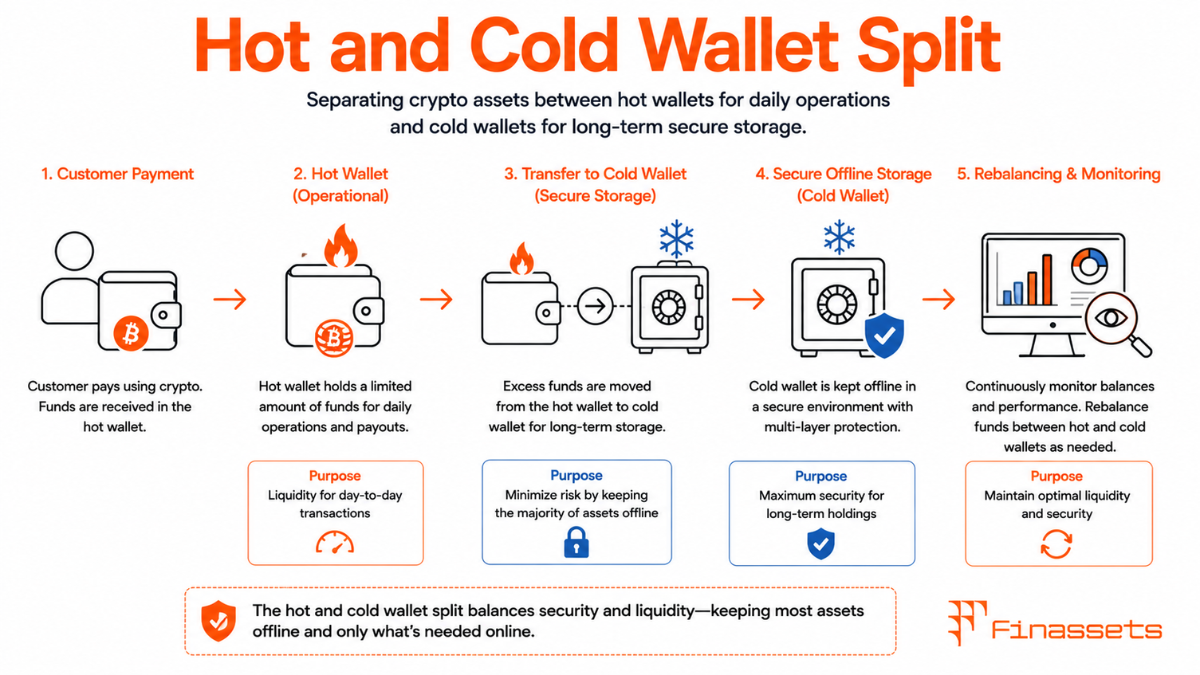
The Security Rationale for the Split
The hot/cold split is a risk partitioning strategy grounded in a simple observation: internet-connected systems will eventually be compromised. No network-connected server has an indefinitely exploitable-free lifetime — vulnerabilities in operating systems, application code, dependencies, and infrastructure configurations will be discovered and may be exploited. Accepting this reality, the only sound approach to protecting crypto assets is to ensure that the funds potentially accessible through a compromise are small relative to total holdings.
Hot wallets hold only what is operationally necessary for the next 24–48 hours of transaction volume — incoming payment monitoring and outgoing settlement disbursements. All accumulated merchant balances above this operational minimum are moved to cold storage, where they are inaccessible to network-based attacks because the private keys are on hardware that has no network connection.
Operational Implementation of the Split
In practice, the split operates through an automated sweeping process. When the hot wallet balance exceeds a defined threshold — set as a multiple of expected daily outgoing volume, plus a buffer — the excess is automatically transferred to a cold wallet address in a signed transaction prepared using an HSM or MPC system. The cold wallet address itself is pre-loaded and verified before the sweep, so the sweep transaction destination cannot be altered by an attacker who compromises the hot wallet server.
The reverse flow — from cold to hot — requires a more controlled process because it involves authorising a withdrawal from protected storage. Cold-to-hot transfers typically require multi-party approval: two or more authorised individuals independently approve the transfer amount and destination, often using an offline signing ceremony where the cold wallet hardware is physically accessed and the signing occurs in an air-gapped environment.
Industry Ratios and Regulatory Expectations
|
Hot Wallet Allocation |
Cold Wallet Allocation |
Typical Use Case |
Risk Profile |
|
5–10% |
90–95% |
Standard retail crypto gateway |
Conservative; industry norm |
|
10–20% |
80–90% |
High-volume gateway with frequent large settlements |
Moderate; acceptable for well-controlled systems |
|
20–30% |
70–80% |
Gateway with intraday settlement requirements |
Higher; requires compensating controls |
|
Above 30% |
Below 70% |
Exceptional operational need only |
Requires specific risk justification and enhanced controls |
MiCA-regulated CASPs, SOC 2 Type II audits, and institutional custody frameworks increasingly treat a 90%+ cold storage ratio as the expected standard. Gateways holding more than 20% in hot wallets without documented risk justification and compensating controls may receive audit findings or regulatory queries. Proof of reserves reports that clearly disclose the hot/cold ratio provide investors and merchants with the transparency to assess the gateway's security posture.
Multi-Location Cold Storage Distribution
A single cold wallet device in a single physical location represents a geographic single point of failure: fire, flood, theft, or regulatory seizure at that location could deny access to assets. Professional gateways distribute cold wallet key material across multiple secure locations — often in different countries — using a multisig or multi-share scheme. A 3-of-5 multisig where the five key holders are located in different jurisdictions ensures that no single physical event can block access to funds, while requiring collaboration of multiple parties to authorise any withdrawal.
Compliance Note: This glossary entry is provided for general educational purposes only and does not constitute financial, investment, legal, or tax advice. Industry terminology may vary across jurisdictions and providers; definitions herein may not directly reflect the specific features, terms, or specifications of Finassets' services. For details on Finassets' offerings, please refer to official product documentation or contact our team directly.