

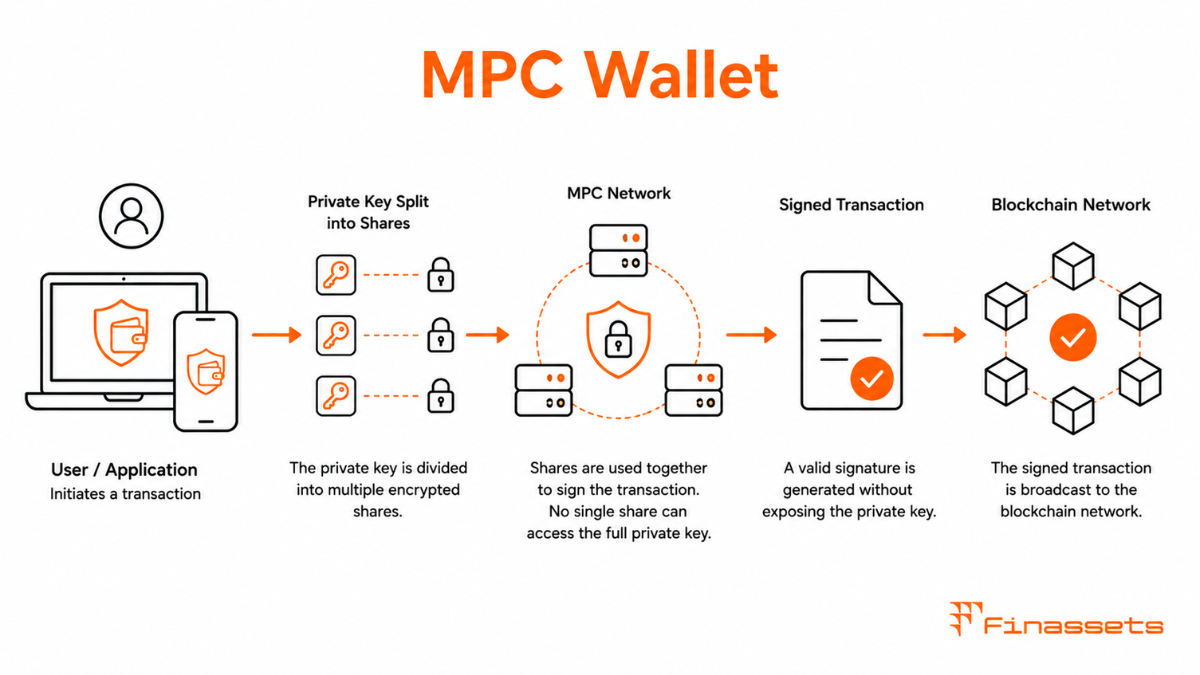
The Mathematical Foundation: Threshold Signature Schemes
MPC wallets are built on threshold signature schemes — cryptographic protocols that allow a group of parties to collectively produce a valid digital signature without any single party ever possessing the complete private key. The most widely used implementation is threshold ECDSA (Elliptic Curve Digital Signature Algorithm), which is the signature algorithm used by Bitcoin, Ethereum, and most major blockchains.
In a t-of-n threshold signature scheme, n parties each hold a share of the private key, and any t of those parties (the threshold) can collaborate to produce a valid signature. The private key itself is never assembled — it exists only implicitly in the mathematical relationship between the shares. A transaction signing session involves the t participating parties running a multi-round cryptographic protocol over an authenticated communication channel to produce the signature jointly, without any single party's share being exposed to the others.
Distributed Key Generation and Share Management
Establishing an MPC wallet begins with Distributed Key Generation (DKG) — a protocol through which n parties collaboratively generate their key shares without any trusted dealer who could observe or reconstruct the full key. In DKG, each party contributes randomness to the generation process, and the resulting shares are mathematically bound to the group's collective public key (and thus the wallet address) without the private key ever materialising in any single location.
Each party's key share must be stored securely and separately. In payment gateway deployments, shares are typically distributed across geographically separated servers — often in different cloud regions or data centres — with HSM-backed storage for the share material on each server. The minimum threshold of servers must be online and reachable to execute a signing session, making both the geographic distribution and the availability of the threshold number of servers part of the operational resilience planning.
MPC in Payment Gateway Key Management Workflows
For a crypto payment gateway processing settlement transactions, MPC replaces the traditional model of a single signing server holding a private key. The signing workflow becomes:
● The settlement engine generates an unsigned transaction and distributes the transaction hash to the MPC signing servers.
● Each signing server that participates in the threshold protocol runs its share of the signing computation.
● The distributed computation produces a complete, valid ECDSA signature without any server seeing the full private key.
● The signed transaction is assembled from the signature and broadcast to the blockchain network.
This workflow is transparent to the blockchain network — the resulting signature is indistinguishable from a standard single-key signature. There is no on-chain record of MPC usage, providing both privacy (the signing architecture is not visible to observers) and compatibility (any blockchain that accepts standard signatures works with MPC without protocol changes).
Security Properties and Limitations of MPC
MPC's primary security property is the elimination of the single private key — there is no moment during key generation, storage, or transaction signing when a complete private key exists in any form that could be extracted. An attacker must simultaneously compromise at least t servers to gain signing capability, and even then, the servers' protocol execution is designed to detect and abort in the presence of malicious participants (by using Byzantine fault-tolerant signing protocols).
MPC has limitations that practitioners should understand. It requires live network connectivity between participating servers during signing — unlike hardware wallet signing, which can occur fully offline. The multi-round nature of the signing protocol adds latency (typically 500ms to several seconds) compared to single-key signing. And while MPC prevents private key extraction, it does not prevent authorised-but-fraudulent signing if a malicious insider controls enough servers to meet the threshold — making robust access controls and independent monitoring of signing activity essential alongside MPC.
Compliance Note: This glossary entry is provided for general educational purposes only and does not constitute financial, investment, legal, or tax advice. Industry terminology may vary across jurisdictions and providers; definitions herein may not directly reflect the specific features, terms, or specifications of Finassets' services. For details on Finassets' offerings, please refer to official product documentation or contact our team directly.