

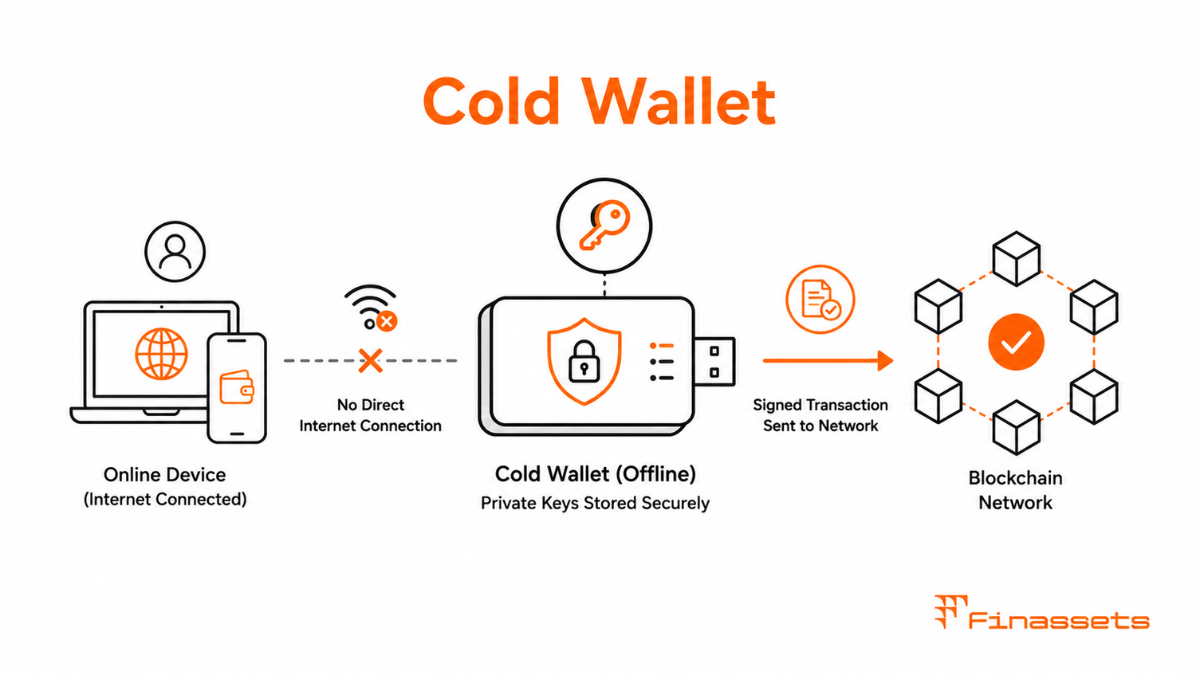
Types of Cold Wallets
Cold wallets differ in how they isolate private keys from internet-connected systems:
● Hardware wallets: Dedicated physical devices (e.g., Ledger, Trezor, BitBox) that store private keys inside a secure chip. Transactions are signed internally and only the signed transaction — not the key — is transmitted to the connected computer. The private key never leaves the device.
● Paper wallets: Private keys and public addresses printed or handwritten on physical paper, kept offline. Entirely dependent on physical security and are vulnerable to damage, degradation, loss, and unauthorized copying.
● Air-gapped computers: Machines that have never been connected to the internet and never will be, used exclusively for key generation and transaction signing. The signed transaction is transferred to an internet-connected machine via USB drive or QR code.
● Steel or metal backups: Seed phrases stamped into metal plates, resistant to fire and water damage. Used as a durable physical backup for hardware wallet recovery phrases, not as a signing device.
How Cold Wallets Sign Transactions Without Going Online
The core mechanism of a hardware wallet illustrates how cold wallets can sign transactions without exposing private keys:
1. The merchant or user prepares an unsigned transaction on an internet-connected device — specifying recipient, amount, and fee.
2. This unsigned transaction data is passed to the hardware wallet, typically via USB or Bluetooth.
3. The hardware wallet's secure chip signs the transaction internally using the stored private key. The user confirms the transaction details on the device's screen.
4. The signed transaction — containing the cryptographic signature but not the private key — is returned to the connected device.
5. The connected device broadcasts the signed transaction to the blockchain.
At no point does the private key leave the hardware chip. Even if the connected computer is infected with malware, the key cannot be extracted.
Cold Wallets in Payment Gateway Operations
In a payment gateway context, cold wallets hold the majority of merchant settlement funds that are not immediately needed for operational purposes. Funds are swept from hot wallets to cold storage periodically — sometimes daily, sometimes triggered by a balance threshold — and only moved back to hot wallets when operational liquidity requires it.
The cold wallet sweeping process itself requires careful security design. The signing of sweep transactions from hot to cold typically happens in an HSM or through an MPC ceremony, while sweeping from cold to hot requires additional authorization layers — often multi-party approval from senior operations staff.
For merchants using a payment gateway, cold storage is typically managed entirely by the gateway. For businesses running their own treasury operations, cold wallet procedures need to be documented and practiced, including recovery procedures and key rotation schedules.
Geographic Distribution of Cold Storage
Institutional-grade crypto custodians and large payment processors typically distribute cold wallet key material across multiple physical locations. A common approach is a 3-of-5 multisig where the five key shares are held in physically separate secure facilities — often in different countries or jurisdictions — so that no single location failure, natural disaster, or seizure event can result in asset loss.
Geographic distribution also reduces the risk that a single regulatory action in one country can freeze all assets. For regulated VASPs operating in multiple jurisdictions, documented multi-location cold storage procedures are increasingly required by regulators.
Limitations and Risks of Cold Wallets
Cold wallets eliminate remote hacking risk but introduce a different set of risks:
● Physical loss: A hardware wallet that is lost without an accessible seed phrase backup results in permanent loss of funds.
● Physical damage: Paper wallets and hardware devices can be destroyed by fire, flood, or physical force. Metal backups address fire and water risks but not theft.
● Seed phrase exposure: The only way to recover a cold wallet is the seed phrase. If the seed phrase is stored digitally or in an insecure physical location, it becomes the attack surface.
● Operational friction: Cold wallets are slow. High-volume transaction environments cannot rely on cold storage for day-to-day operations. Every signature requires physical device access and manual approval.
● Supply chain attacks: Hardware wallets purchased through unauthorized resellers have been tampered with. Always purchase hardware wallets directly from the manufacturer.
● Key person risk: If only one person knows how to access cold storage and that person is unavailable, assets may be inaccessible. Institutional cold storage procedures should require multiple authorized signatories.
Is a Ledger or Trezor Always Cold Storage?
Hardware wallets like Ledger and Trezor are cold storage devices by design — their private keys are generated and stored in a secure element chip and never leave it. However, when a hardware wallet is connected to a computer to sign a transaction, it briefly interacts with an internet-connected environment. The device itself remains cold (keys never leave the chip), but the transaction data passes through an internet-connected computer.
A strict interpretation reserves 'cold' for wallets that have never and will never touch an internet-connected device at all — i.e., air-gapped systems. In practice, hardware wallets are universally accepted as cold storage because the key isolation is cryptographically enforced by the secure chip, regardless of how the device is connected for signing.
Regulatory Expectations for Cold Storage
MiCA-regulated CASPs and other licensed VASPs face increasing scrutiny over their cold storage practices. Regulators expect documented cold wallet custody procedures, segregation of client assets from operational assets, and independently verifiable proof of reserves that accounts for both hot and cold wallet holdings.
Proof of reserves audits — where a gateway cryptographically demonstrates on-chain ownership of addresses covering merchant balances — are only meaningful if cold wallet addresses are included. A gateway that holds 90% of assets in cold storage but excludes those wallets from its proof of reserves provides incomplete assurance.
Compliance Note: This glossary entry is provided for general educational purposes only and does not constitute financial, investment, legal, or tax advice. Industry terminology may vary across jurisdictions and providers; definitions herein may not directly reflect the specific features, terms, or specifications of Finassets' services. For details on Finassets' offerings, please refer to official product documentation or contact our team directly.