

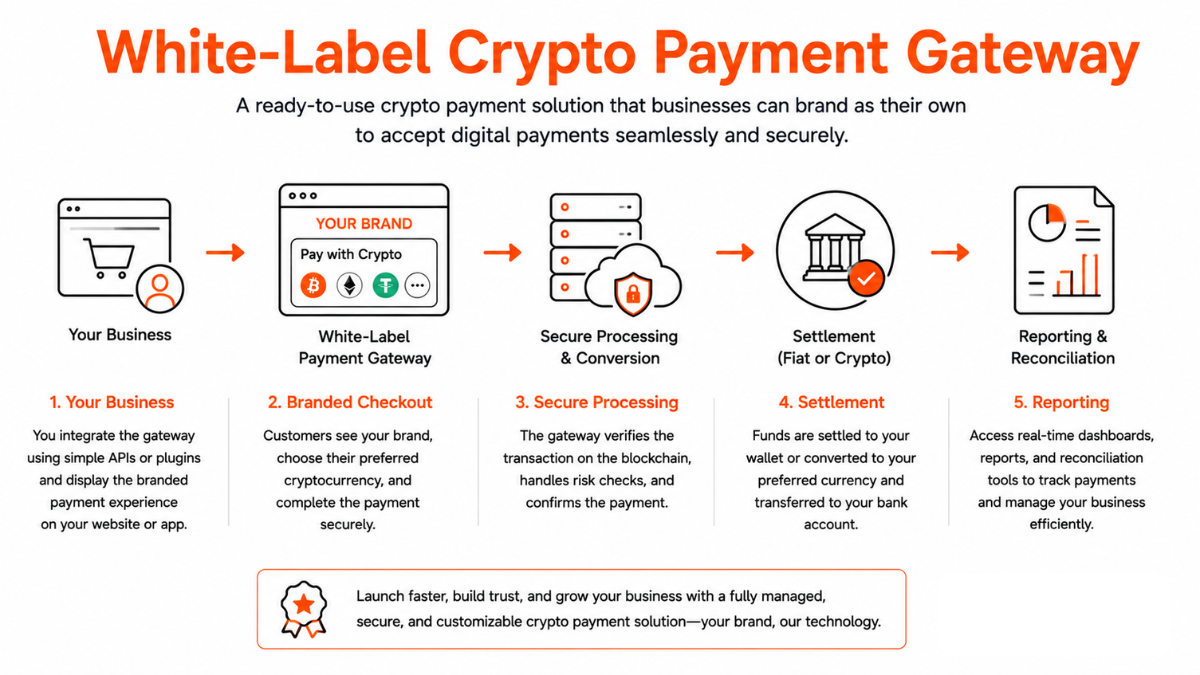
What White-Labelling Means in a Gateway Context
A white-label crypto payment gateway is the underlying processing infrastructure operated by one company and made available to other businesses to rebrand and offer under their own name. The white-label operator takes the infrastructure provider's product — blockchain monitoring, conversion, settlement, compliance tools, API, and dashboard — and presents it to their own merchants as their own branded product, typically with the infrastructure provider invisible to the end merchant.
The degree of white-labelling available varies significantly between providers. Shallow white-labelling may offer only logo replacement on the checkout page and dashboard. Deep white-labelling includes: custom domains (pay.clientbrand.com rather than checkout.provider.com), fully rebranded merchant dashboard and API documentation, custom fee structures set independently by the white-label operator, separate sub-merchant MIDs under the operator's master account, and configurable feature sets per operator.
Commercial Models for White-Label Operators
White-label gateway operators monetise the infrastructure through the spread between what they pay the infrastructure provider and what they charge their merchants. A white-label operator might pay the provider 0.5% on converted volume and charge their merchants 1.2%, retaining 0.7% as margin. This revenue sharing model aligns incentives — the infrastructure provider benefits from the operator's merchant acquisition efforts — while allowing the operator to set their own pricing strategy independently.
|
Revenue Model |
How It Works |
Best For |
|
Spread markup |
Operator charges merchants more than provider charges operator |
Operators with price-sensitive merchants; simple model |
|
Flat fee per transaction |
Operator charges fixed fee; provider charges percentage |
High-value transaction merchants; predictable pricing |
|
Monthly subscription + transaction fee |
Merchants pay monthly + per-transaction; provider charges volume-based |
SaaS businesses; fintech platforms with recurring revenue |
|
Custom enterprise pricing |
Operator negotiates bespoke structure; charges merchants independently |
Large operator with significant volume commitments |
Who Holds the Regulatory Licence in a White-Label Arrangement
The regulatory question in a white-label gateway is critical: which entity is the licensed CASP/VASP responsible for compliance? The most common arrangement is that the infrastructure provider holds the licence — the white-label operator operates under the provider's regulatory umbrella, with the operator's merchants effectively being sub-merchants under the provider's master licence. In this model, the infrastructure provider is responsible for AML compliance, including conducting KYB on operators (who themselves become the provider's merchant) and the operator is responsible for KYB on their own sub-merchants.
Some white-label arrangements allow the operator to hold their own CASP licence and use the provider purely for technical infrastructure — this is the more complex model and requires the operator to be a regulated entity in their own right, but gives them greater control over their merchant relationships and compliance posture. Operators pursuing this model must disclose their use of third-party infrastructure to their regulator and ensure the infrastructure provider's systems meet their own compliance requirements.
Compliance Note: This glossary entry is provided for general educational purposes only and does not constitute financial, investment, legal, or tax advice. Industry terminology may vary across jurisdictions and providers; definitions herein may not directly reflect the specific features, terms, or specifications of Finassets' services. For details on Finassets' offerings, please refer to official product documentation or contact our team directly.