

How an HSM Physically Protects Cryptographic Keys
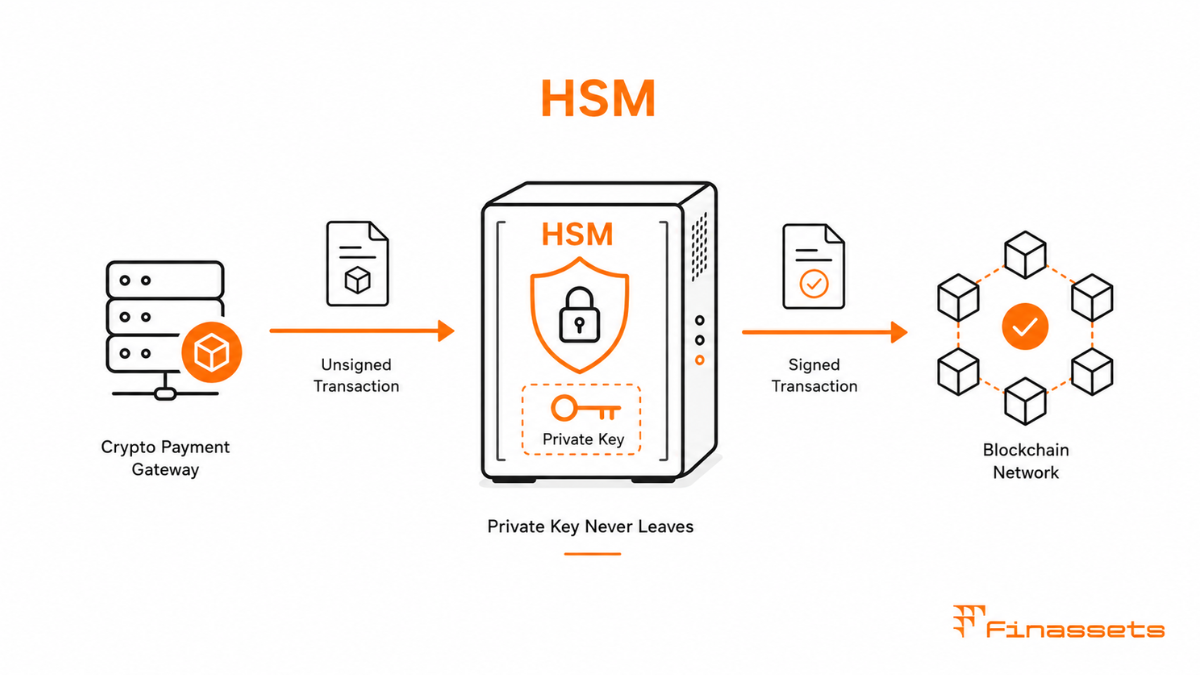
Software-based key storage keeps private keys in memory or on disk — environments that a sufficiently privileged attacker, malware, or cloud provider can read. An HSM removes this exposure by generating and storing keys inside a dedicated chip that is physically separate from the host server. The chip is designed to destroy key material if it detects tampering: probing the circuit, unexpected voltage changes, or temperature anomalies all trigger automatic key erasure. Signing happens inside the chip; the private key itself never travels across any bus or interface.
When a payment gateway needs to sign an outgoing transaction, the host server sends the unsigned transaction data to the HSM. The HSM signs it internally and returns only the signature. The private key never leaves the device, even during active use. This is fundamentally different from fetching a key from a secrets manager, even an encrypted one.
Types of HSMs Used in Crypto Payment Infrastructure
|
Type |
Common Use |
Example |
|
Network HSM |
High-throughput signing for gateway transaction queues |
Thales Luna, Utimaco SecurityServer |
|
PCI HSM |
PIN and payment data processing; common in card networks |
Thales payShield |
|
Cloud HSM |
Managed key protection without physical hardware |
AWS CloudHSM, Google Cloud HSM |
|
Hardware wallet (consumer) |
Single-user key storage and transaction signing |
Ledger, Trezor |
Enterprise crypto gateways typically use network HSMs or cloud HSMs rather than consumer hardware wallets. Network HSMs support thousands of signing operations per second and can be clustered for redundancy, making them the correct choice for high-volume payment processing environments.
HSM vs. Software Key Storage — Why the Gap Matters
Software key storage — including encrypted vaults, cloud secrets managers, and environment variables — protects keys at rest but exposes them in memory during use. A process with sufficient privilege can read memory at runtime, and a server-level exploit can dump the keys of every process running on that machine. An HSM eliminates this window entirely: the key is never in memory outside the chip, so there is no moment during signing when it can be intercepted.
The distinction matters most in shared hosting or cloud environments, where hypervisor exploits, memory leaks between containers, and insider access from cloud staff all represent realistic attack surfaces. HSMs are designed so that even the manufacturer cannot extract a stored key.
When Are HSMs Required for Crypto Payment Gateways?
No single global standard mandates HSMs for all crypto businesses, but several regulatory and audit frameworks effectively require them in practice. PCI DSS requires HSMs for any system that processes card data alongside crypto. MiCA-regulated CASPs in the EU are expected to implement 'adequate technical and organisational measures' for key protection, which auditors interpret as HSM-level controls for high-value custody. SOC 2 Type II audits for crypto custodians increasingly include HSM use as a control point. Additionally, institutional clients — banks, asset managers — typically contractually require HSM-backed custody before onboarding a gateway as a settlement counterparty.
Limitations of HSMs
HSMs introduce latency: each signing operation requires a round-trip to the device. For high-frequency transaction environments, this is managed through HSM clustering and connection pooling, but it adds engineering complexity. HSMs also represent a physical single point of failure if not replicated across multiple devices and locations. The upfront cost is significant — enterprise HSMs range from several thousand to tens of thousands of dollars per unit, plus licensing fees. And while HSMs prevent remote key extraction, they do not prevent an authorized operator from misusing signing capabilities. Role-based access controls and multisig authorization are required alongside HSMs to prevent insider misuse.
Compliance Note: This glossary entry is provided for general educational purposes only and does not constitute financial, investment, legal, or tax advice. Industry terminology may vary across jurisdictions and providers; definitions herein may not directly reflect the specific features, terms, or specifications of Finassets' services. For details on Finassets' offerings, please refer to official product documentation or contact our team directly.