

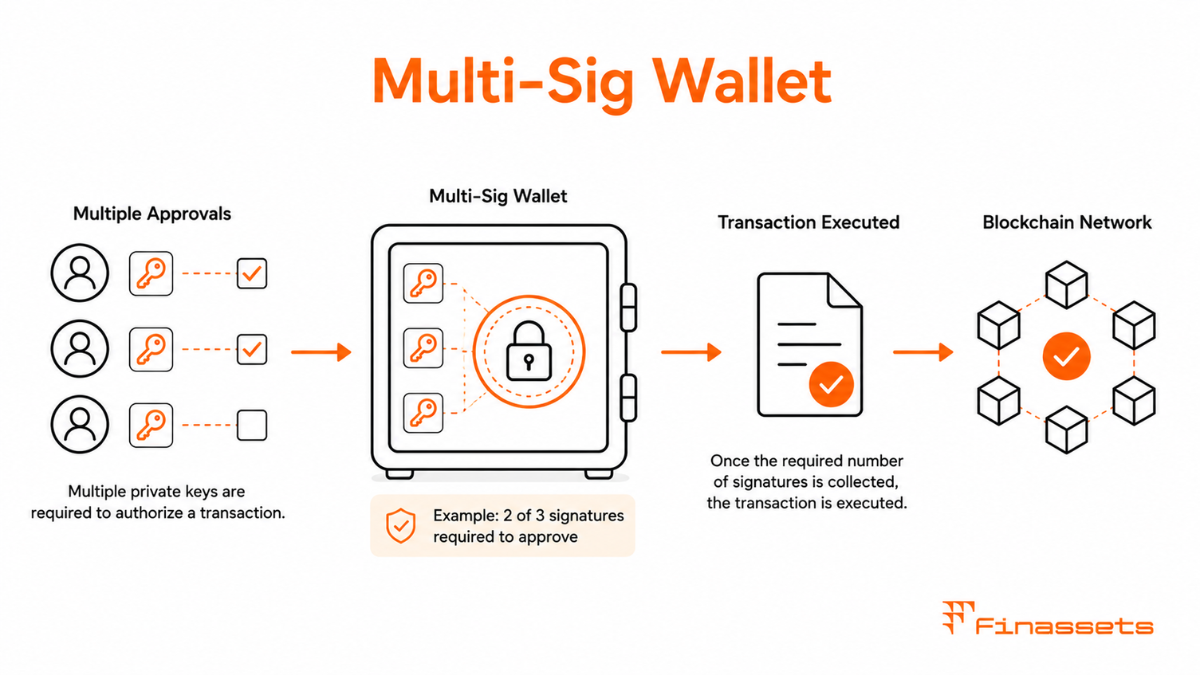
How M-of-N Multisig Works
Multisig (multiple signature) wallets require a minimum number M of N possible private keys to jointly sign a transaction before it can be broadcast. A 2-of-3 multisig holds three independent keys, any two of which can authorise a transaction. A 3-of-5 multisig holds five keys and requires any three. The M threshold determines the security floor: an attacker must compromise at least M key holders simultaneously to steal funds. The N count determines redundancy: up to N-M key holders can be lost or become unavailable without funds being permanently locked.
On Bitcoin, multisig is implemented at the protocol level using Pay-to-Script-Hash (P2SH) or Pay-to-Witness-Script-Hash (P2WSH) addresses, which encode the multisig requirements directly in the spending conditions. On Ethereum, multisig is typically implemented through smart contracts — the most widely used being Gnosis Safe (now Safe) — that execute the M-of-N logic programmatically.
Common Multisig Configurations and Their Trade-offs
|
Configuration |
Minimum Signers |
Total Keys |
Loss Tolerance |
Use Case |
|
1-of-2 |
1 |
2 |
Can lose 1 key |
Simple backup; low-value operational wallets |
|
2-of-2 |
2 |
2 |
None — both required |
Two-person control; no redundancy |
|
2-of-3 |
2 |
3 |
Can lose 1 key |
Standard enterprise treasury; good balance of security and redundancy |
|
2-of-4 |
2 |
4 |
Can lose 2 keys |
High-volume gateways; flexible signing |
|
3-of-5 |
3 |
5 |
Can lose 2 keys |
Institutional custody; geographic distribution |
|
4-of-7 |
4 |
7 |
Can lose 3 keys |
Large custodians; maximum redundancy |
Multisig vs. MPC Wallet — Key Differences
Multisig and MPC (Multi-Party Computation) wallets both require multiple parties to authorise transactions, but their technical implementation differs significantly and creates different security and operational properties:
● On-chain visibility: Multisig transactions on Bitcoin and Ethereum are identifiable as multisig on the blockchain, revealing the signing policy to anyone who inspects the transaction. MPC produces a standard single-key signature that is indistinguishable from a single-key transaction, providing stronger privacy.
● Fee efficiency: Multisig transactions include multiple signatures in the transaction data, increasing byte size and therefore network fees. MPC produces a compact single signature regardless of the number of parties, keeping fees at single-key levels.
● Supported networks: Native multisig is well-supported on Bitcoin and Ethereum but varies by network. MPC is network-agnostic — any blockchain that accepts standard signatures can benefit from MPC without protocol-level support.
● Signing ceremony: Multisig parties can sign independently with standard wallets. MPC requires the parties to participate in a cryptographic protocol to jointly produce the signature, which typically requires specialised software and network connectivity between parties.
Multisig in Settlement Authorization Workflows
Beyond treasury protection, multisig is used in payment gateways as an internal control mechanism for authorising large outgoing payments. A gateway might configure automatic processing for settlements below €50,000 using a single key, while settlements above €50,000 require a 2-of-3 approval from the CFO, the operations lead, and the compliance officer. This tiered authorization structure limits the damage an internal bad actor or compromised credential can cause, since large unauthorised transfers cannot be signed by a single compromised party.
Compliance Note: This glossary entry is provided for general educational purposes only and does not constitute financial, investment, legal, or tax advice. Industry terminology may vary across jurisdictions and providers; definitions herein may not directly reflect the specific features, terms, or specifications of Finassets' services. For details on Finassets' offerings, please refer to official product documentation or contact our team directly.