

How Crypto-to-Fiat Settlement Differs From Related Models
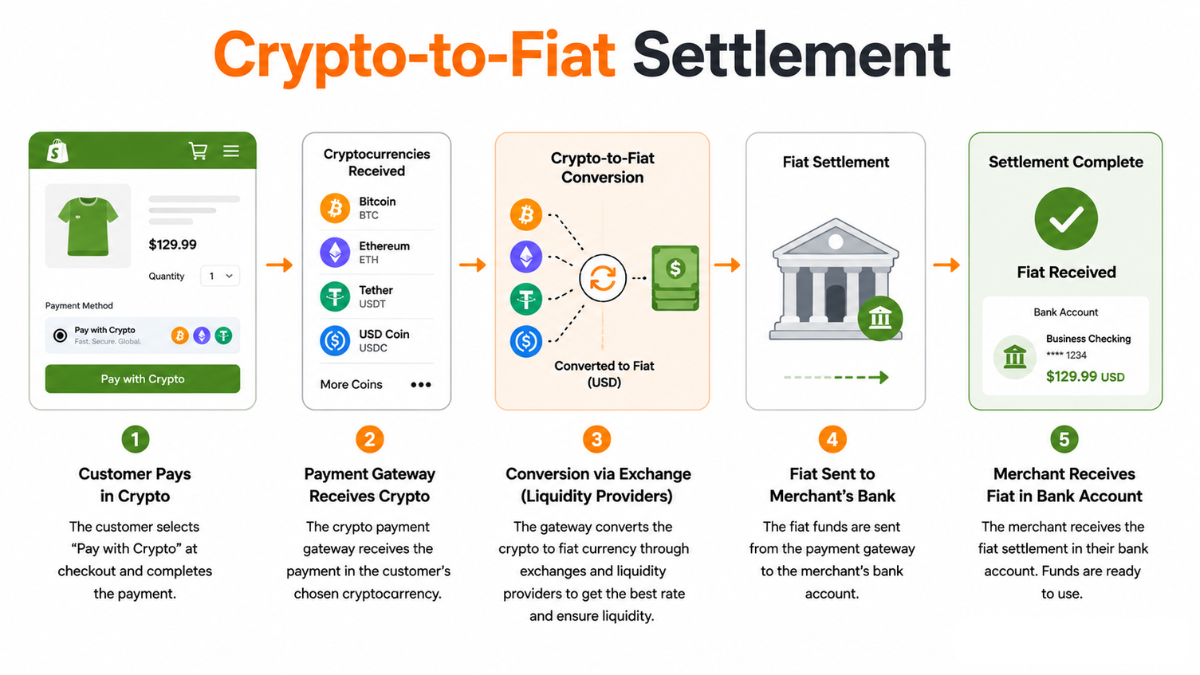
Three settlement models exist for merchants accepting crypto: crypto-to-fiat (the focus here), crypto-to-crypto, and stablecoin settlement. Crypto-to-fiat is the only model in which the merchant's bank account receives a transfer in their local currency — EUR, USD, GBP, or another fiat — with no digital asset held at any point post-conversion. The merchant receives neither the original cryptocurrency nor a stablecoin equivalent, only the fiat value of the transaction minus the gateway's fees and spread.
This makes crypto-to-fiat the settlement model with the highest operational simplicity for businesses that operate entirely in fiat: accounting, tax reporting, treasury management, and cash flow forecasting all work exactly as they would for any other fiat payment channel. No crypto wallet, no asset custody, no exchange access, and no exposure to cryptocurrency price risk beyond the gateway's price lock window.
Who Bears the Conversion Risk
In a crypto-to-fiat settlement, the gateway bears the market risk between the moment a payment is confirmed on-chain and the moment the gateway converts the received cryptocurrency into fiat. If Bitcoin rises 3% during that window, the gateway benefits. If it falls 3%, the gateway absorbs the loss. This is why price lock windows are short — 10 to 20 minutes — and why gateways operate their own liquidity infrastructure rather than converting manually on an exchange for each payment.
Gateways manage this market exposure through hedging strategies: pre-selling cryptocurrency in futures markets to lock in conversion rates, maintaining liquidity reserves that allow immediate conversion without moving the market, or using algorithmic conversion that executes immediately upon payment confirmation. The cost of this risk management is embedded in the spread the gateway charges on top of the mid-market rate.
The Conversion Timing Options
|
Conversion Timing |
When It Happens |
Rate Used |
Merchant Risk |
|
Instant (on confirmation) |
As soon as payment reaches required confirmations |
Rate at confirmation moment |
None — fully hedged by gateway |
|
End-of-day batch |
All payments from the day converted at a single rate |
Average of day's conversions |
Intraday price movement |
|
Manual on-demand |
Merchant triggers conversion from dashboard |
Rate at trigger moment |
Full price risk during holding period |
|
Scheduled (e.g., noon daily) |
Fixed time regardless of payment timing |
Rate at scheduled time |
Price movement from receipt to scheduled time |
Instant conversion on confirmation is the default and most common configuration for merchants seeking full volatility protection. End-of-day batching reduces the number of conversion events but introduces intraday price exposure. Manual conversion gives the merchant maximum control but requires active treasury management and shifts all price risk to the merchant.
Tax Treatment of Crypto-to-Fiat Settlement for Merchants
In most jurisdictions that have issued guidance on crypto taxation for businesses, the receipt of cryptocurrency as payment for goods or services is a taxable income event at the moment of receipt, regardless of when conversion occurs. The income amount is the fair market value of the cryptocurrency at the time of receipt, in local currency.
Crypto-to-fiat settlement simplifies this because the conversion happens almost immediately, meaning the 'fair market value at receipt' is very close to the fiat amount the merchant actually receives. The spread and fee represent an expense, not a separate gain or loss event. For merchants who hold crypto between receipt and conversion, however, each subsequent conversion creates a separate capital gain or loss calculation based on the change in value since receipt.
Payment gateways providing crypto-to-fiat settlement should supply merchants with transaction records showing the exact cryptocurrency amount received, the conversion rate applied, and the fiat amount credited for each transaction. This data is essential for compliant tax reporting.
Compliance Note: This glossary entry is provided for general educational purposes only and does not constitute financial, investment, legal, or tax advice. Industry terminology may vary across jurisdictions and providers; definitions herein may not directly reflect the specific features, terms, or specifications of Finassets' services. For details on Finassets' offerings, please refer to official product documentation or contact our team directly.