

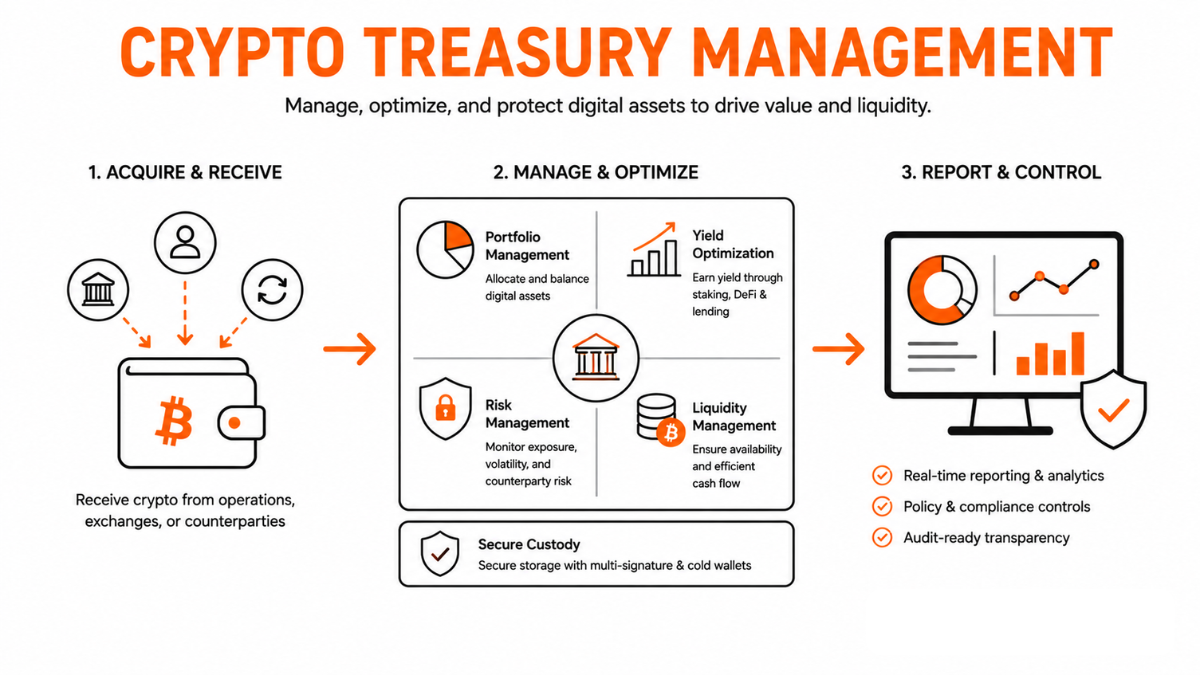
The Three Treasury Objectives in a Crypto Context
Corporate treasury management has three universal objectives: liquidity (ensuring the business has sufficient funds accessible when needed), risk management (protecting the business from financial losses), and yield optimisation (earning returns on idle cash). Crypto treasury management addresses all three but with instruments and risk profiles that differ substantially from traditional treasury.
Liquidity in crypto treasury is more complex than in fiat because crypto assets may need to be converted before they are usable for fiat-denominated expenses. A treasury manager holding Bitcoin must account for the conversion timeline and potential slippage when planning whether sufficient liquid resources are available to meet a fiat payroll next week. Risk management must address crypto price volatility — an exposure with no direct equivalent in traditional treasury. Yield optimisation can involve DeFi lending, staking, or structured products, each with risk profiles that require specialist assessment.
The Allocation Decision Framework
Businesses receiving crypto payments must decide what portion to convert to fiat immediately, what portion to retain in stablecoins, and what portion to hold in volatile crypto assets. This allocation decision should be driven by the business's underlying cost structure rather than market speculation:
● Fiat conversion allocation: Should cover all fiat-denominated expenses for the next operational period — salaries, rent, utilities, supplier invoices. This is the minimum fiat allocation required regardless of market outlook.
● Stablecoin allocation: Can cover expenses payable to counterparties who accept stablecoin settlement, or serve as a reserve for crypto-denominated costs (blockchain fees, crypto service subscriptions). Stablecoins provide operational flexibility without fiat conversion costs.
● Volatile crypto allocation: Any allocation beyond fiat and stablecoin operational needs represents a treasury investment in crypto price appreciation. This allocation should be explicitly approved by the board, treated as an investment exposure with defined risk limits, and hedged or sized appropriately for the business's risk tolerance.
Risk Management Tools for Crypto Treasuries
Businesses with material crypto treasury exposure have several risk management options beyond the simple strategy of immediate fiat conversion:
● Futures hedging: Selling Bitcoin or Ethereum futures contracts at a defined price to lock in the fiat value of a crypto holding, regardless of subsequent price movements. Used by treasury teams with derivatives experience and access to institutional futures markets (CME, Deribit).
● Options strategies: Buying put options that provide downside protection below a defined price level while allowing participation in price appreciation. More flexible than futures but requires option premium payment.
● OTC structured products: Banks and crypto-native financial institutions offer structured products — principal-protected notes, yield-enhanced certificates — that provide defined exposure to crypto price movements within guaranteed floors or caps.
● Dollar-cost averaging out: Instead of converting the entire crypto position at once, converting a fixed dollar amount at regular intervals to reduce timing risk on the conversion itself.
Board Governance and Policy Requirements
For companies where crypto treasury constitutes a material balance sheet exposure, board-level governance is not optional. Publicly traded companies and larger private enterprises should have a board-approved treasury policy that specifies: the maximum percentage of liquid assets that may be held in volatile crypto; the hedging framework for positions above defined size thresholds; the reporting frequency for crypto treasury positions to the CFO and board; and the authorisation matrix for changes to the allocation policy.
Compliance Note: This glossary entry is provided for general educational purposes only and does not constitute financial, investment, legal, or tax advice. Industry terminology may vary across jurisdictions and providers; definitions herein may not directly reflect the specific features, terms, or specifications of Finassets' services. For details on Finassets' offerings, please refer to official product documentation or contact our team directly.