

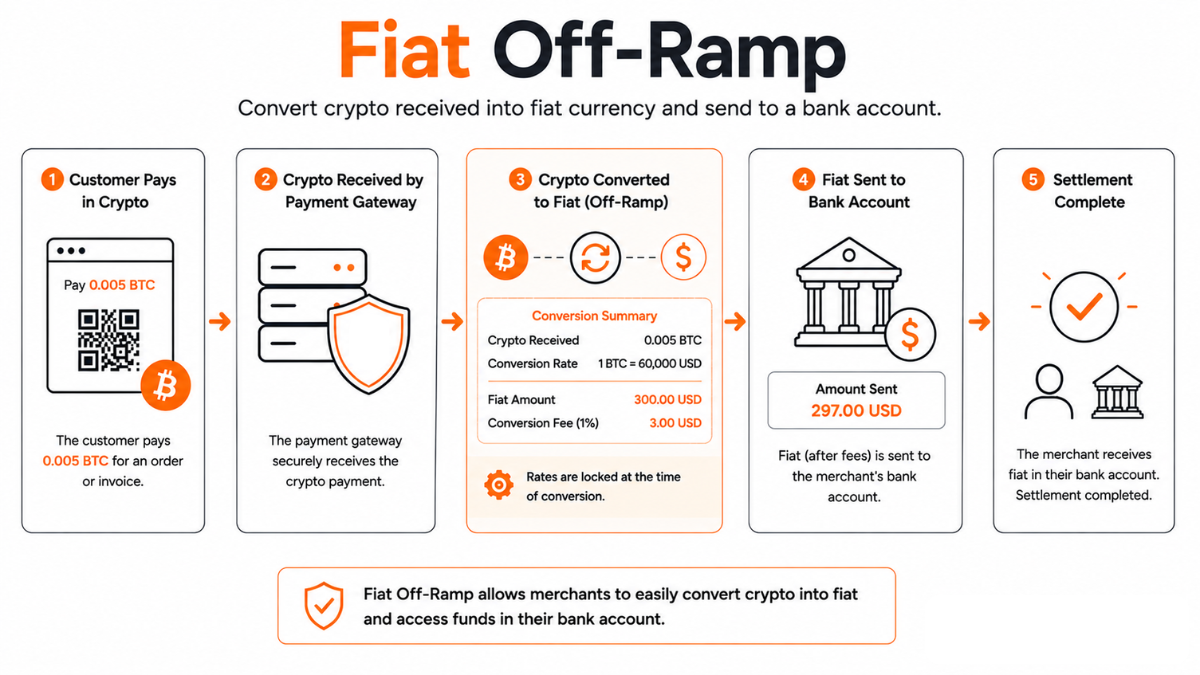
Types of Fiat Off-Ramps and Their Characteristics
Fiat off-ramps convert cryptocurrency to fiat and deliver the proceeds through a banking or payment channel. The mechanism varies by provider type:
● Gateway-integrated off-ramp: The payment gateway converts received crypto and initiates a bank transfer as part of its standard settlement flow. No separate provider needed — the entire process is handled by the gateway.
● Crypto exchange off-ramp: The business sends crypto to an exchange account, sells on the market, and withdraws fiat. Requires exchange account, KYC, and manual or API-based execution of each step.
● OTC desk off-ramp: For large conversions (typically above €50,000–€100,000 per transaction), an OTC desk provides a quoted rate for a block trade, avoiding market impact. Faster execution and often a tighter spread than exchange trading for large amounts.
● P2P off-ramp: Matching buyers and sellers directly, with payment through local payment methods or bank transfers. Useful in markets with limited banking infrastructure but carries counterparty risk and regulatory complexity.
● Local payment method off-ramp: Services like MoonPay, Banxa, or regional providers that deliver fiat via local methods (iDEAL, Pix, UPI, M-Pesa) as an alternative to bank wire. Relevant for merchants settling into emerging market currencies.
Speed vs. Cost Trade-offs Across Off-Ramp Types
|
Off-Ramp Type |
Typical Speed |
Typical Cost |
Best For |
|
Gateway-integrated (SEPA) |
1 business day |
Included in gateway spread |
EU merchants settling in EUR |
|
Gateway-integrated (SWIFT) |
2–5 business days |
€15–€50 per transfer |
Non-EU merchants settling via wire |
|
Exchange (manual) |
1–3 days (after trade) |
0.1%–0.5% trading fee + withdrawal fee |
Mid-volume businesses with exchange access |
|
OTC desk |
Same-day to next-day |
0.1%–0.3% (tight spread for large trades) |
High-value single conversions €50k+ |
|
Local payment method |
Minutes to hours |
1%–3% |
Emerging market settlement |
KYC Requirements for Fiat Off-Ramps
All regulated fiat off-ramps are obligated to conduct KYC on their users under AML regulations. For business off-ramps, this means full KYB: company documents, director identification, UBO verification, and source-of-funds documentation for the cryptocurrency being converted. Off-ramp providers face regulatory scrutiny similar to that applied to VASPs, particularly as regulators focus on the crypto-to-fiat conversion point as a key money laundering risk.
Businesses using integrated gateway settlement avoid separate off-ramp KYB because the gateway's KYB process covers the settlement function. Businesses that use a separate exchange or OTC desk as their off-ramp need to complete the off-ramp provider's own onboarding, which may duplicate documentation already provided to their payment gateway.
OTC Desk Off-Ramps for Large Volume Conversions
Exchanges execute trades at the market price at the moment of execution, which can move unfavourably for large orders — selling a significant amount of Bitcoin on an exchange may push the price down mid-trade, resulting in worse average prices than quoted. OTC desks provide firm quotes for the entire block volume, eliminating this market impact risk. For any single conversion above approximately €50,000–€100,000, requesting an OTC quote from two or three reputable desks and comparing against the current exchange rate is standard practice. The OTC rate is typically within 0.1%–0.3% of the mid-market rate for liquid assets, often better than what can be achieved by breaking the volume into smaller exchange trades.
Compliance Note: This glossary entry is provided for general educational purposes only and does not constitute financial, investment, legal, or tax advice. Industry terminology may vary across jurisdictions and providers; definitions herein may not directly reflect the specific features, terms, or specifications of Finassets' services. For details on Finassets' offerings, please refer to official product documentation or contact our team directly.