

Use Cases That Drive Mass Payout Adoption
Mass crypto payouts serve business models that require simultaneous payments to many recipients — a category that traditional banking handles poorly. Wire transfer fees of €15–€50 per payment make paying 500 contractors in different countries prohibitively expensive through SWIFT. A single mass payout batch eliminates per-transfer banking fees and completes in minutes rather than the 2–5 business days typical of international wire transfers. The primary use cases are:
● Affiliate and referral commission payments: Marketing platforms, iGaming operators, and SaaS companies paying commissions to thousands of affiliate partners globally. Crypto eliminates international wire delays and currency conversion costs for cross-border affiliate networks.
● Marketplace seller payouts: E-commerce platforms, gig economy marketplaces, and content platforms disbursing earnings to sellers, creators, or service providers. Crypto payouts remove the minimum payout threshold problem that traps small earners in traditional systems.
● Contractor and freelancer payments: Companies paying development, design, or content teams across multiple countries in a single weekly or bi-weekly batch. Stablecoins eliminate the currency risk that makes international contractor payments unpredictable in fiat.
● Token distributions and airdrops: Blockchain projects distributing governance tokens, reward tokens, or airdrop allocations to thousands of wallet addresses. These are high-recipient-count, low-per-recipient-value operations that are impractical via any other channel.
● Crypto cashback and loyalty rewards: Consumer platforms distributing crypto rewards to users based on spending behaviour or programme participation.
Technical Mechanics of Batch Payment Execution
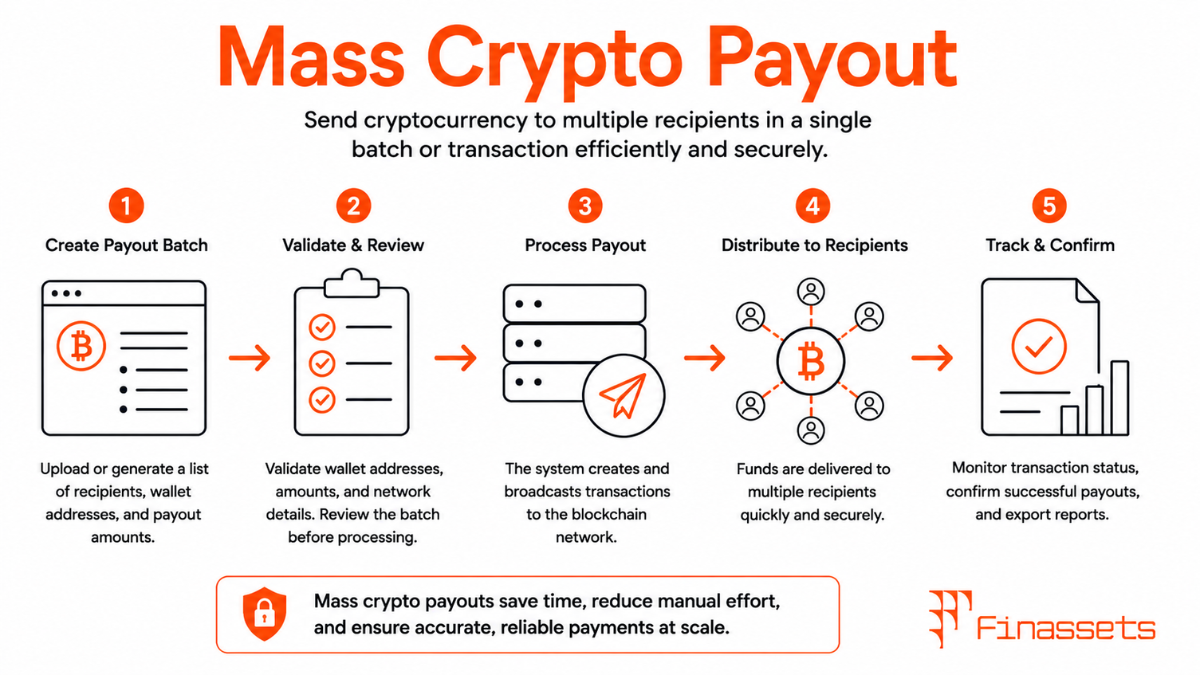
A mass payout is submitted to the gateway either as a CSV file (uploaded through the dashboard) or as an API call containing an array of recipient objects, each specifying a wallet address, asset type, and amount. The gateway validates every address in the batch before execution, rejecting any entry that fails format validation or sanctions screening, and returns a validation report to the operator before broadcasting any transactions.
Once validated and approved, the gateway queues the payout transactions and executes them in batches optimised for network conditions. On networks like Ethereum, where each transaction is submitted individually, the gateway sequences transactions with appropriate gas prices and manages nonce values to prevent processing conflicts. On UTXO networks like Bitcoin, a single transaction with many outputs can pay hundreds of recipients simultaneously — far more efficient than individual transfers.
|
Network |
Batch Mechanism |
Max Recipients Per Transaction |
Typical Execution Time |
|
Bitcoin (BTC) |
Single TX with multiple outputs |
Hundreds (limited by tx size) |
10–60 minutes |
|
Ethereum (ETH) — native |
Individual transactions per recipient |
1 per transaction |
Minutes (depends on gas) |
|
Ethereum — smart contract |
Batch transfer contract call |
Hundreds in one transaction |
Minutes |
|
Tron (TRC-20 USDT) |
Individual transactions |
1 per transaction |
1–3 minutes |
|
Solana |
One transaction with multiple instructions |
Dozens |
< 1 minute |
Address Validation and Pre-Execution Screening
Before any mass payout is executed, every recipient address in the batch must be validated on two dimensions. Technical validation confirms that the address format is valid for the specified network — a malformed address or an Ethereum address submitted for a Bitcoin payout would result in irreversible loss of funds. Compliance screening checks every address against sanctions lists and blockchain analytics risk scores, flagging or blocking addresses with high-risk profiles.
Gateways with strong mass payout capabilities return a pre-execution report identifying any invalid or flagged addresses, allowing the operator to correct the batch before committing to irreversible disbursement. Operators should not bypass pre-execution validation even under time pressure — discovering a misdirected payment after execution has no remedy.
Compliance Requirements for Mass Payout Recipients
When a mass payout is made to business counterparties — suppliers, partners, or service providers — the payer VASP may have Travel Rule obligations if the recipients hold their crypto at VASP-hosted wallets. Identifying whether each recipient uses a VASP-hosted wallet and, if so, which VASP, is operationally complex at scale. In practice, most gateways handle this through blockchain analytics attribution combined with a Travel Rule protocol like TRP or TRISA for identified VASP recipients, and self-hosted wallet verification workflows for non-attributed addresses above the regulatory threshold.
Compliance Note: This glossary entry is provided for general educational purposes only and does not constitute financial, investment, legal, or tax advice. Industry terminology may vary across jurisdictions and providers; definitions herein may not directly reflect the specific features, terms, or specifications of Finassets' services. For details on Finassets' offerings, please refer to official product documentation or contact our team directly.