

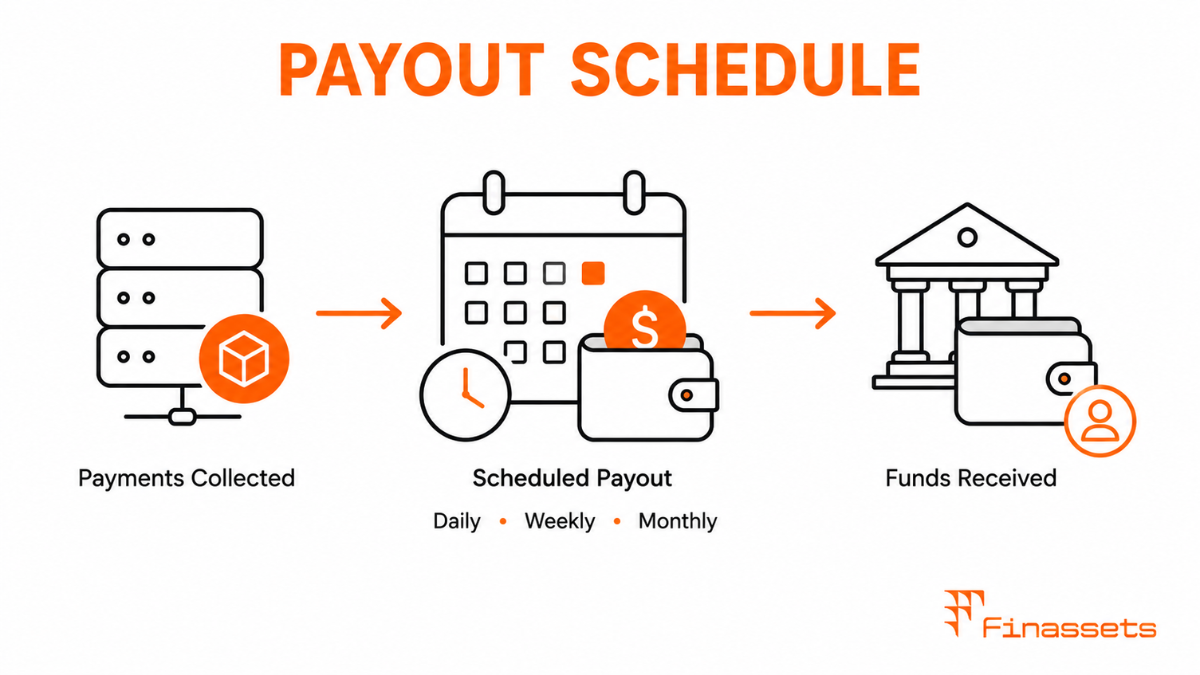
How Payout Schedules Work Operationally
A payout schedule defines the cadence at which a payment gateway transfers accumulated merchant settlement balances to the merchant's bank account or designated wallet. Between payout events, received and converted funds accumulate in the merchant's gateway account as a ledger balance — the merchant is owed the amount but has not yet received it. At each scheduled payout event, the gateway calculates the accumulated balance, deducts any pending fees, initiates a bank transfer or on-chain transaction, and resets the balance to zero.
The mechanics behind the payout are straightforward, but the operational implications require careful configuration. A merchant who configures weekly payouts will wait up to seven days between receiving payments and seeing funds in their bank account — acceptable for a business with adequate working capital but problematic for a cash-flow-constrained operation that needs daily access to payment receipts. Conversely, a merchant who configures daily payouts receives faster access but generates more individual bank entries, complicating bookkeeping and potentially incurring per-transfer banking fees that reduce net settlement amounts.
Settlement Schedule Options and Their Practical Implications
|
Schedule |
Trigger |
Typical Settlement Time |
Cash Flow Impact |
Bookkeeping Complexity |
|
Instant |
Each confirmed payment |
Minutes (on-chain) or next banking day (fiat) |
Best |
Highest — one entry per transaction |
|
Daily |
Once per calendar day |
Next banking day for fiat |
Good |
Moderate — one batch per day |
|
Weekly |
Fixed day of week (e.g., Monday) |
1–2 banking days after batch |
Moderate |
Low — one entry per week |
|
Threshold-based |
When balance exceeds defined amount |
Within 1 banking day of trigger |
Variable |
Low — entries correlate with business activity |
|
On-demand |
Merchant triggers manually via dashboard |
1–2 banking days |
Merchant-controlled |
Low — merchant controls timing |
|
Bi-weekly |
Twice monthly on fixed dates |
1–2 banking days after batch |
Moderate |
Low |
Banking Cut-Off Times and Their Effect on Payout Timing
Even when a gateway processes a daily settlement batch at midnight UTC, the actual arrival of funds in the merchant's bank account depends on banking cut-off times. Standard SEPA Credit Transfers are processed in batches by clearing houses (typically EBA Clearing's STEP2) at defined times during the business day — usually two to three processing cycles. A settlement batch submitted after the final cut-off of a business day will not clear until the following morning, adding an effective delay of one calendar day.
SEPA Instant Credit Transfers bypass cut-off times entirely, processing 24/7/365 with funds arriving in seconds. Gateways integrated with banking partners that support SEPA Instant can offer same-day fiat payouts regardless of when the settlement batch is processed. For merchants in the EU with working capital sensitivity, asking whether a gateway supports SEPA Instant settlement is a practically important question that significantly affects the real-world payout experience.
Payout Schedule and Accounting Period Alignment
For merchants whose accounting is period-based — monthly financial statements, quarterly VAT returns, annual corporation tax — the payout schedule should align with accounting period boundaries where possible. A daily payout schedule that generates 30 individual bank entries per month is harder to reconcile against the gateway's monthly transaction report than a threshold-based schedule that generates 5–8 payments. Many merchants align their payout schedule with their payroll cycle or supplier payment schedule to simplify cash flow management: if supplier invoices are due on the 15th and last day of the month, a bi-weekly payout schedule ensures funds are available before each payment run.
Compliance Note: This glossary entry is provided for general educational purposes only and does not constitute financial, investment, legal, or tax advice. Industry terminology may vary across jurisdictions and providers; definitions herein may not directly reflect the specific features, terms, or specifications of Finassets' services. For details on Finassets' offerings, please refer to official product documentation or contact our team directly.