

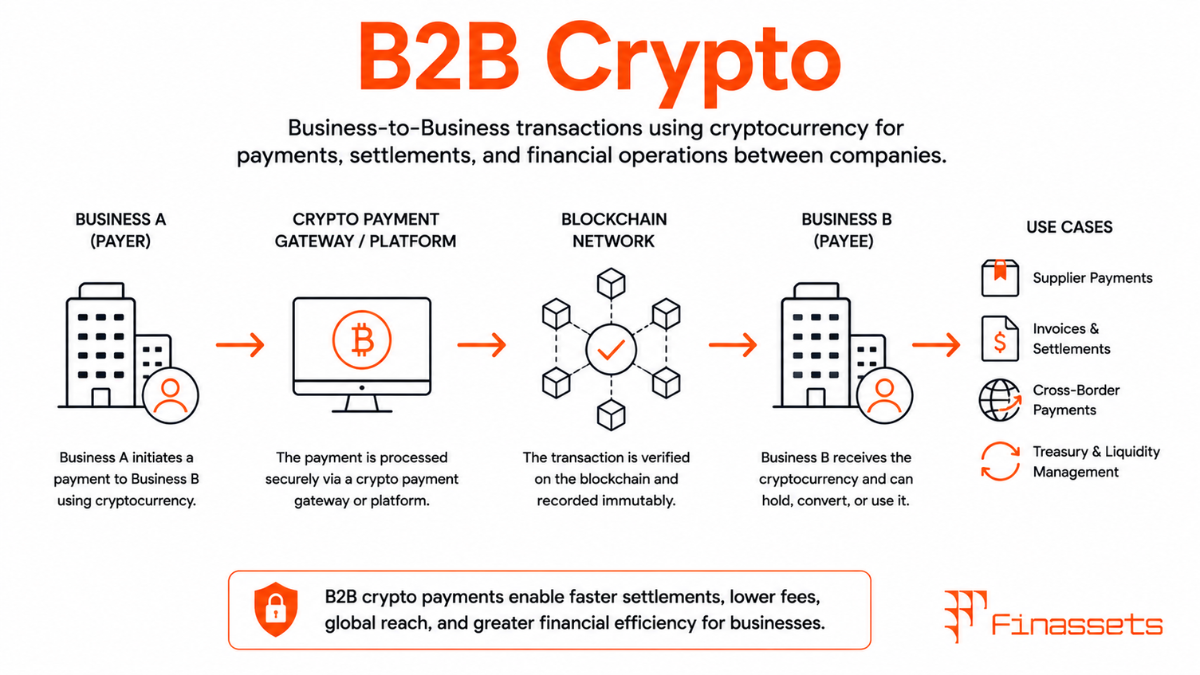
How B2B Crypto Payments Differ From Consumer Payments
B2B crypto payments share the same underlying blockchain infrastructure as consumer payments but differ significantly in their commercial and compliance context. Consumer payments are typically low-value, anonymous, and driven by immediate purchase intent. B2B payments are invoice-driven, involve pre-existing commercial relationships, carry larger individual amounts, and require detailed documentation trails for accounting, tax, and audit purposes.
The invoice serves a different function in B2B crypto than in consumer checkout. A consumer crypto invoice is a payment page generated for an immediate checkout. A B2B crypto invoice is a formal commercial document — specifying payment terms, bank or wallet details, VAT information, and line items — with the crypto amount calculated and appended as the payment method. The relationship between buyer and seller typically involves credit terms (net-30, net-60), purchase orders, and contractual frameworks that crypto does not itself replace but must integrate with.
Advantages Over Traditional B2B Payment Rails
|
Factor |
SWIFT Wire Transfer |
SEPA Credit Transfer |
Crypto (Stablecoin) |
|
Settlement speed |
2–5 business days |
1 business day |
Minutes (24/7) |
|
Cost per transfer |
€15–€50 + correspondent fees |
€0.10–€0.30 |
< $1 (network fee) |
|
Currency availability |
Any, with conversion |
EUR only |
Any (via stablecoins or native crypto) |
|
Weekend / holiday processing |
No |
No |
Yes — no banking hours |
|
Required bank account |
Both parties need bank accounts |
Both need SEPA bank accounts |
Only wallet address required |
|
Reversibility |
Possible (costly) |
Possible (SDD only) |
None — final on confirmation |
|
Transparency |
Bank statement only |
Bank statement only |
Public blockchain record |
Stablecoin as the Preferred B2B Payment Asset
For most B2B use cases, stablecoins — particularly USDT and USDC — are the preferred settlement asset rather than volatile cryptocurrencies. The reason is practical: a supplier invoicing €50,000 for delivered goods needs predictable revenue. If the buyer pays in Bitcoin, the supplier is exposed to the full volatility of Bitcoin from the moment of receipt until conversion. If the buyer pays in USDC, the supplier receives the euro-equivalent at the prevailing EUR/USD rate, with no crypto price risk.
USDC on networks like Solana or Base, or USDT on Tron, achieves the principal B2B payment goals of near-instant settlement, negligible fees, and 24/7 availability without imposing crypto price risk on either party. Treasury teams that might resist 'accepting crypto' due to volatility concerns are often receptive to stablecoin settlement, which they can frame as receiving a USD-denominated digital payment instrument rather than a speculative asset.
KYB and Compliance in B2B Crypto Payments
B2B crypto transactions between businesses require that the payer VASP conducts appropriate due diligence on both the sending business and the receiving business. When a payment gateway facilitates a B2B payment from Company A to Company B, it must understand the commercial purpose of the transaction, verify that neither party is a prohibited or sanctioned entity, and — for transfers above Travel Rule thresholds — exchange originator and beneficiary information with the receiving VASP if Company B's wallet is VASP-hosted.
Businesses using crypto for supply chain payments should maintain documentation of the commercial relationship — purchase orders, contracts, delivery confirmations — alongside the blockchain transaction records. This documentation is essential for demonstrating the legitimate business purpose of large crypto transfers during AML audits or regulatory inquiries.
Compliance Note: This glossary entry is provided for general educational purposes only and does not constitute financial, investment, legal, or tax advice. Industry terminology may vary across jurisdictions and providers; definitions herein may not directly reflect the specific features, terms, or specifications of Finassets' services. For details on Finassets' offerings, please refer to official product documentation or contact our team directly.