

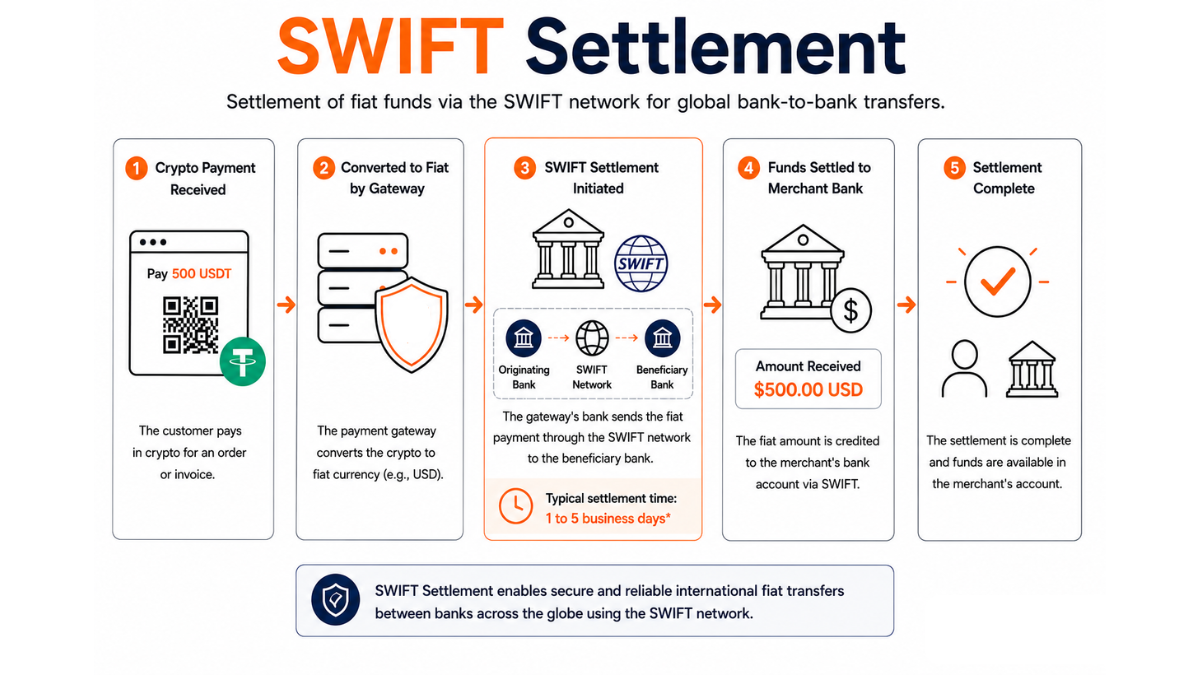
What SWIFT Is and How It Works
SWIFT (Society for Worldwide Interbank Financial Telecommunication) is the global messaging network that financial institutions use to securely communicate instructions for international money transfers. SWIFT does not move money itself — it transmits standardised messages between correspondent banks, who then move funds through their bilateral nostro and vostro account relationships. A payment from a Lithuanian gateway to a US merchant's bank account flows as follows: the gateway's bank sends a SWIFT message to an intermediary correspondent bank, which forwards to the US correspondent bank, which credits the merchant's bank, which credits the merchant's account.
The multi-hop nature of this process creates the 2–5 business day timeline and the fee structure of SWIFT transfers. Each correspondent bank in the chain may deduct its own processing fee before forwarding the remaining amount, meaning the merchant may receive less than the full settlement amount if correspondent fees are deducted 'SHA' (shared) rather than paid in full by the sender ('OUR' payment instruction).
SWIFT Message Types Relevant to Crypto Gateway Settlement
The MT103 is the standard SWIFT message type for customer-to-customer credit transfers — it is the message format used by crypto gateways to instruct their banking partner to pay a merchant's bank account via SWIFT. The MT103 contains the sender's account details, the beneficiary's IBAN or account number and SWIFT BIC, the amount, value date, and payment reference. Crypto gateways include the merchant's order or settlement reference in the payment reference field, enabling the merchant's bank to pass the reference through to the account statement for reconciliation.
SWIFT GPI (Global Payments Innovation), introduced in 2017 and now adopted by the majority of SWIFT member banks, adds real-time tracking to MT103 payments. Gateways whose banking partners support SWIFT GPI can provide merchants with end-to-end payment tracking — a meaningful improvement over the traditional 'we sent it, wait 3–5 days' experience of legacy SWIFT.
Correspondent Banking Fees and How They Are Charged
|
Fee Code |
Who Pays |
Effect on Merchant |
When to Use |
|
OUR |
Sender (gateway) pays all fees |
Merchant receives full settlement amount |
Best for merchant experience; gateway absorbs all fees |
|
SHA |
Fees shared; correspondent deducts from amount |
Merchant receives less than expected |
Common default; merchant should verify what they receive |
|
BEN |
Recipient (merchant) pays all fees |
All correspondent charges deducted from merchant's receipt |
Rarely appropriate for merchant settlement |
The fee code is a detail that merchants and gateways often overlook. A gateway that charges a flat settlement fee to the merchant but uses SHA fee instructions with SWIFT transfers effectively passes additional correspondent banking charges on top of the agreed fee, reducing the net amount received. Merchants should ask their gateway which fee code is used for SWIFT settlements and whether the agreed settlement amount is guaranteed to arrive in full.
When SWIFT Is the Right Settlement Rail
SWIFT is the appropriate choice when: the merchant's bank account is in a country outside SEPA (the US, UK non-SEPA, Asia-Pacific, Latin America); the settlement currency is not EUR (USD, GBP, SGD, AUD, or other major currencies); or the merchant's bank does not participate in any alternative fast payment scheme. For many non-European merchants, SWIFT is the only practical option for receiving fiat settlement from a European-licensed gateway, and the 2–5 day processing time must be incorporated into cash flow planning.
SWIFT Settlement vs. Stablecoin Settlement for Cross-Border
For merchants outside the SEPA zone who need fast, low-cost settlement, stablecoin settlement is an increasingly viable alternative to SWIFT. Settling in USDC or USDT on a fast network like Solana or Tron delivers funds in seconds at negligible cost, with no correspondent banking fees and no 2–5 day delay. The trade-off is that the merchant holds a stablecoin rather than receiving local fiat directly — they must either operate with a stablecoin balance or use a local off-ramp to convert to their domestic currency. For businesses in markets with underdeveloped or expensive fiat banking infrastructure, this trade-off frequently favours stablecoin settlement over SWIFT.
Compliance Note: This glossary entry is provided for general educational purposes only and does not constitute financial, investment, legal, or tax advice. Industry terminology may vary across jurisdictions and providers; definitions herein may not directly reflect the specific features, terms, or specifications of Finassets' services. For details on Finassets' offerings, please refer to official product documentation or contact our team directly.