

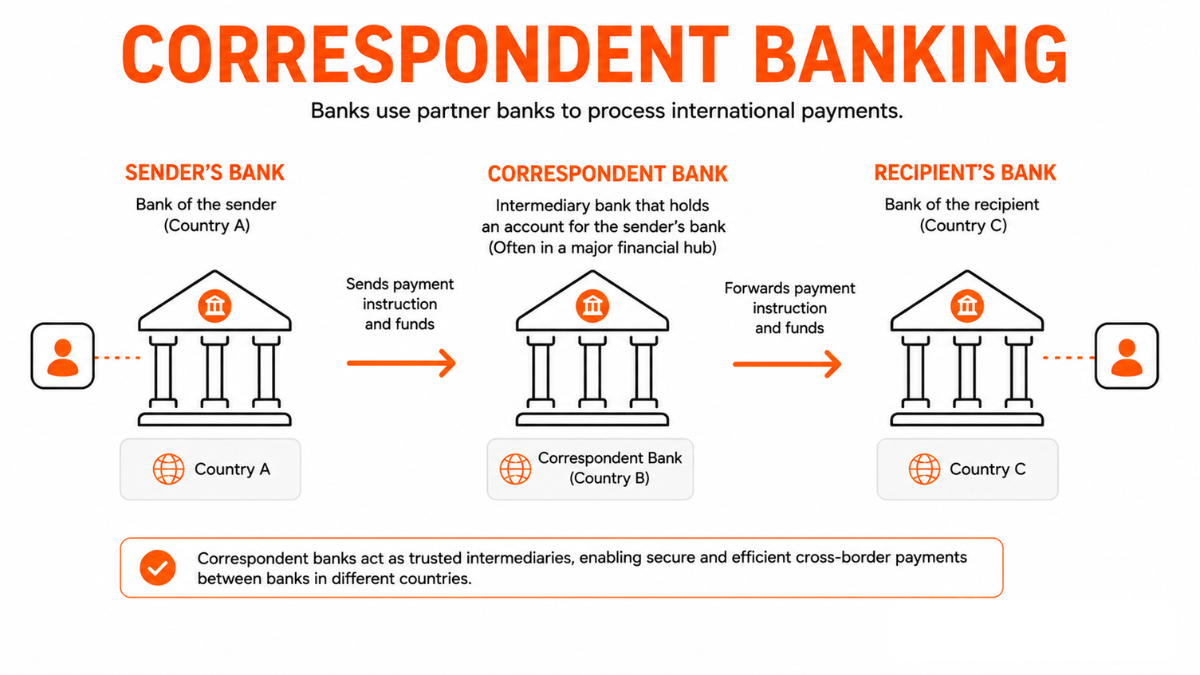
How the Correspondent Banking System Works
Correspondent banking is the mechanism by which banks without direct bilateral relationships settle cross-border payments through a chain of intermediary banks that do have such relationships. When a payment needs to travel from Bank A in Lithuania to Bank B in Singapore, it typically routes through correspondent banks that each maintain nostro accounts (accounts held at foreign banks, denominated in the foreign currency) and vostro accounts (accounts held by foreign banks, denominated in the domestic currency) with each other.
The bank initiating the payment sends a SWIFT message to its correspondent bank, which forwards it along the chain to the next correspondent, and ultimately to the recipient's bank. Each bank in the chain processes the instruction, deducts any fees, and forwards the remaining amount. This is why international wire transfers take 2–5 business days and lose value to correspondent bank deductions — the payment is literally being processed by multiple separate institutions in sequence, each with their own operational timelines and fee structures.
Why Correspondent Banking Is Structurally Challenging for Crypto Gateways
Crypto payment gateways face three specific structural challenges in accessing correspondent banking for fiat settlement. First, banks perceive crypto businesses as inherently higher compliance risk, requiring enhanced due diligence that is costly for the bank relative to the revenue a single crypto gateway account generates — leading to account terminations even for compliant businesses (de-risking). Second, crypto payment gateways need banking access not just in their home country but in every country where they settle merchant funds in local currency — a multi-jurisdictional banking requirement that multiplies the relationship complexity.
Third, correspondent banks — the large international banks that provide settlement services to smaller regional banks — have been particularly aggressive in restricting their services to crypto-exposed correspondents. When a regional bank loses its correspondent banking relationship because a correspondent objects to the crypto clients in the regional bank's portfolio, that regional bank may in turn terminate its crypto clients to protect its correspondent relationship. This cascade effect means that even a well-regulated, compliant crypto gateway can lose banking access indirectly because of decisions made three steps removed in the correspondent chain.
The Nostro/Vostro Account Structure and Settlement
Understanding nostro and vostro accounts helps explain both why correspondent banking works and why it is slow. Bank A maintains a nostro account (Latin: 'our account held at your bank') at Correspondent Bank C in a foreign currency. When Bank A's customer sends a cross-border payment, Bank A funds the transaction from its nostro account balance at Correspondent C, which processes the payment in the destination country. Bank A must pre-fund its nostro accounts with sufficient foreign currency to cover expected payment flows — this pre-funding represents trapped working capital that earns no yield.
The pre-funding requirement is one of the hidden costs of correspondent banking: a gateway that uses SWIFT for multi-currency merchant settlements must maintain adequate pre-funded balances in nostro accounts across multiple currencies and correspondent banks. The management of these balances — ensuring sufficient liquidity without tying up excessive capital — is a treasury management function that adds operational overhead for any business conducting significant cross-border settlement volumes.
Stablecoin Settlement as a Correspondent Banking Alternative
For cross-border merchant settlements where the recipient is willing to accept stablecoin rather than fiat, the entire correspondent banking chain is bypassed. A USDC transfer on Solana from a gateway's settlement wallet to a merchant's wallet in any country completes in under a second with no correspondent bank involvement, no pre-funded nostro accounts, and no per-transfer fees beyond the negligible Solana network fee. The merchant then converts USDC to local fiat through a local off-ramp if needed.
This is precisely why stablecoin settlement is gaining traction for cross-border B2B payments: it eliminates the efficiency and cost problems of correspondent banking entirely for the crypto-to-recipient leg of the payment. The gateway still needs banking for its own fiat operations (receiving funds from customers who pay by bank transfer, paying its own suppliers in fiat), but the settlement function — delivering value to merchants — can operate without correspondent banking intermediaries.
Compliance Note: This glossary entry is provided for general educational purposes only and does not constitute financial, investment, legal, or tax advice. Industry terminology may vary across jurisdictions and providers; definitions herein may not directly reflect the specific features, terms, or specifications of Finassets' services. For details on Finassets' offerings, please refer to official product documentation or contact our team directly.