

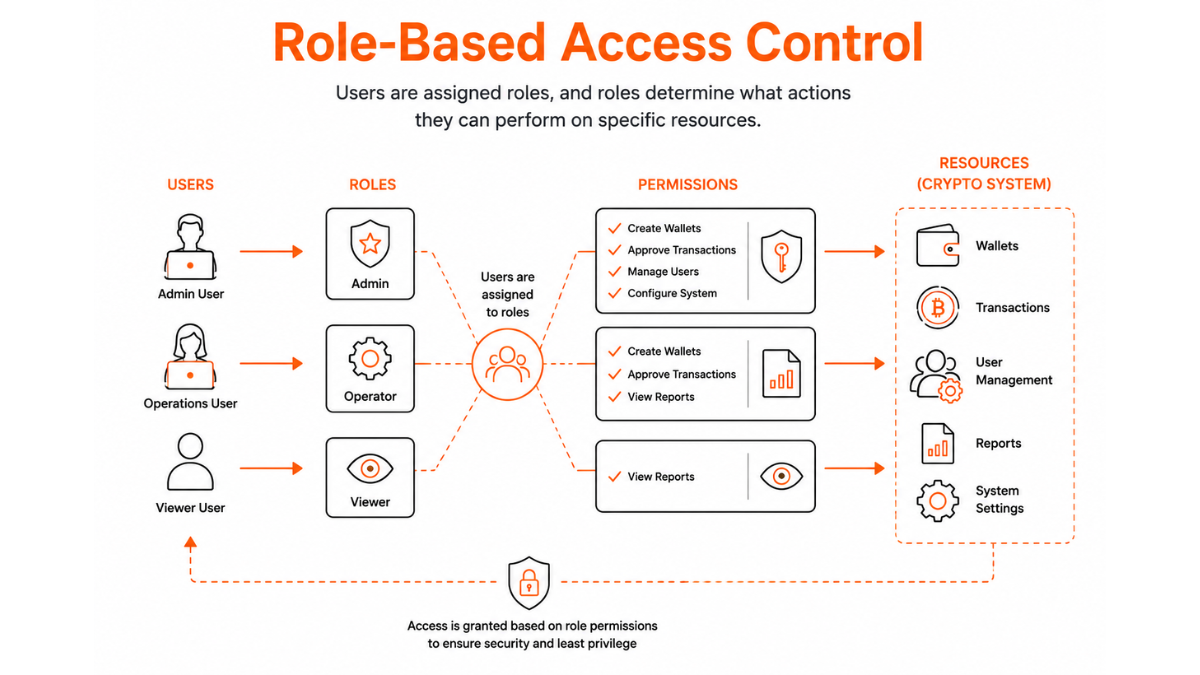
RBAC Concepts Applied to Crypto Gateway Access
Role-Based Access Control is a security model where permissions are not assigned directly to individual users but to roles, and users are assigned to roles. This indirection simplifies access management at scale: when a new team member joins the finance team, they are assigned the 'Finance' role and automatically inherit all finance permissions — rather than requiring an administrator to manually grant each permission individually. When a permission needs to change (for example, removing the ability to initiate large settlements from the standard Finance role), the change applies automatically to all users in that role.
In a crypto payment gateway context, RBAC must address a more sensitive access control problem than most business software: gateway accounts control real money, and overly permissive access directly enables financial loss. The principle of least privilege — granting each user only the minimum permissions necessary for their legitimate work — is not merely a best practice but a regulatory requirement under MiCA and a condition of most institutional audit frameworks.
Standard Role Framework for a Crypto Gateway
|
Role |
Dashboard Access |
API Operations |
Financial Operations |
Compliance Access |
|
Read-Only / Viewer |
View transactions and reports; no actions |
API read access (transaction status, balances) |
None |
View only — no document upload/download |
|
Merchant Operator |
View + create invoices + manage payment links |
Create invoices; cancel invoices; webhook config |
None |
None |
|
Finance Manager |
View + reports + export |
Read-only reporting API |
View and configure settlements; payout schedule; no fund initiation |
None |
|
Treasury / Payout Officer |
View + reports |
Payout API (with limits) |
Initiate settlements and payouts within defined limits; multisig participant |
None |
|
Compliance Officer |
View all transactions and customer data |
Read-only compliance data API |
None |
Full — KYB review; SAR workflow; risk tier management |
|
Administrator |
Full access |
Full API access including key management |
Full — including large payout approval |
Full |
Separation of Duties — Why Role Boundaries Matter
Separation of duties is a financial control principle that prevents any single individual from having sufficient authority to commit and conceal a fraud. In a payment gateway context, the critical separation is between transaction initiation and transaction approval: the person who creates a payout request should not be the same person who approves it for execution. Similarly, the person who adds a wallet address to the whitelist should not also have the authority to initiate payouts to that address without a separate approval.
RBAC enables separation of duties by ensuring that no single role combines initiation and approval authority for high-value operations. A well-designed gateway role framework requires a Treasury Officer role (which can propose payouts) and a separate Administrator or CFO approval role (which can authorise them) for amounts above defined thresholds. This two-person rule for significant financial operations is a standard internal control requirement in regulated financial institutions and increasingly expected in crypto gateway compliance assessments.
RBAC and Regulatory Compliance Requirements
MiCA requires CASPs to implement 'sound governance arrangements', which regulators interpret to include documented access control policies, role-based permissions, and evidence that segregation of duties is enforced in practice. A CASP's authorization assessment by a national competent authority will examine whether the organisation has a documented RBAC policy, whether that policy is implemented in the technology systems, and whether access reviews are conducted periodically to remove access for departed employees and correct inappropriate permissions.
Annual access reviews — where each user's role assignments are reviewed by an administrator and approved by a manager — are a standard control. Reviews should document: who has what roles, when those roles were last confirmed as appropriate, whether any user has roles that create segregation of duties conflicts, and whether departed employees have been promptly de-provisioned. These records are subject to review during regulatory inspections and should be retained for the standard five-year compliance record period.
Audit Logging Connected to RBAC
The value of RBAC is multiplied when every role-based action generates an immutable audit log entry. When a user creates an invoice, changes a settlement setting, adds a whitelist address, or approves a payout, the audit log should record: the specific user (not just the role), the timestamp, the action taken, the parameters of the action (amount, address, setting value), the IP address from which the action was taken, and the outcome (successful or rejected). This per-user attribution is only possible when individual users have personal credentials and are not sharing accounts — another reason why role-based, individually assigned access is both a security and an audit requirement.
Compliance Note: This glossary entry is provided for general educational purposes only and does not constitute financial, investment, legal, or tax advice. Industry terminology may vary across jurisdictions and providers; definitions herein may not directly reflect the specific features, terms, or specifications of Finassets' services. For details on Finassets' offerings, please refer to official product documentation or contact our team directly.