

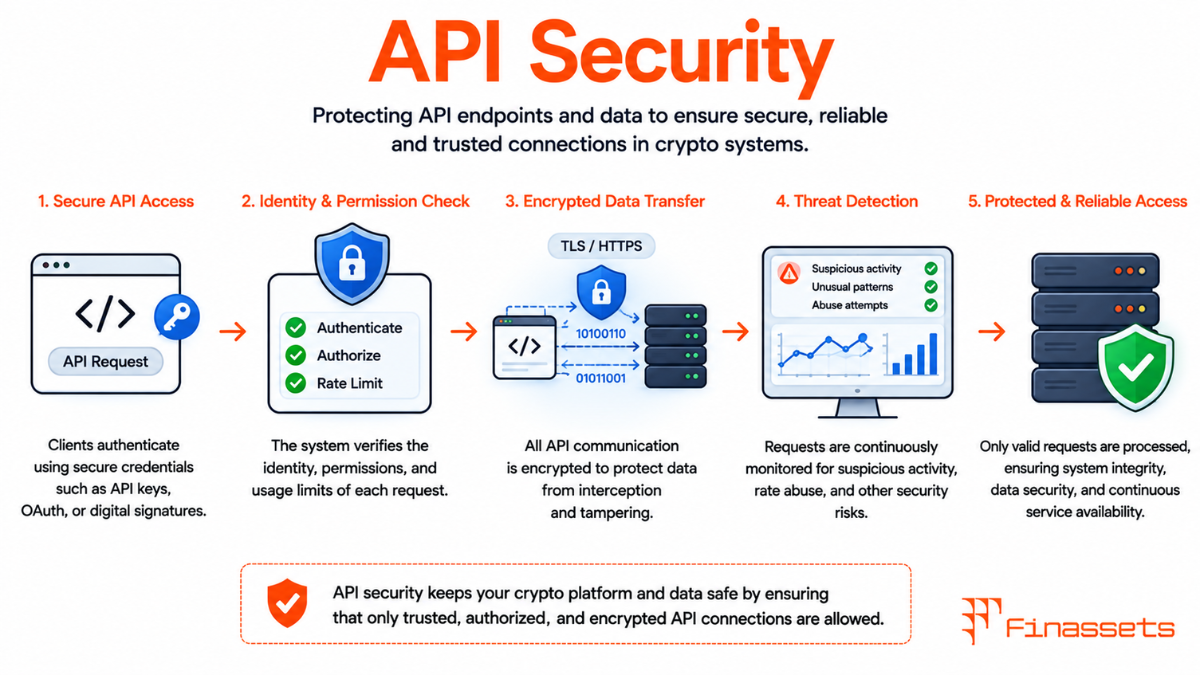
Authentication Mechanisms for Crypto Payment APIs
API authentication verifies that the caller is who they claim to be. Crypto payment gateways commonly use one of three approaches, each with different security properties:
● API key + secret: The merchant is issued a unique key ID and a corresponding secret. The key ID identifies the merchant, and the secret is used to sign requests or is passed as a bearer token. Simple to implement but vulnerable if the secret is ever transmitted in plaintext or logged. The secret must be stored securely server-side — never in client-side code or version control.
● HMAC request signing: Instead of sending the secret directly, the merchant uses the secret to compute an HMAC of the request payload and timestamp, sending only the HMAC in the request header. The gateway recomputes the HMAC and compares. This approach ensures the secret is never transmitted and that requests cannot be replayed (timestamp prevents reuse).
● OAuth 2.0: The merchant obtains a short-lived access token by authenticating with the gateway, then uses the token for subsequent requests. More complex to implement but provides token expiry, scope restrictions, and revocation capabilities that static API keys lack.
HMAC Request Signing — Implementation Details
HMAC-based request signing requires agreement on what data is included in the signature: typically the HTTP method, request path, query string, request body, and a timestamp or nonce. The signing formula is: HMAC-SHA256(secret, method + '\n' + path + '\n' + body + '\n' + timestamp). The resulting hex digest is included in a request header. The gateway performs the same computation using the stored secret and rejects any request where the computed HMAC does not match the received one.
The timestamp prevents replay attacks: a request signed at 14:00:00 that is captured and replayed at 14:05:00 will fail if the gateway rejects timestamps older than 5 minutes. The gateway should also maintain a short-lived nonce cache to reject duplicate requests with the same timestamp, preventing attacks that replay requests within the validity window.
TLS Requirements and Certificate Management
All crypto payment API communications must use TLS 1.2 or higher — TLS 1.0 and 1.1 are deprecated and vulnerable to known attacks. TLS provides encryption in transit (preventing interception of credentials and payload data) and server authentication (preventing man-in-the-middle attacks where a malicious server impersonates the gateway). Merchants integrating with payment APIs should validate TLS certificates strictly — disabling certificate validation for development convenience is a common mistake that sometimes persists into production.
Gateways should use TLS certificates from trusted Certificate Authorities and implement HTTP Strict Transport Security (HSTS) to prevent SSL stripping attacks. Certificate pinning — where the client refuses to connect unless the server presents a specific certificate or public key — provides an additional layer of protection for mobile integrations but requires a certificate rotation plan to avoid locking out legitimate updates.
Rate Limiting and Abuse Prevention
Payment APIs are targets for credential stuffing, brute-force enumeration, and abuse that generates fraudulent invoices or triggers excessive notification traffic. Rate limiting restricts the number of requests a client can make within a time window, protecting both security and infrastructure stability. Effective rate limiting strategies for payment APIs include:
● Per-key rate limits: Each API key has its own request quota, preventing a single key's abuse from affecting other merchants.
● Endpoint-specific limits: Invoice creation (a resource-intensive operation) is limited more strictly than status polling (lightweight reads).
● Progressive throttling: After a rate limit is exceeded, subsequent requests receive 429 responses with a Retry-After header indicating when requests will be accepted again.
● Anomaly detection: Sudden spikes in invoice creation volume, requests from new IP addresses, or unusual endpoint access patterns trigger alerts regardless of whether they hit rate limits.
Compliance Note: This glossary entry is provided for general educational purposes only and does not constitute financial, investment, legal, or tax advice. Industry terminology may vary across jurisdictions and providers; definitions herein may not directly reflect the specific features, terms, or specifications of Finassets' services. For details on Finassets' offerings, please refer to official product documentation or contact our team directly.