

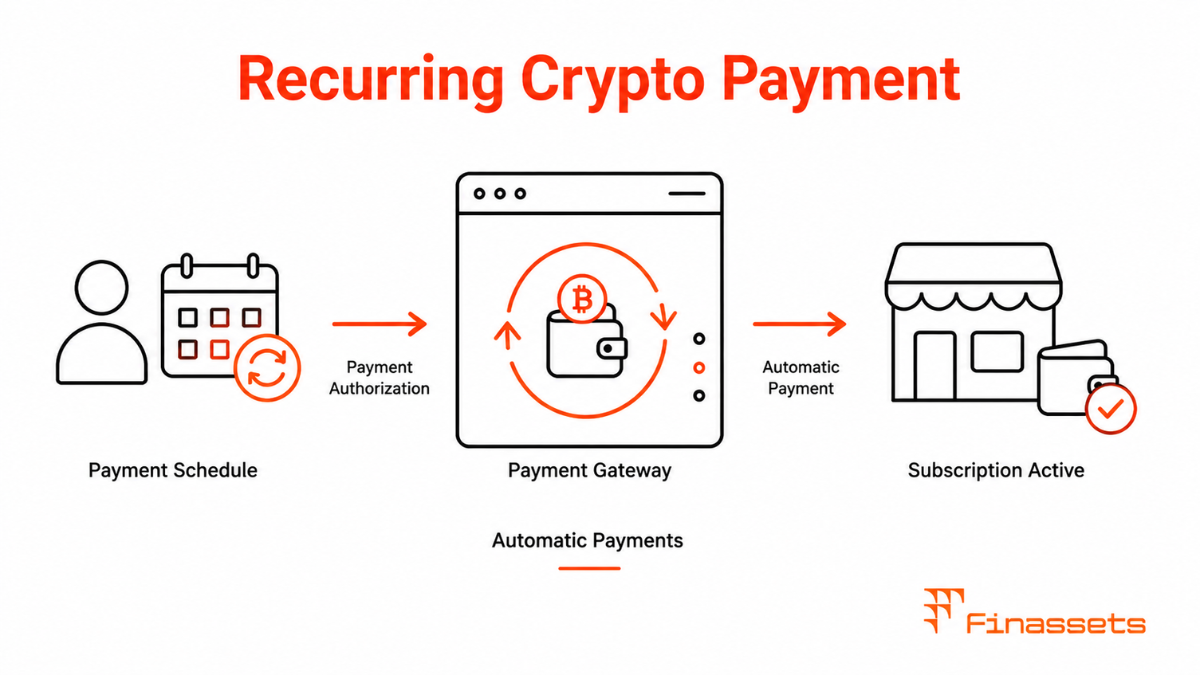
The Push vs. Pull Distinction — Why Crypto Recurring Billing Is Different
In traditional card payments, recurring billing is a pull payment: the merchant (or their payment processor) initiates each charge by sending a tokenised payment credential to the card network, which pulls funds from the cardholder's account. The cardholder does not need to take any action for each billing cycle after the initial setup. This convenience is what makes monthly subscriptions so commercially effective — customer inertia works in the merchant's favour.
Crypto is fundamentally push-only. No entity — not the merchant, not the gateway, not any smart contract — can extract cryptocurrency from a user's wallet without an action authorised by the wallet owner's private key. The user must actively initiate every crypto payment. This architectural difference is not a flaw but a feature of crypto's trustless design: removing the ability to pull funds prevents unauthorised charges and removes the need for the consumer protection mechanisms (chargebacks) that exist precisely because pull payments can be abused.
Approaches to Enable Recurring Payments in Crypto
Despite the push-only constraint, several technical approaches create a functional recurring payment experience:
● Gateway-managed invoice reminders: The gateway generates a new invoice for each billing cycle and the merchant sends the customer an email or notification with a payment link. The customer must manually approve each payment. Simple to implement, but requires active customer participation every cycle — churn from non-payment is higher than card-based subscriptions.
● Smart contract streaming (ERC-20 stream): Protocols like Superfluid and Sablier allow users to authorise a continuous token stream at a defined rate per second — the functional equivalent of a standing order. Once set up, the stream runs automatically until the user cancels or the balance runs out. This enables per-second salary payments, real-time subscription models, and programmable recurring revenue without per-payment action by the customer.
● Account abstraction (ERC-4337): Smart contract wallets using ERC-4337 can define custom transaction validation logic, including pre-authorised recurring payments to specific addresses up to defined amounts. Once the user sets up the rule in their smart contract wallet, payments execute automatically without requiring a signature for each cycle.
● Crypto-to-card bridge: The user tops up a prepaid crypto card or maintains a crypto balance at an exchange that issues a card, and the merchant charges the card on its normal recurring basis. The user experiences a pull-payment subscription; the gateway settles via card rails; crypto is the funding source.
Currency Choice for Recurring Payments
The currency denomination of a recurring crypto invoice significantly affects both the merchant's revenue predictability and the customer's payment experience. If a monthly subscription is priced as '0.001 BTC', the customer pays a fixed amount of Bitcoin — but the USD or EUR value fluctuates. If the subscription is priced as '$50 in USDC', the customer pays a fluctuating amount of USDC (depending on USDC/USD rate, which is nearly constant) but effectively pays a stable dollar amount. If priced as '$50 worth of Bitcoin at payment time', the customer pays a freshly calculated BTC amount each cycle.
For most subscription businesses, stablecoin-denominated recurring invoices (USDC or USDT at a fixed dollar amount per cycle) provide the closest analog to traditional subscription economics — predictable revenue for the merchant, predictable cost for the customer — without requiring either party to manage crypto price exposure within the billing relationship.
Compliance Note: This glossary entry is provided for general educational purposes only and does not constitute financial, investment, legal, or tax advice. Industry terminology may vary across jurisdictions and providers; definitions herein may not directly reflect the specific features, terms, or specifications of Finassets' services. For details on Finassets' offerings, please refer to official product documentation or contact our team directly.