

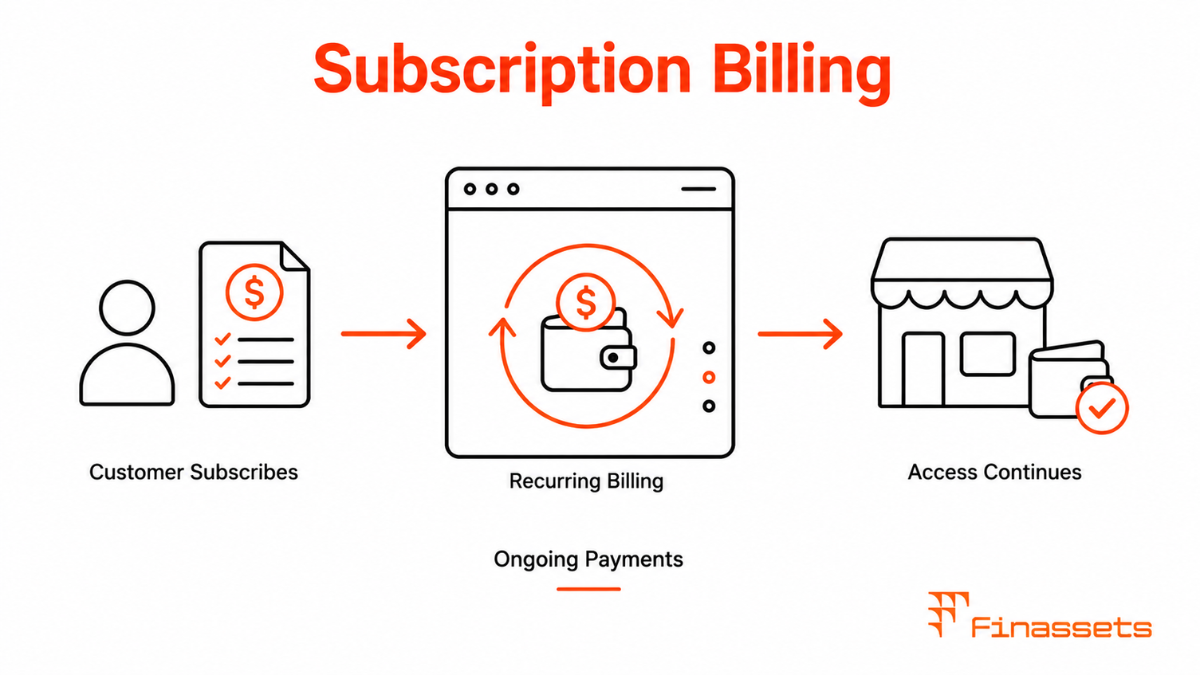
Building a Crypto Subscription Billing Workflow
A functional crypto subscription billing workflow requires solving four distinct problems: initial activation, recurring payment collection, failed payment recovery, and cancellation. Traditional subscription platforms (Stripe, Recurly) provide automated solutions for all four. In crypto, each must be designed explicitly because the infrastructure that handles them automatically in card billing does not exist at the protocol level.
A practical gateway-supported workflow for USDC monthly subscriptions operates as follows. At sign-up, the customer pays the first month's fee via a standard crypto invoice, activating the subscription. Fourteen days before the next billing date, the gateway generates a new invoice and the merchant's system sends the customer a payment reminder with the invoice link. The customer has 7 days to pay before the subscription is flagged as at-risk. If no payment is received by the due date, a grace period of 3–7 days gives the customer additional time before service suspension. Throughout the grace period, the merchant's system sends escalating reminders. If the grace period expires without payment, the subscription is suspended. The customer can reactivate by paying the outstanding amount through a new invoice.
Smart Contract Streaming as a Subscription Mechanism
Token streaming protocols allow a different model entirely. Instead of monthly invoice-and-pay cycles, the customer opens a payment stream that continuously transfers USDC to the merchant's address at a constant rate — for example, $50/month translates to approximately 0.0000019 USDC per second. The merchant's balance grows in real time; the customer's authorised stream balance depletes at the same rate. If the customer's stream balance runs low, the merchant's service can proactively notify them before the stream runs dry.
This model has appealing properties: revenue is genuinely continuous rather than lumpy monthly receipts; cancellation is immediate (the customer stops the stream) rather than involving a billing cycle dispute; and partial month prorations are handled automatically by the time-based rate calculation. The primary limitation is that streaming requires customers to use ERC-4337 smart contract wallets or streaming-compatible applications — not yet mainstream wallet infrastructure, though adoption is growing rapidly in DeFi-native markets.
Failed Payment Recovery in Crypto Subscriptions
Card subscription systems have sophisticated dunning — automated retry schedules, intelligent retry timing based on card network data, and account updater services that automatically fetch new card credentials when a card is replaced. None of these exist in crypto. Failed crypto subscription payments fail for one reason: the customer did not send the payment. There is no technical reason (insufficient funds at the gateway level, card expiry, network decline) — the customer simply did not act.
Effective crypto subscription dunning relies on communication rather than technical retry: email sequences, push notifications, in-app messaging, and SMS at increasing urgency levels. Merchants should communicate the payment link directly in each notification rather than asking customers to 'log in to pay' — reducing friction at the payment step reduces non-payment. Some gateways support embeddable payment widgets that can be served directly within the merchant's app, so the customer can complete payment without switching context to an external page.
Compliance Note: This glossary entry is provided for general educational purposes only and does not constitute financial, investment, legal, or tax advice. Industry terminology may vary across jurisdictions and providers; definitions herein may not directly reflect the specific features, terms, or specifications of Finassets' services. For details on Finassets' offerings, please refer to official product documentation or contact our team directly.