

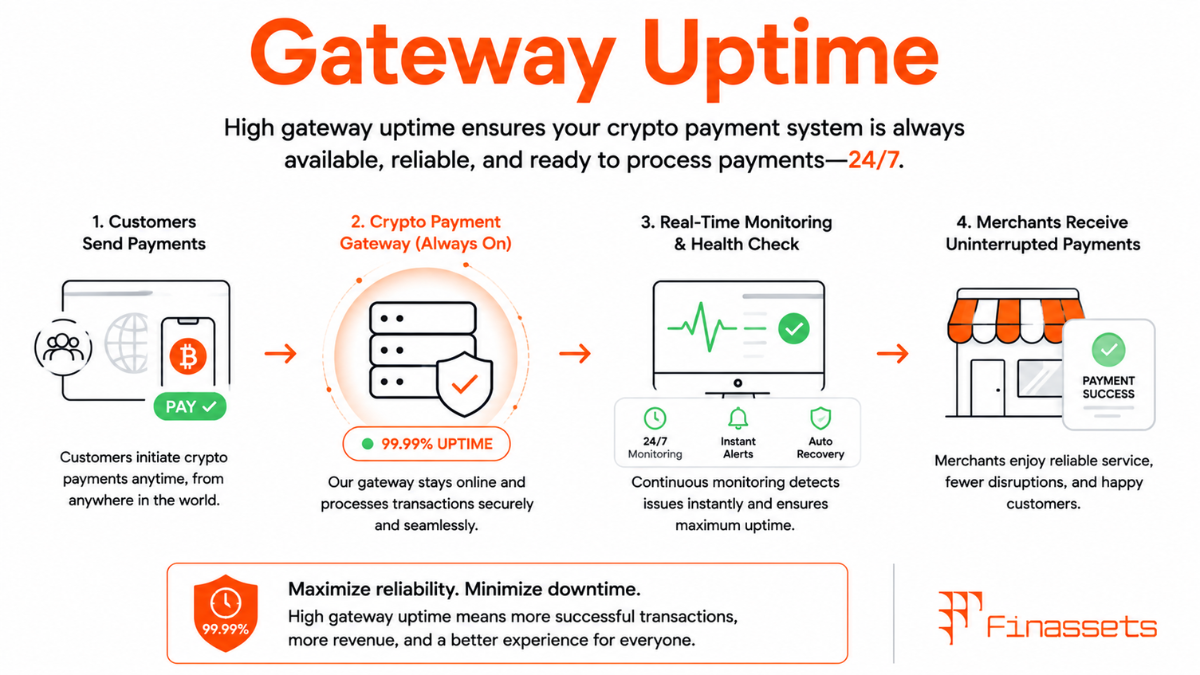
What Uptime Means in a Crypto Payment Context
Gateway uptime measures the availability of the crypto payment processing service — the ability to create invoices, detect incoming transactions, process confirmations, and deliver webhooks and settlements without interruption. An uptime of 99.9% translates to a maximum of approximately 8.7 hours of total downtime per year; 99.99% ('four nines') translates to approximately 52 minutes per year. The difference matters acutely for merchants whose businesses operate continuously: an e-commerce platform receiving orders from international customers has no business hours during which downtime is acceptable.
'Uptime' in practice is not a single metric but a composite of several service availability dimensions that can fail independently. The payment creation API may be available while the blockchain monitoring system experiences a delay in detecting incoming transactions. Webhook delivery may be disrupted while the gateway dashboard and status API remain accessible. Settlement processing may pause during a banking system maintenance window without affecting payment acceptance. Merchants evaluating gateway uptime should ask about per-component SLAs, not just the headline availability figure.
Gateway Infrastructure Failure Modes
|
Component |
Function |
Failure Impact |
Typical Redundancy |
|
Blockchain monitoring nodes |
Detect incoming payments |
Payments not detected; invoices expire |
Redundant nodes per chain; fallback node providers |
|
Invoice creation API |
Generate payment addresses and invoices |
Customers cannot be served at checkout |
Load-balanced API servers; multi-region deployment |
|
Webhook delivery system |
Notify merchant of payment events |
Order status not updated automatically |
Queue-based delivery with retry logic; dead-letter queues |
|
Settlement engine |
Convert and disburse merchant funds |
Settlement delayed; balances accumulate |
Scheduled redundancy; manual override capability |
|
Banking rails (SEPA/SWIFT) |
Deliver fiat to merchant accounts |
Settlement held at bank transfer stage |
Multiple banking partners; stablecoin settlement fallback |
|
Dashboard |
Merchant interface for reporting and management |
Operators cannot view activity |
Cached read views; separate availability from API |
SLA Terms and What Merchants Should Verify
A gateway's Service Level Agreement (SLA) defines the committed uptime level, how it is measured (typically as a percentage of minutes in a calendar month), exclusions (planned maintenance windows, force majeure events, external blockchain congestion), the process for claiming SLA credits when commitments are missed, and the remedies available (typically service credits as a percentage of monthly fees, rarely cash compensation).
Merchants should read SLA exclusion clauses carefully. An SLA that excludes 'network conditions outside the gateway's control' effectively excludes blockchain congestion, node synchronisation issues, and banking system outages from uptime calculations — circumstances that, while technically external, are precisely the conditions under which payment failures occur. An SLA that excludes scheduled maintenance but performs maintenance without advance notice functionally provides weaker guarantees than the headline percentage implies.
Protecting Merchants Against Gateway Downtime
No single gateway can guarantee zero downtime, and merchants processing payments at scale should build contingency arrangements. Practical resilience measures include: monitoring the gateway's public status page and subscribing to incident notification services; configuring order management systems to handle delayed webhook delivery gracefully (marking orders as 'payment processing' rather than failing them outright if the webhook does not arrive within the expected window); maintaining an account with a secondary gateway that can be switched to during extended outages; and ensuring that customers have a visible fallback payment option (card or alternative method) if the crypto checkout is unavailable.
Compliance Note: This glossary entry is provided for general educational purposes only and does not constitute financial, investment, legal, or tax advice. Industry terminology may vary across jurisdictions and providers; definitions herein may not directly reflect the specific features, terms, or specifications of Finassets' services. For details on Finassets' offerings, please refer to official product documentation or contact our team directly.