

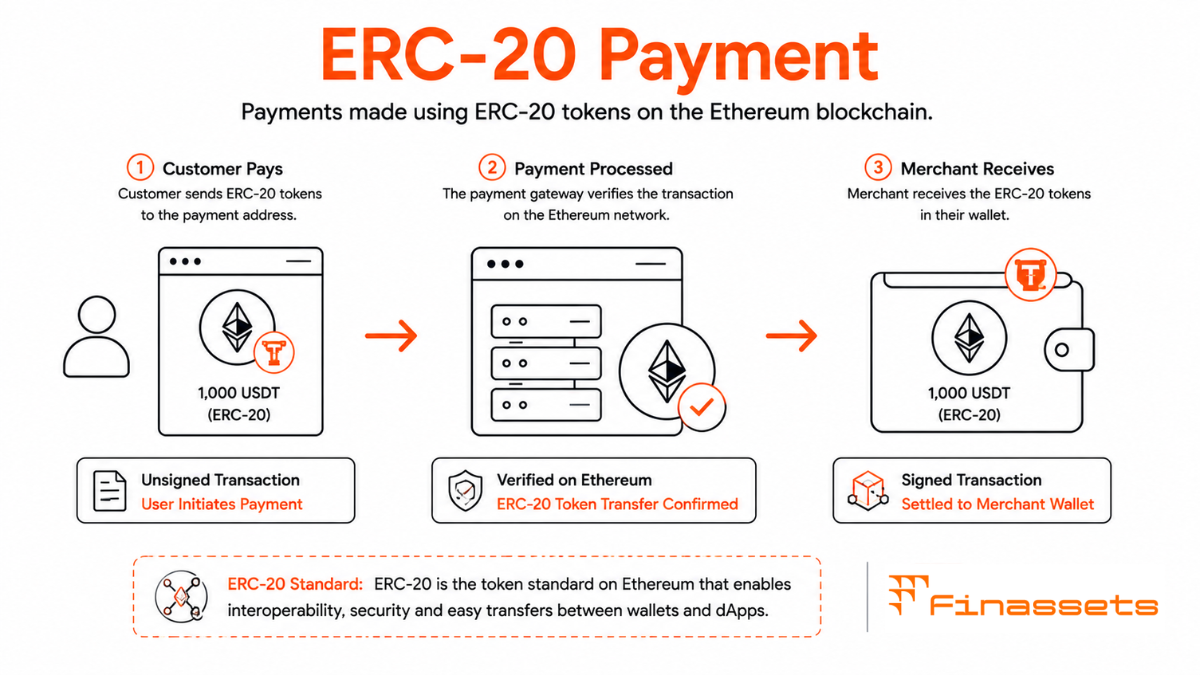
What the ERC-20 Standard Defines
ERC-20 (Ethereum Request for Comments 20) is a technical standard defining the interface that fungible tokens on the Ethereum blockchain must implement. The standard specifies six mandatory functions — totalSupply, balanceOf, transfer, transferFrom, approve, and allowance — that every ERC-20 token contract must expose, plus two events (Transfer and Approval) that must be emitted on relevant state changes. This uniformity means that any wallet, exchange, or smart contract written to interact with ERC-20 tokens can work with any ERC-20 token without custom code per token.
For payment gateways, ERC-20 uniformity means that a single integration monitoring Ethereum for incoming ERC-20 transfers can detect payments in USDT, USDC, DAI, LINK, UNI, and hundreds of other tokens simultaneously. The gateway reads the Transfer events emitted by each token contract, filters for transfers to its monitored payment addresses, and credits the appropriate merchant account with the received token amount.
ERC-20 vs. Native ETH Transfers — Key Technical Difference
A native ETH transfer moves Ether directly from one address to another as part of the transaction's value field — no smart contract invocation required. An ERC-20 token transfer works differently: it calls the token contract's transfer function, which updates an internal mapping of balances within the contract's storage. The token never physically moves between addresses in the same way ETH does — what changes is the record within the contract that says how much of that token each address is entitled to.
This distinction has practical implications for payment detection. A payment gateway monitoring for native ETH transfers watches for transactions where value > 0 arriving at its addresses. A gateway monitoring for ERC-20 token transfers watches for Transfer events emitted by token contracts, filtered to those where the 'to' address is one of the gateway's monitored addresses. The detection logic is more complex and requires active log filtering rather than simple transaction monitoring.
Gas Costs for ERC-20 Payments on Mainnet and Layer 2
|
Network |
Gas Cost for ERC-20 Transfer |
Typical Fee (USD) |
Confirmation Time |
|
Ethereum Mainnet |
~65,000 gas |
$1–$50 (volatile) |
~15 seconds to 5 min |
|
Polygon PoS |
~65,000 gas |
< $0.01 |
~2 seconds |
|
Arbitrum One |
~65,000 gas (L2) |
$0.10–$0.50 |
~0.3 seconds |
|
Optimism |
~65,000 gas (L2) |
$0.10–$0.50 |
~2 seconds |
|
Base |
~65,000 gas (L2) |
$0.05–$0.30 |
~2 seconds |
|
BNB Chain (BEP-20) |
~65,000 gas |
< $0.05 |
~3 seconds |
The same ERC-20 transfer that costs $10–$50 on Ethereum mainnet during high-demand periods costs under $0.05 on BNB Chain or Layer 2 networks, using an identical token contract structure. This fee differential is why USDT on Tron (which uses a TRC-20 equivalent, not ERC-20 but functionally similar) and USDC on Solana or Base have gained significant share as payment tokens — the underlying asset is the same or equivalent, but the transfer economics are dramatically different.
The Token Allowance Mechanism and Its Security Implications
ERC-20 includes an approval mechanism: a user can authorise a smart contract or wallet to spend up to a specified token amount on their behalf, using the approve function. This enables DeFi protocols and payment flows where a smart contract needs to pull tokens from a user's wallet. In a batch transfer scenario, a payer approves the payment gateway's batch contract to spend their USDC up to the total payout amount, then the contract's execute function transfers tokens to all recipients in a single transaction.
The allowance mechanism is a security consideration: granting unlimited approval (approve(address, type(uint256).max)) to a contract means that contract can transfer all of the user's tokens at any time until the approval is explicitly revoked. Gateways and merchants using ERC-20 approval flows should grant the minimum necessary approval amount and revoke approvals for unused contracts — a best practice that many users overlook but that limits the damage from compromised contracts.
Compliance Note: This glossary entry is provided for general educational purposes only and does not constitute financial, investment, legal, or tax advice. Industry terminology may vary across jurisdictions and providers; definitions herein may not directly reflect the specific features, terms, or specifications of Finassets' services. For details on Finassets' offerings, please refer to official product documentation or contact our team directly.