

Who Is a PEP — Categories and Family Members
Politically Exposed Persons are individuals who hold or have recently held prominent public functions, whose positions create an elevated risk of involvement in bribery, corruption, or the abuse of public funds. FATF Recommendation 12 and the EU AML Directive establish the categories that define PEP status:
● Heads of state and heads of government.
● Ministers and deputy or assistant ministers.
● Members of parliament and similar legislative bodies.
● Members of the governing bodies of political parties.
● Members of supreme courts, constitutional courts, or equivalent high-level judicial bodies.
● Members of courts of auditors and central bank governing boards.
● Ambassadors, chargés d'affaires, and high-ranking officers in the armed forces.
● Members of the administrative, management, or supervisory bodies of state-owned enterprises.
● Directors, deputy directors, and members of the board of international organisations.
PEP status extends to close family members (spouses, partners, children, parents, siblings) and known close associates (business partners, anyone known to jointly own assets or entities with a PEP). This extended definition is significant for gateway KYB: a beneficial owner who is the sister of a government minister is a PEP family member and triggers EDD obligations, even though she holds no public office herself.
Domestic vs. Foreign PEPs — Different Risk Profiles
FATF distinguishes between domestic PEPs (individuals holding public positions in the regulated entity's own country) and foreign PEPs (individuals holding public positions in other countries). EU AML law has historically applied mandatory EDD to foreign PEPs regardless of risk level but allowed a risk-based approach for domestic PEPs. The 5th AML Directive extended the automatic EDD requirement to domestic PEPs as well, removing the distinction.
In practice, foreign PEPs — particularly those from high-risk jurisdictions — carry higher corruption risk for two reasons. First, the ability to verify the individual's actual role, reputation, and conduct through independent sources is more limited for a public official in a distant jurisdiction than for a domestic official who appears in local court records, news archives, and official government publications. Second, the proceeds of corruption in some foreign jurisdictions are specifically channelled through international financial systems because domestic enforcement is weak.
Former PEPs and De-Listing Timelines
PEP status does not end the moment an individual leaves public office. FATF guidance and most national implementations require that former PEPs continue to be treated as PEPs for a period after leaving office — typically a minimum of one year, with many jurisdictions specifying 12–18 months, and some requiring risk-based assessment for longer periods depending on the nature of the role held.
The rationale is that the corruption risk of a public position does not immediately dissipate when the position ends. A former head of government who established financial relationships with private businesses during their term continues to present corruption risk shortly after leaving office. Only after a sufficient period during which no concerning information emerges, and where the former official's financial activities become more transparent through the passage of time, is it appropriate to apply standard rather than enhanced due diligence.
Automated PEP Screening in Gateway Workflows
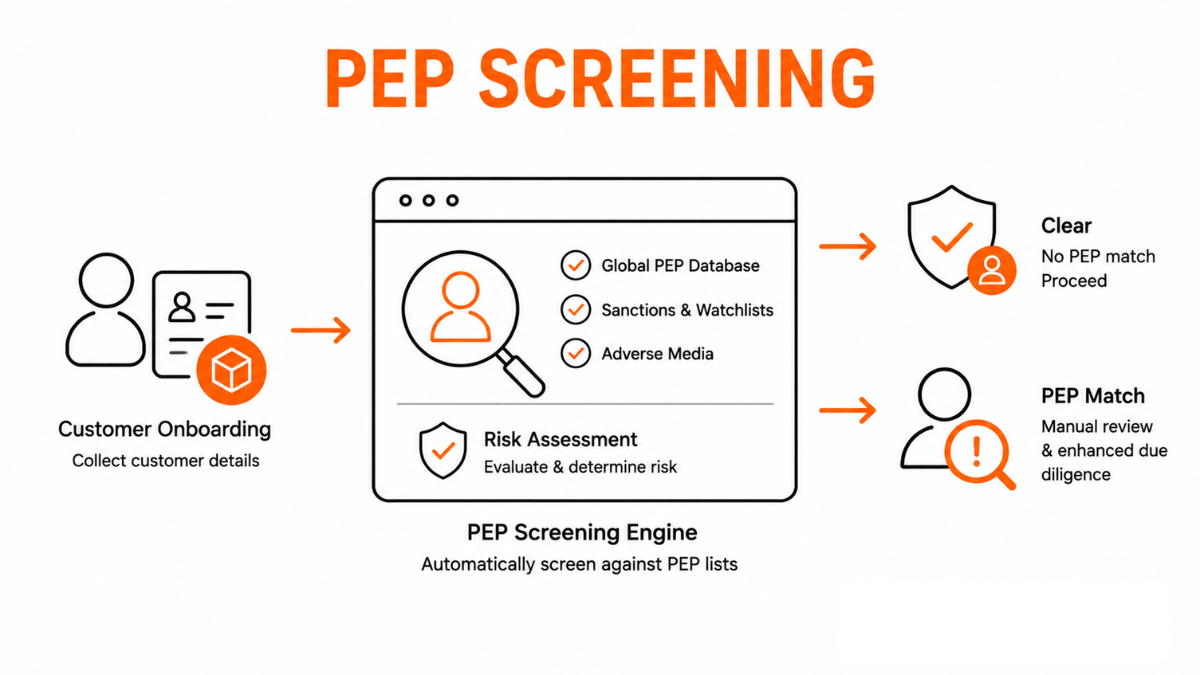
Manual PEP screening — checking a person's name against lists — is impractical at scale and vulnerable to name variation errors. A UBO named 'Ahmed Al-Rashidi' may appear in PEP databases as 'Ahmad Al-Rashdi', 'Ahmed Alrashidi', or in Arabic script. Automated screening systems use fuzzy matching algorithms that catch name variations, combined with date of birth, nationality, and address matching to reduce false positives from common names.
Commercial PEP database providers — Refinitiv World-Check, Dow Jones Risk & Compliance, Acuris, LexisNexis — maintain continuously updated PEP records sourced from official government publications, news sources, and structured intelligence. Gateways integrating automated PEP screening through these providers screen against databases that are updated daily or in real time, ensuring that newly appointed public officials are captured quickly. Screening should occur at initial onboarding and at periodic intervals, since a customer who was not a PEP at onboarding may become one if a family member is appointed to public office.
Compliance Note: This glossary entry is provided for general educational purposes only and does not constitute financial, investment, legal, or tax advice. Industry terminology may vary across jurisdictions and providers; definitions herein may not directly reflect the specific features, terms, or specifications of Finassets' services. For details on Finassets' offerings, please refer to official product documentation or contact our team directly.