

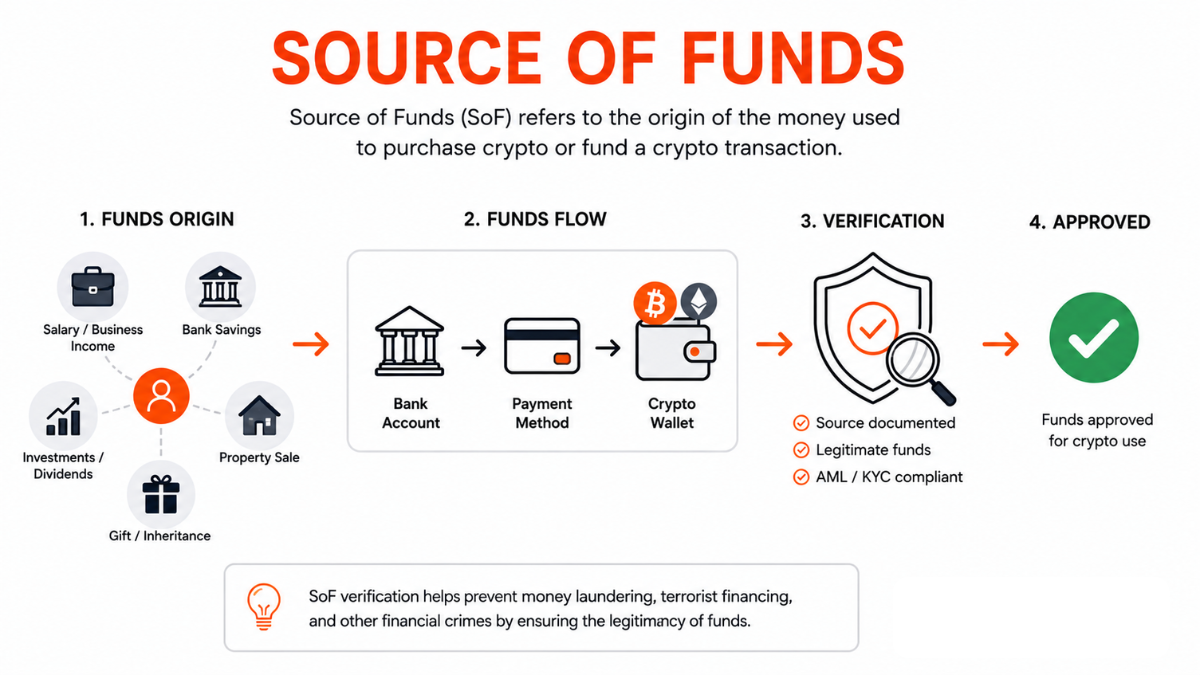
Source of Funds vs. Source of Wealth — A Critical Distinction
Source of funds (SoF) and source of wealth (SoW) are related but distinct compliance concepts that serve different purposes in AML due diligence. Source of funds identifies where the specific money used in a particular transaction or set of transactions came from — the immediate origin of the funds being transferred through the gateway. Source of wealth identifies how a person or business accumulated their overall financial resources — their lifetime wealth accumulation story.
In a gateway context, SoF is the primary and more operationally immediate requirement: when a merchant or customer transmits a large crypto payment, the gateway needs to understand what the immediate source of those specific funds is. SoW becomes relevant for high-risk customers, PEPs, or situations where the declared SoF is disproportionate to the customer's apparent financial profile — for example, a recently registered company claiming to have accumulated €5 million in crypto reserves.
When Source of Funds Verification Is Required
Source of funds verification is not a universal requirement for every gateway transaction — it would be operationally impossible to document the origin of every €50 payment. Rather, it is triggered by specific risk factors:
● Transaction amounts above defined thresholds: Most gateways set internal SoF request triggers for transactions above €10,000–€25,000, and FATF guidance highlights large cash or crypto transactions as high-risk.
● Customer risk tier: Merchants classified as higher-risk at onboarding may be subject to routine SoF documentation requirements for any transaction above a lower threshold.
● Unusual transaction patterns: A merchant whose payment volume suddenly spikes to 10x normal levels triggers a SoF review even if individual transactions are below the standard threshold.
● High-risk asset types: Payments involving privacy coins (Monero, Zcash), recently mixed funds detected by blockchain analytics, or funds with significant exposure to high-risk wallet clusters may trigger SoF requests.
● Jurisdiction flags: Transactions involving senders or recipients in high-risk jurisdictions typically require SoF documentation regardless of amount.
Crypto-Specific SoF Challenges
Verifying the source of cryptocurrency funds presents unique challenges that do not exist in fiat SoF verification. Blockchain analytics can trace the movement history of crypto funds through wallet clusters, providing objective evidence of where funds originated — whether from exchange withdrawals (suggesting legitimate purchase), mining rewards, DeFi yield, or more concerning sources like darknet markets or mixing services. This on-chain SoF information is not available for fiat transactions.
However, blockchain traceability cuts both ways. A customer claiming their USDT came from a legitimate crypto trading account on Binance can be cross-referenced against on-chain data — if the funds actually came from a wallet previously associated with a darknet market, blockchain analytics will reveal this even if the customer's stated SoF sounds plausible. Gateways with strong blockchain analytics integration can supplement — and in some cases replace — manual SoF documentation with on-chain evidence.
Acceptable SoF Documentation by Scenario
|
Funds Origin |
Primary Documentation |
Supporting Evidence |
|
Crypto purchased on exchange |
Exchange withdrawal record / trade history export |
Exchange account screenshot; bank transfer to exchange |
|
Mining rewards |
Mining pool payout records; wallet transaction history |
Mining hardware purchase evidence; electricity bills |
|
Business trading profits |
Business bank statements; payment processor reports |
Audited accounts; VAT returns |
|
Investment returns |
Broker statement; exchange trade history |
Purchase records showing original investment |
|
Property sale proceeds |
Completion statement; solicitor confirmation |
Land registry; mortgage discharge |
|
Inheritance |
Probate documents; solicitor letter |
Estate valuation; bank transfer records |
Compliance Note: This glossary entry is provided for general educational purposes only and does not constitute financial, investment, legal, or tax advice. Industry terminology may vary across jurisdictions and providers; definitions herein may not directly reflect the specific features, terms, or specifications of Finassets' services. For details on Finassets' offerings, please refer to official product documentation or contact our team directly.