

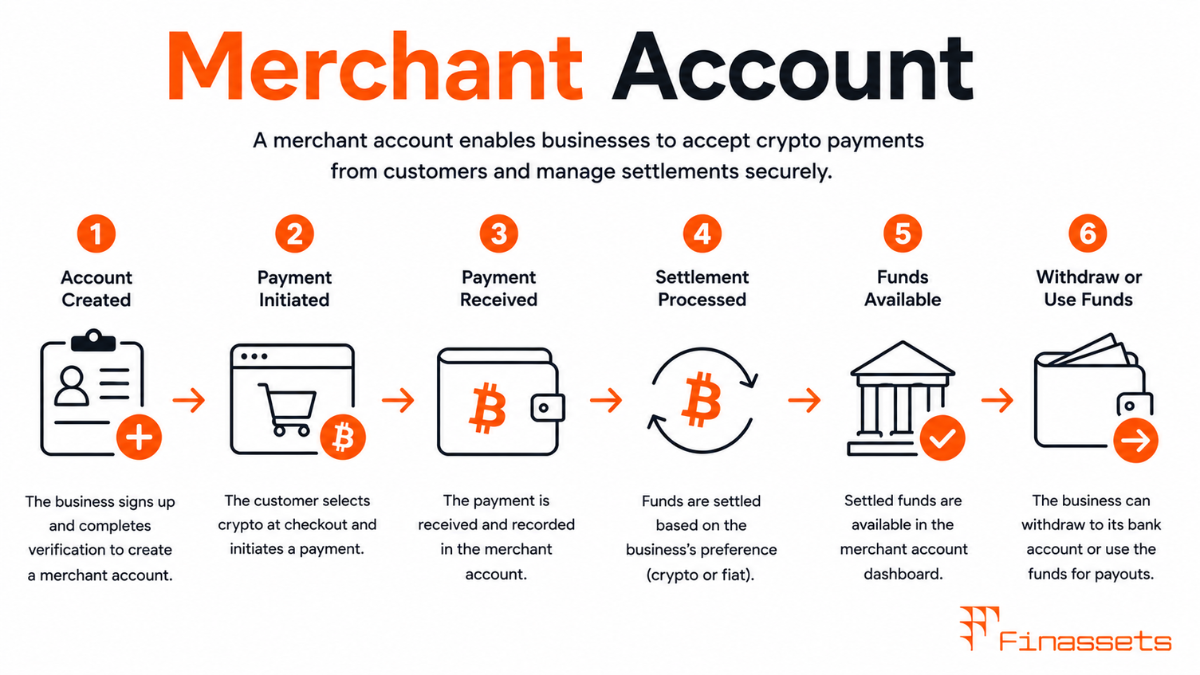
How a Crypto Merchant Account Differs From a Traditional Merchant Account
A traditional merchant account is a contractual relationship between a business and an acquiring bank, enabling the business to accept card payments. The acquiring bank holds a reserve, processes chargebacks, and remits settlement to the business minus fees. The entire arrangement is bank-centric: the merchant's ability to accept payments depends on maintaining an account in good standing with a regulated financial institution.
A crypto merchant account is established directly with a licensed payment gateway — not a bank. There is no acquiring bank in the chain. Settlement does not flow through card networks. Chargeback risk does not exist. The gateway holds the crypto received on the merchant's behalf, converts it according to the merchant's settlement configuration, and transfers the proceeds through banking rails (SEPA or SWIFT) or on-chain. The merchant's relationship is with the gateway, and the gateway's relationship with banks is transparent to the merchant.
What a Crypto Merchant Account Includes
A fully configured crypto merchant account typically provides:
● Dashboard access for real-time transaction monitoring, reporting, and settlement management.
● API credentials — a public key and secret — for programmatic integration with the merchant's platform.
● Webhook endpoint configuration for automated payment event notifications.
● Settlement settings — currency preference, payout schedule, auto-conversion ratios.
● Supported cryptocurrency selection — which assets the merchant is willing to accept.
● Compliance documents — KYB approval records, accepted use policy, service agreement.
● Volume and per-transaction limits defined by the merchant's risk category.
● Refund functionality — ability to initiate crypto refunds directly from the dashboard or API.
Account Tiers and Processing Limits
Most crypto payment gateways structure merchant accounts in tiers based on KYB depth and transaction history. A basic tier account — for example, a business with a simple ownership structure and a clearly verifiable website — might have a €10,000 monthly processing limit. A higher tier, requiring additional documentation such as audited accounts or a source-of-funds declaration, might allow €100,000 or more per month.
Merchants who anticipate high transaction volumes should discuss limit expansion during the onboarding process rather than after hitting a limit in production. Processing limits that are reached unexpectedly can cause payment failures for customers, particularly for merchants with seasonal volume spikes. The document requirements for limit increases — and the timeline for processing them — vary significantly between gateway providers.
Multi-Currency Merchant Accounts
Some gateways support a single merchant account that can receive payments in multiple cryptocurrencies and settle in multiple fiat currencies simultaneously. For example, a merchant might accept Bitcoin, Ethereum, and USDT from customers and settle a portion in EUR via SEPA and another portion in USD via wire, with different settlement schedules for each currency pair.
This multi-currency capability is particularly valuable for businesses with international customer bases and multi-currency cost structures — a company paying salaries in EUR but suppliers in USD can align its crypto settlement configuration with its natural currency exposures, reducing the need for additional FX conversion steps.
Compliance Note: This glossary entry is provided for general educational purposes only and does not constitute financial, investment, legal, or tax advice. Industry terminology may vary across jurisdictions and providers; definitions herein may not directly reflect the specific features, terms, or specifications of Finassets' services. For details on Finassets' offerings, please refer to official product documentation or contact our team directly.