

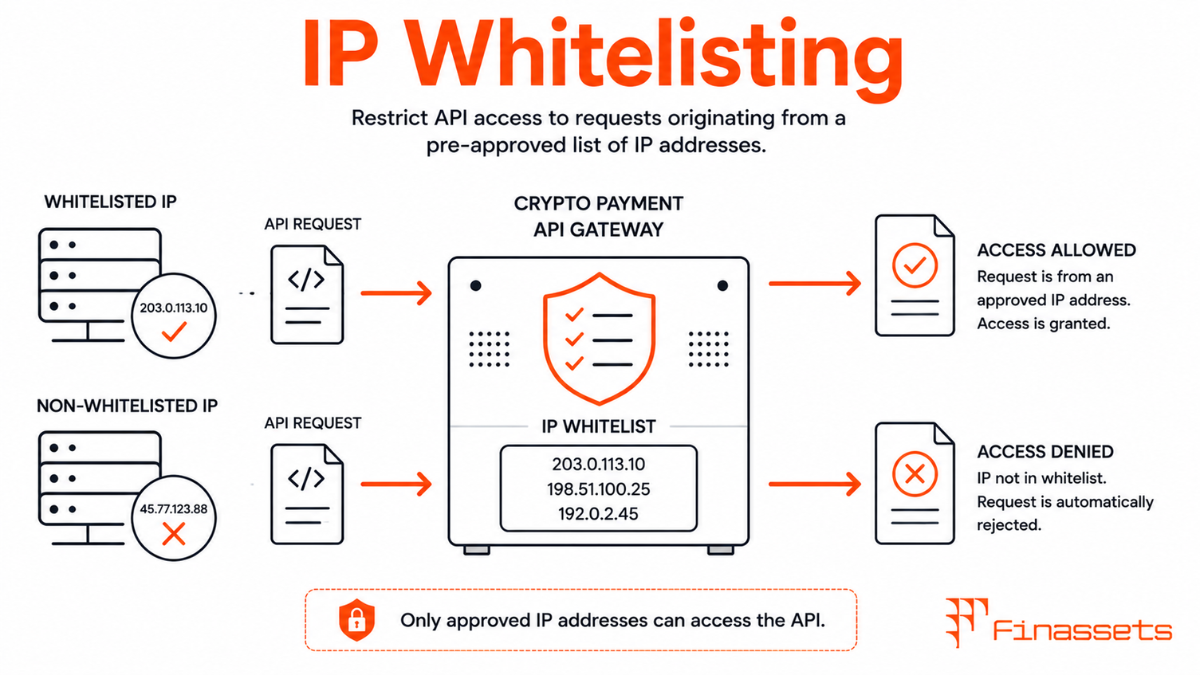
How IP Whitelisting Is Implemented
IP whitelisting in a payment gateway is configured at the API layer: when a merchant enables IP whitelisting in their account settings and enters one or more IP addresses or CIDR ranges, the gateway adds a firewall rule that allows API requests only from those addresses. Any request from a non-whitelisted IP — even if it carries valid API credentials — receives a 403 Forbidden response with no further processing.
The implementation is typically per-API-key rather than per-account: a merchant may whitelist their production servers for the primary API key while allowing their developers' office IP range for a separate read-only reporting key. This granularity prevents overly broad whitelists that might inadvertently allow access from development or staging environments to production payment endpoints.
When IP Whitelisting Effectively Protects and When It Does Not
IP whitelisting provides strong protection in a specific scenario: static-IP server-to-server integrations where the merchant's payment processing logic runs on identifiable, fixed-IP infrastructure. In this context, even a fully compromised API key cannot be exploited by an attacker on a different network because their requests will always originate from an IP not on the whitelist.
IP whitelisting is less effective — or practically unusable — in several common scenarios:
● Cloud compute with dynamic IPs: AWS EC2, Google Compute Engine, and Azure VM instances often have dynamic public IP addresses that change when instances are stopped and restarted. Merchants must manage Elastic IP allocation or NAT gateway configurations to ensure stable egress IPs for whitelisting.
● Serverless functions: AWS Lambda, Google Cloud Functions, and similar serverless platforms use shared IP address pools that may contain thousands of other tenants' functions. Whitelisting these IP ranges effectively disables the whitelist's protective value.
● Mobile or browser-based integrations: Requests that originate from customer devices cannot be IP-whitelisted because the IP addresses are unknown and constantly changing. For these integrations, scope restrictions and short-lived tokens are more appropriate controls.
IP Whitelisting in the Broader Security Architecture
IP whitelisting is most valuable as one layer within a defence-in-depth security architecture, not as the sole protection. A merchant who relies exclusively on IP whitelisting — without HMAC signing, key scoping, and rate limiting — has significant gaps even within their whitelisted IP range: a compromised server within the whitelisted range can still make arbitrary API calls. The correct design layers IP whitelisting on top of strong authentication and request signing, so that an attacker must simultaneously compromise both the credentials and the network position.
Many gateway security advisories recommend the combination: HMAC-signed requests (so credentials alone are insufficient) + IP whitelisting (so network position alone is insufficient) + key scoping (so access is limited to the minimum necessary permissions) + MFA on dashboard access (so account settings cannot be changed even if one layer is bypassed). This four-layer approach means an attacker needs to defeat multiple independent controls simultaneously.
Compliance Note: This glossary entry is provided for general educational purposes only and does not constitute financial, investment, legal, or tax advice. Industry terminology may vary across jurisdictions and providers; definitions herein may not directly reflect the specific features, terms, or specifications of Finassets' services. For details on Finassets' offerings, please refer to official product documentation or contact our team directly.