

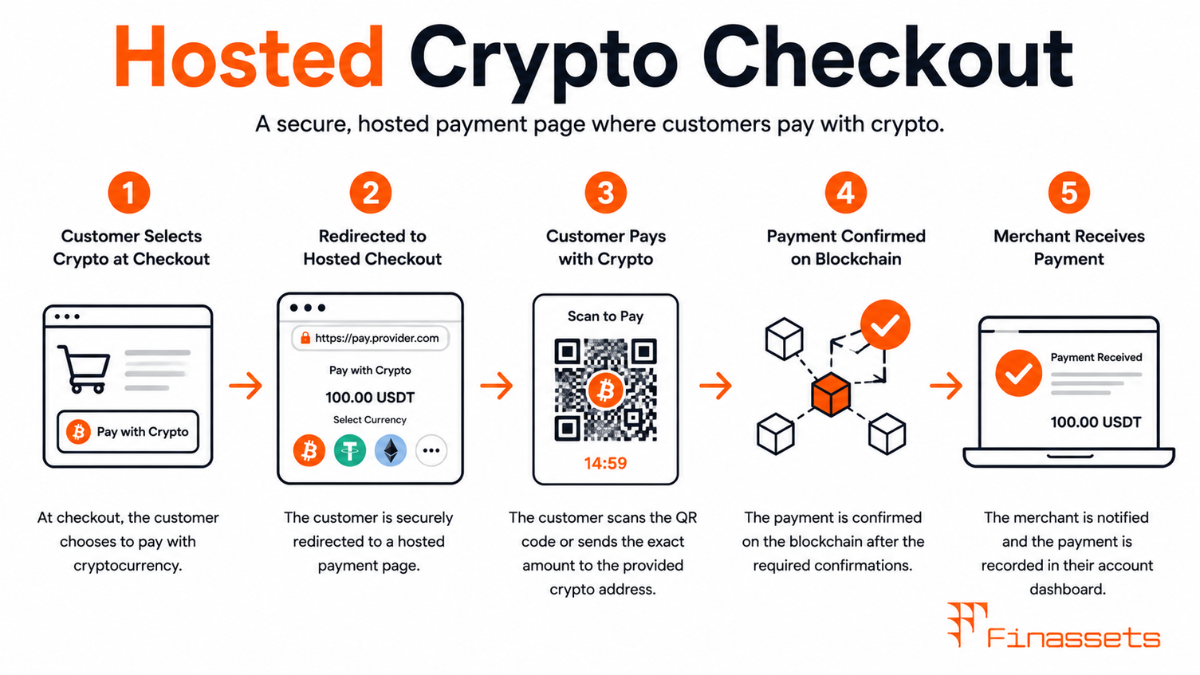
The Security Argument for Hosted Checkout
When a merchant embeds payment logic directly in their own website — whether a custom form or a widget that runs in their browser context — sensitive payment operations execute within the merchant's domain. If the merchant's site is compromised through a JavaScript injection attack, a supply chain attack on a third-party library, or a server breach, the payment flow is exposed. An attacker who can execute code in the merchant's page context can intercept payment data, redirect payment addresses, or tamper with amount displays.
Hosted crypto checkout removes payment logic from the merchant's environment entirely. The merchant's page redirects the customer to a payment URL on the gateway's own domain, over which the merchant has no control and into which no third-party script from the merchant's site is loaded. The gateway's domain is independently secured, monitored, and PCI-equivalent hardened. A compromise of the merchant's website cannot affect the hosted checkout page.
The Technical Flow of a Hosted Checkout Redirect
When a customer clicks 'Pay with Crypto' in a merchant's checkout, the merchant's server calls the gateway API to create a payment session and receives a hosted checkout URL in return. The merchant's server redirects the customer's browser to this URL. From the customer's perspective, they leave the merchant's domain and arrive on the gateway's payment page, where they see the order summary, crypto amount, QR code, payment address, and countdown timer.
Once the payment is confirmed, the gateway redirects the customer back to the merchant's success URL — a return_url specified by the merchant during checkout session creation. Simultaneously, the gateway sends a webhook to the merchant's callback URL to trigger order fulfillment. The two signals — the browser redirect and the webhook — are independent; merchants should fulfil the order based on the webhook, not the browser redirect, because browser redirects can be manipulated or never arrive if the customer closes the browser.
Customisation Within a Hosted Checkout
Hosted checkout pages are controlled by the gateway, but most professional gateways offer meaningful customisation within their template: merchant logo, brand colours, font selection, and custom domain (so the payment page appears at pay.merchantdomain.com rather than checkout.gatewaydomain.com). Some gateways offer white-label hosted checkout where the entire page carries the merchant's branding with no gateway attribution.
Customisation depth varies significantly between providers. Merchants with strong brand standards should evaluate hosted checkout customisation capabilities during gateway selection, particularly if they serve customers who may be sensitive to unexpected domain changes during checkout.
Customer Trust Signals on Hosted Pages
A hosted checkout redirect introduces a brief moment of trust uncertainty for the customer: they were on the merchant's site and are now on a different domain. Gateways address this through several trust signals: HTTPS with a valid TLS certificate clearly visible in the browser's address bar, the merchant's name and logo prominently displayed on the payment page, an order summary matching what the customer saw in the merchant's cart, and — for white-label setups — the merchant's own domain in the URL.
Despite these signals, some customers are uncomfortable completing payments on a domain they do not recognise. For merchants serving security-conscious audiences, an embedded checkout widget — which keeps the payment interface on the merchant's own domain — may produce higher conversion rates than a hosted redirect, at the cost of greater technical implementation effort and expanded security responsibility.
Compliance Note: This glossary entry is provided for general educational purposes only and does not constitute financial, investment, legal, or tax advice. Industry terminology may vary across jurisdictions and providers; definitions herein may not directly reflect the specific features, terms, or specifications of Finassets' services. For details on Finassets' offerings, please refer to official product documentation or contact our team directly.