

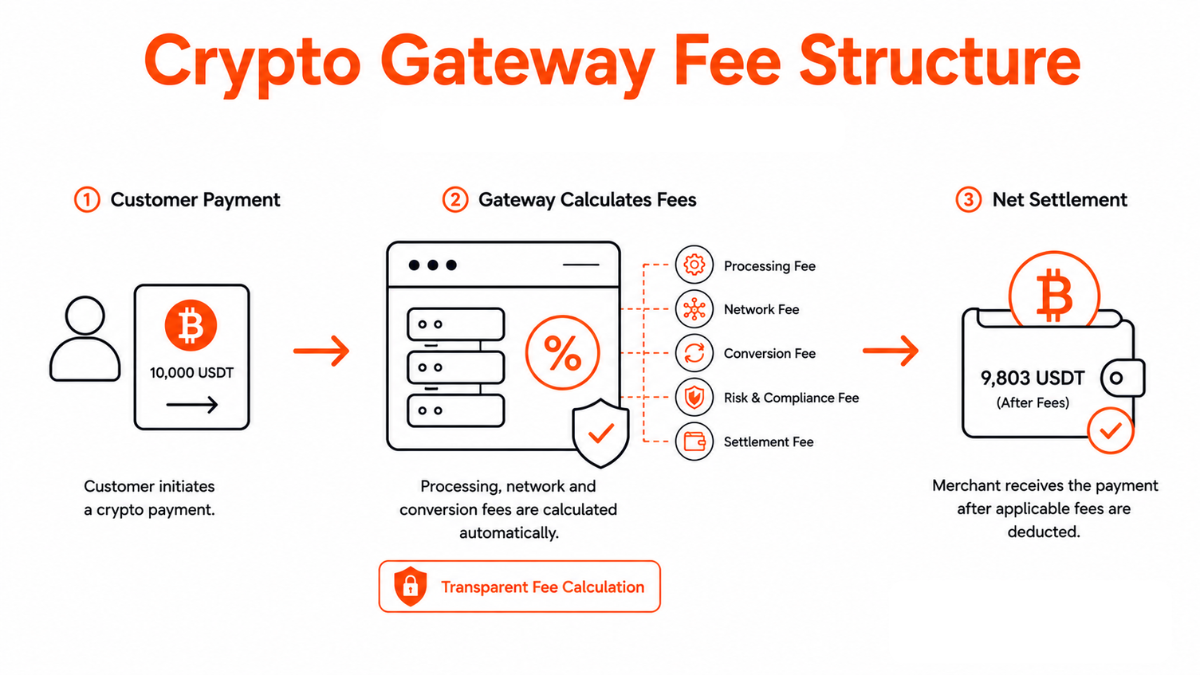
Components of the Total Cost of Crypto Payment Acceptance
The total cost of accepting crypto payments through a gateway is not the single-line fee quoted in the marketing materials — it is the sum of multiple fee components that apply at different points in the transaction lifecycle. Understanding each component is essential for accurate cost modelling and for comparing competing providers on a like-for-like basis:
● Processing fee: Charged per confirmed payment, either as a flat amount or a percentage of transaction value. This is the primary fee and the most prominently quoted.
● Conversion spread: Built into the exchange rate at settlement, not separately itemised. The difference between the market mid-rate and the rate applied by the gateway is the effective spread cost.
● Network fee: The blockchain fee paid to validators for including transactions. Some gateways absorb this into their processing margin; others charge it explicitly.
● Settlement fee: Charged per settlement disbursement to the merchant's bank account. May be flat (e.g., €2 per SEPA transfer) or a percentage of the settled amount.
● Withdrawal fee: For on-chain outgoing transfers (refunds, crypto settlements), a fee covering the network transaction cost and gateway processing.
● Monthly platform fee: A fixed recurring subscription charged regardless of transaction volume. More common in enterprise pricing models.
● Currency conversion fee: Applies when settlement currency differs from received currency, on top of the spread.
● Chargeback equivalent / dispute fee: Rare in crypto, but some gateways charge an administrative fee for processing payment disputes or investigations.
Pricing Models Across the Market
|
Model |
Structure |
Best For |
Risk for Merchant |
|
Flat percentage |
Fixed % of every transaction (e.g., 1%) |
Simple, predictable; good for mid-volume |
Expensive at high volume; better rates not negotiated |
|
Tiered percentage |
Lower % at higher monthly volumes |
High-volume merchants |
Rate tables can be complex; tier thresholds matter |
|
Interchange-plus equivalent |
Gateway's cost + fixed margin |
Institutional; high-volume |
Requires understanding of underlying costs |
|
Flat fee per transaction |
Fixed amount per payment (e.g., €0.50) |
High-value B2B transactions |
Expensive for low-value consumer payments |
|
Subscription + usage |
Monthly fee + lower per-transaction rate |
High-frequency merchants |
Requires minimum volume to justify subscription |
|
Custom enterprise |
Individually negotiated |
Very high volume (€1M+/month) |
Complex to compare; requires detailed modelling |
How to Calculate True Total Cost
To compare two gateways accurately, model the total cost for a representative month of your actual transaction profile. Use a realistic mix of transaction sizes and currencies, apply each fee component, and include the spread. For example: if Gateway A charges 0.8% processing with a 0.8% spread and a €2 settlement fee, and Gateway B charges 1.2% processing with a 0.3% spread and no settlement fee, Gateway A's total cost at €50,000 monthly volume with 200 transactions and one monthly settlement is: €400 (processing) + €400 (spread) + €2 (settlement) = €802. Gateway B's total is: €600 (processing) + €150 (spread) + €0 = €750. Gateway B is cheaper despite the higher quoted processing rate.
Negotiating Fee Structures
Published fee schedules are starting points for negotiation, not fixed prices, for merchants processing meaningful volume. Most gateways begin accepting custom rate requests at €100,000–€250,000 per month in volume, and serious negotiation becomes appropriate above €500,000 per month. Merchants should approach negotiations having modelled the total cost accurately, compared multiple providers, and identified the specific fee components they want adjusted. Asking for a lower processing rate while leaving the spread untouched often produces a worse outcome than negotiating both simultaneously. Gateways also respond better to volume commitment offers — agreeing to route a minimum monthly volume in exchange for a rate reduction.
Compliance Note: This glossary entry is provided for general educational purposes only and does not constitute financial, investment, legal, or tax advice. Industry terminology may vary across jurisdictions and providers; definitions herein may not directly reflect the specific features, terms, or specifications of Finassets' services. For details on Finassets' offerings, please refer to official product documentation or contact our team directly.