

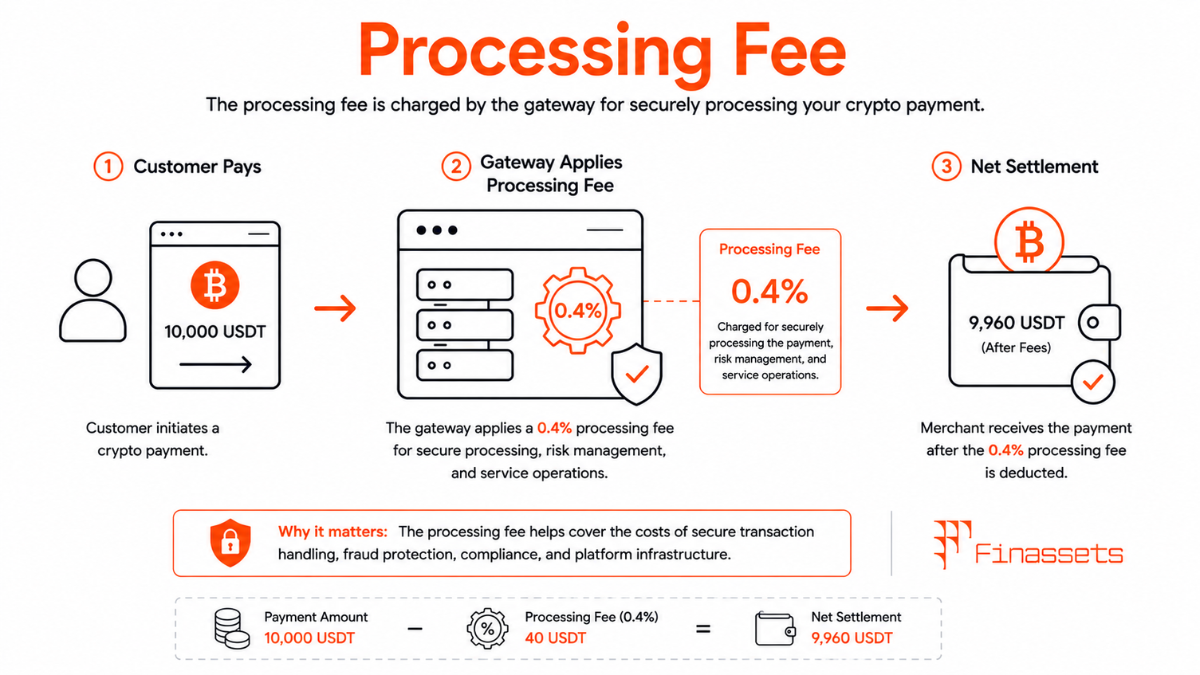
What a Processing Fee Covers Operationally
A crypto payment processing fee is not simply a revenue line for the gateway — it covers a defined set of operational costs that the gateway incurs to handle each transaction. Understanding what the fee covers clarifies why rates vary between providers and why the cheapest fee does not always represent the best value:
● Blockchain monitoring infrastructure: Running nodes or accessing node providers for each supported network costs money — either through cloud infrastructure for self-operated nodes or through API subscription fees to node providers like Alchemy, Infura, or QuickNode.
● Address generation and key management: Generating HD wallet derivation paths, storing xpubs, and managing the signing infrastructure for outgoing transactions has operational overhead per payment.
● Confirmation tracking: Continuously polling block data and maintaining confirmation counts for open invoices consumes compute resources proportional to the number of concurrent active invoices.
● Compliance operations: Each transaction is screened by blockchain analytics tools, which charge per API call. The cost of compliance screening, monitoring, and the human analyst time for flagged transactions is embedded in the processing fee.
● Customer support: Operational overhead from merchant and customer payment queries, dispute handling, and documentation support is distributed across the transaction base.
When and How Processing Fees Are Deducted
Processing fees are typically deducted at settlement time rather than at the moment of payment receipt. This means the merchant's real-time gateway balance shows the gross received amount, and the fee is subtracted when the settlement is calculated. Some gateways deduct fees from each transaction as it confirms; others batch-deduct at settlement. The timing difference affects cash flow visibility: a gateway that deducts at settlement makes the fee impact visible only once per settlement period, while per-transaction deduction gives a clearer real-time picture of net revenue.
Settlement statements should always show: gross received amount, processing fee deducted, conversion fee deducted (if applicable), network fee (if separately charged), and net fiat or crypto amount credited. Statements that show only the net settled amount without itemising deductions make it impossible to verify that the correct rates were applied.
Processing Fee vs. Network Fee — A Critical Distinction
A processing fee and a network fee are distinct costs that are sometimes conflated in gateway marketing. The processing fee is charged by the gateway for its own services — monitoring, matching, confirmation tracking, compliance, and customer support. The network fee is the cost paid to blockchain validators or miners for including transactions in blocks — it goes to the blockchain network, not the gateway, and fluctuates with network congestion.
Gateways handle network fees in different ways. Some absorb network fees into the processing fee — the merchant pays a flat processing percentage and the gateway pays network fees from its margin. Others charge network fees separately — the processing percentage covers gateway services and network fees are charged at cost. Still others build network fee estimates into the conversion spread. The absorb-into-processing model is more predictable for merchants; the pass-through model is more transparent but variable. Neither is inherently better — the comparison must account for the gateway's margin in each model.
Volume Discounts and Merchant Growth Planning
Processing fee schedules typically include volume tiers that reduce the per-transaction cost as monthly volume grows. A merchant paying 1.2% on €50,000 per month may pay 0.9% at €200,000 and 0.7% at €500,000. These thresholds matter for growth planning: a merchant approaching a volume tier should understand what additional revenue is needed to cross the tier and what the fee savings represent, as this informs whether to consolidate volume with one gateway (to achieve tier discounts) or diversify across providers (for resilience).
Compliance Note: This glossary entry is provided for general educational purposes only and does not constitute financial, investment, legal, or tax advice. Industry terminology may vary across jurisdictions and providers; definitions herein may not directly reflect the specific features, terms, or specifications of Finassets' services. For details on Finassets' offerings, please refer to official product documentation or contact our team directly.