

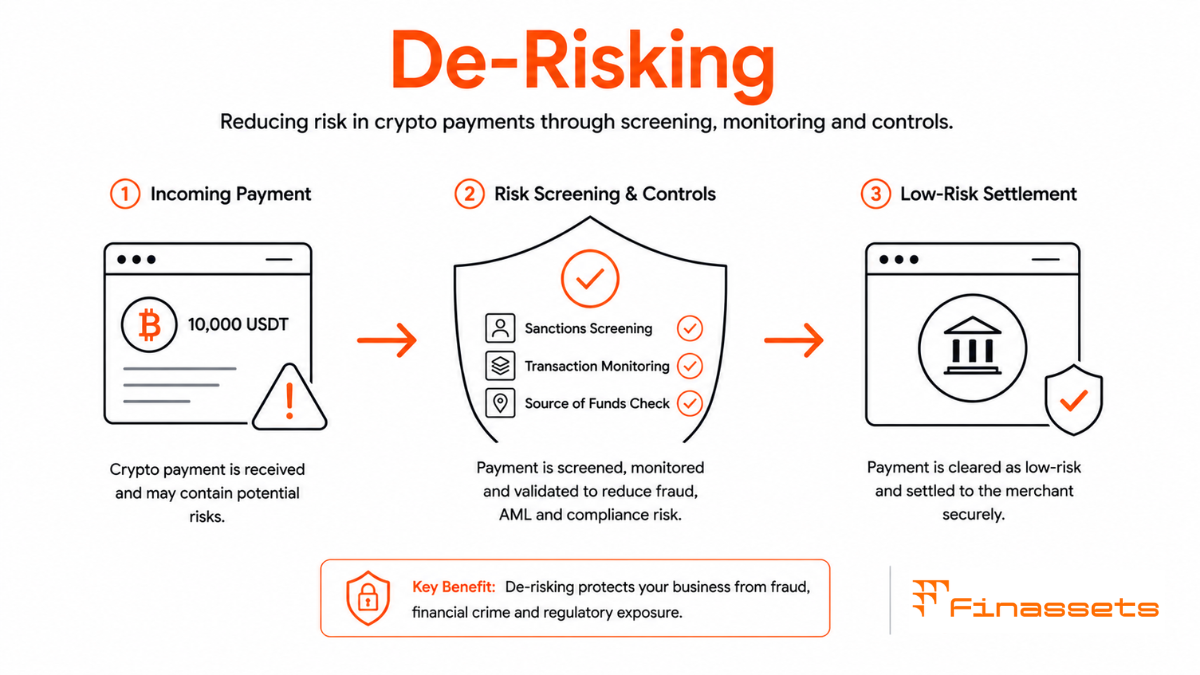
Why Banks Terminate Crypto Business Accounts
Banks that terminate or refuse accounts to crypto businesses are not acting from moral objection to digital assets — they are making a commercial risk calculation. AML compliance costs for crypto-exposed accounts are high: enhanced due diligence on crypto business customers, transaction monitoring for crypto-sourced fund flows, and the risk of regulatory penalty if a crypto client later proves to be facilitating money laundering all create costs and liabilities that can exceed the fee revenue a single crypto account generates. When the expected cost of managing a relationship exceeds its expected revenue, the bank closes the account — a decision that has nothing to do with the crypto company's actual compliance quality.
The pattern intensified following several high-profile enforcement actions against banks that processed funds connected to crypto-related money laundering. Banks that saw competitors face nine-figure fines for inadequate crypto AML controls became acutely risk-averse. The consequence — denying services to legitimate, compliant crypto businesses because they are in the same sector as higher-risk actors — is what the industry calls de-risking rather than risk-based decision-making.
Impact on Crypto Payment Gateways
De-risking creates an existential dependency for crypto payment gateways: fiat settlement capability depends on a banking partner that will accept the gateway's deposits and execute outgoing SEPA or SWIFT transfers. A gateway without a banking partner cannot deliver fiat settlement to merchants. It can still process on-chain crypto payments, but any merchant who wants their crypto converted to EUR or USD and transferred to a business bank account requires the gateway to have working banking relationships.
For smaller and newer gateways, accessing banking has historically been the hardest operational challenge — harder than building the technical infrastructure, harder than navigating licensing. Established gateways with long operational histories, large volumes, and strong compliance programs maintain stable banking because they provide sufficient revenue to justify the bank's compliance costs. Newer entrants often cycle through several banking providers before finding stable relationships, creating operational disruptions during transitions.
How MiCA Is Reshaping the Banking Relationship
The Markets in Crypto-Assets Regulation is shifting the calculus for European banks. Pre-MiCA, a bank assessing a crypto payment gateway faced regulatory uncertainty: was this business a VASP? What oversight framework applied? What due diligence was expected? MiCA answers these questions definitively: a CASP-authorized crypto gateway is a regulated financial institution operating under a framework comparable to a payment institution. A bank servicing a MiCA CASP is servicing a regulated counterparty, not an unclassified crypto entity.
This regulatory clarity reduces the perceived risk of the relationship and lowers the due diligence cost for the bank — the CASP's own AML program, license conditions, and ongoing supervision provide the compliance infrastructure the bank would otherwise have to assess independently. Early evidence from the post-MiCA market suggests that CASP-licensed gateways are finding banking easier to access than their predecessors, though the transition is gradual as banks update their internal frameworks.
Alternative Infrastructure for Banking-Challenged Gateways
Gateways that face persistent banking difficulty have developed alternative infrastructure paths that reduce reliance on traditional correspondent banking:
● EMI licensing: An Electronic Money Institution license allows a gateway to issue e-money and maintain merchant balances in e-money accounts, reducing dependency on direct bank account relationships for holding client funds. The gateway still needs banking for incoming fiat deposits and outgoing wire transfers, but the scope of banking dependency is narrower.
● Stablecoin settlement: Settling merchants in USDC or USDT rather than fiat bypasses bank transfer rails entirely. Merchants who accept stablecoin settlement receive on-chain transfers that need no banking intermediary.
● Banking-as-a-Service partners: Fintechs providing BaaS capabilities — issuing IBANs, executing SEPA transfers — through their own licensed entity, allowing gateways to offer bank transfer settlement without directly holding banking licenses.
● Geographic diversification: Maintaining banking relationships in multiple jurisdictions so that termination in one country does not disrupt operations elsewhere.
Compliance Note: This glossary entry is provided for general educational purposes only and does not constitute financial, investment, legal, or tax advice. Industry terminology may vary across jurisdictions and providers; definitions herein may not directly reflect the specific features, terms, or specifications of Finassets' services. For details on Finassets' offerings, please refer to official product documentation or contact our team directly.