

Which Networks Use Memos and Why
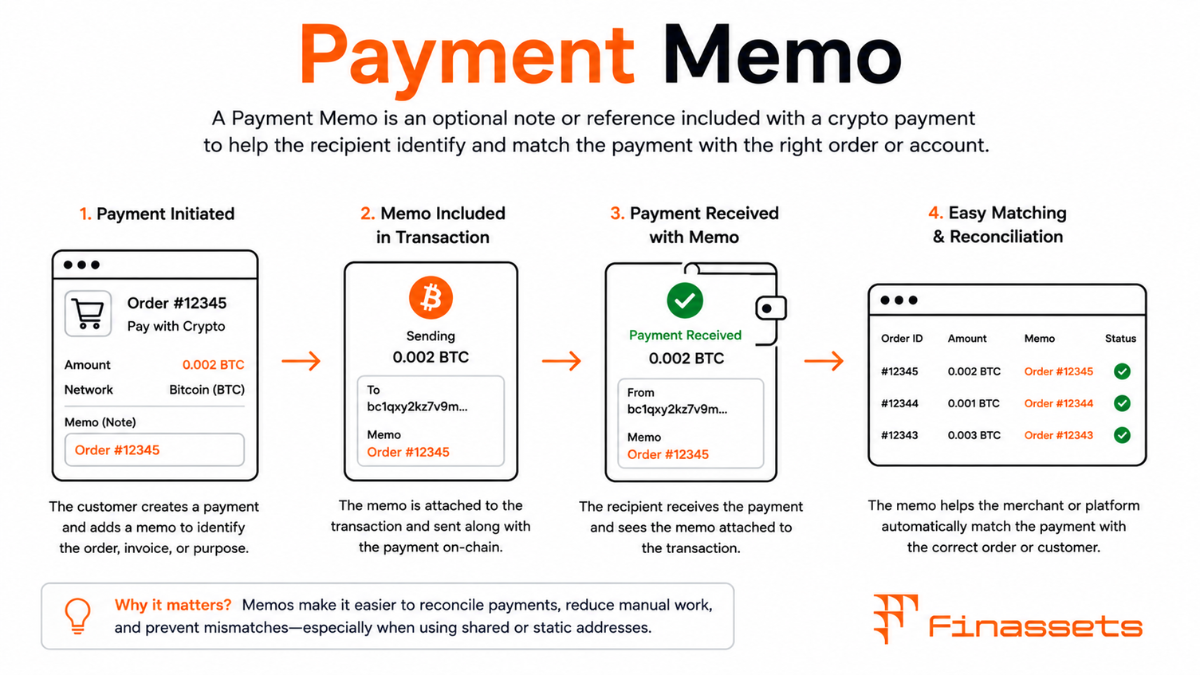
Memo-based payment routing exists on networks that share a single deposit address across many users rather than generating unique per-user addresses. The memo is the data field that distinguishes recipients. It serves the same routing purpose as a unique payment address on Bitcoin or Ethereum — but implemented at the application layer rather than the protocol layer. Networks that use memos typically do so because their address model is optimised for efficiency at centralised custodians, not for the privacy and uniqueness guarantees of UTXO or account-per-user models.
|
Network |
Field Name |
Memo Types |
Character / Size Limit |
|
Stellar (XLM) |
Memo |
Text (28 bytes), ID (uint64), Hash (32 bytes), Return Hash |
28 chars (text), 8 bytes (ID) |
|
Cosmos (ATOM) |
Memo |
Free-text string |
256 bytes |
|
Hedera (HBAR) |
Memo |
Free-text string |
100 bytes |
|
Toncoin (TON) |
Comment |
Text or 32-byte integer |
127 bytes |
|
Ripple (XRP) |
Destination Tag |
32-bit unsigned integer |
0 to 4,294,967,295 |
|
EOS |
Memo |
Free-text string |
256 bytes |
|
Monero (XMR) |
Payment ID (legacy) / integrated address |
Hex string |
Deprecated; use integrated addresses |
Stellar Memo Types and When to Use Each
Stellar supports four memo types, and the choice affects both what can be encoded and how the receiving platform processes the payment. Text memos (the most common) accept up to 28 UTF-8 characters and are used by most exchanges and gateways to encode an order reference, account identifier, or alphanumeric tag. ID memos encode a 64-bit unsigned integer — more compact and better suited to numeric reference systems. Hash memos encode a 32-byte hash of an associated document or transaction, used in advanced payment protocols. Return hash memos are used when routing a return payment to reference the original transaction.
Payment gateways generating Stellar payment invoices typically use Text or ID memos. The memo is included in the Stellar payment URI as the memo parameter, pre-populating the customer's wallet with the correct value. Gateways should confirm which memo type their monitoring system expects and validate that incoming transactions carry the correct type, since a gateway expecting an ID memo that receives a Text memo with the same numeric value may fail to match the payment.
What Happens When a Memo Is Missing on Stellar
Stellar transactions without a memo arrive at the destination address with no routing identifier. Unlike Bitcoin — where the payment address itself identifies the recipient — a Stellar payment to a shared gateway address without a memo is functionally unassigned. The gateway has no information about which customer or order the funds should be credited to.
Recovery depends on the gateway's capabilities. The gateway can identify the sending address from the transaction record and cross-reference it against registered customer addresses or recent KYC records. If the sender used a personal Stellar wallet, their public key may be linkable to their account. If they sent from an exchange withdrawal, the sending address belongs to that exchange's shared hot wallet, making account identification impossible without contacting the exchange's support team. Recovery timelines range from hours to several weeks. Some amounts are never recoverable due to unidentifiable senders.
Memo vs. Unique Address — When to Choose Each Approach
For gateways integrating Stellar, a design decision exists between using the network's native shared address with memos or generating unique Stellar addresses per invoice. Stellar supports account creation for any address, making unique address generation technically feasible, but each account requires a minimum balance reserve (currently 1 XLM) that locks funds indefinitely. At scale, generating unique Stellar accounts per invoice creates significant locked capital that grows with transaction volume. The memo approach is economically preferable despite its operational complexity, provided the gateway enforces strict memo validation and has a documented recovery process for memo-missing deposits.
Compliance Note: This glossary entry is provided for general educational purposes only and does not constitute financial, investment, legal, or tax advice. Industry terminology may vary across jurisdictions and providers; definitions herein may not directly reflect the specific features, terms, or specifications of Finassets' services. For details on Finassets' offerings, please refer to official product documentation or contact our team directly.