

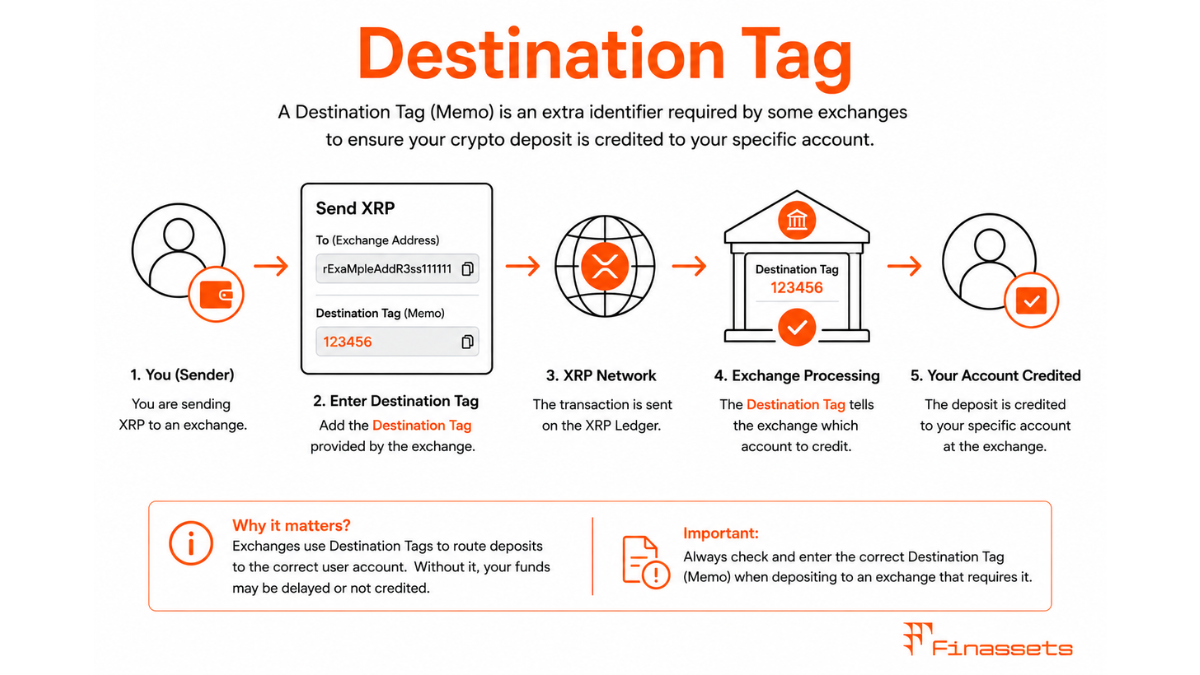
Why Destination Tags Exist
Most blockchain networks assign a unique address to each wallet, making payment routing straightforward: one address, one recipient. XRP Ledger (and several other networks) operate differently. Centralised services — exchanges, custodians, payment gateways — can receive funds for millions of customers at a single shared address. The destination tag is a numeric field in the transaction data that tells the receiving platform which specific customer account should be credited.
This architecture reduces the number of on-chain addresses a platform needs to manage, which has operational and accounting benefits. The trade-off is that an XRP payment without a correct destination tag arrives at the platform's general address with no instruction on where to allocate it — creating a support case that may take days to resolve and, in some systems, cannot be resolved at all if the platform does not have a recovery process for tagless deposits.
Networks That Use Destination Tags or Equivalent Fields
|
Network |
Field Name |
Format |
Required? |
|
XRP Ledger |
Destination Tag |
32-bit unsigned integer (0–4,294,967,295) |
Platform-dependent; often mandatory |
|
Stellar (XLM) |
Memo |
Text (28 bytes), ID (64-bit int), or hash |
Platform-dependent; often mandatory |
|
Cosmos (ATOM) |
Memo |
Text string |
Platform-dependent |
|
Hedera (HBAR) |
Memo |
Text string |
Platform-dependent |
|
Toncoin (TON) |
Comment |
Text or integer |
Platform-dependent |
|
EOS |
Memo |
Text string |
Platform-dependent |
How Payment Gateways Generate and Assign Destination Tags
When a gateway generates an XRP invoice for a specific merchant order, it assigns a unique destination tag — typically derived from an internal sequence counter or a hash of the order reference — and includes it in the invoice alongside the shared deposit address. The gateway's blockchain monitoring system then listens for incoming XRP transactions to the shared address and uses the destination tag field to match each incoming payment to its corresponding order.
This is functionally equivalent to how unique payment addresses work on Bitcoin or Ethereum — but instead of generating a new on-chain address, the uniqueness is encoded in the memo field. The customer's wallet sends the payment with the destination tag pre-populated from the payment URI or QR code, and the gateway routes the credit automatically.
What Happens When a Destination Tag Is Missing
If a customer sends XRP to a gateway's shared address without including the correct destination tag — either because they manually typed the address without the tag, or because their wallet does not support memo fields — the funds arrive in the gateway's general deposit pool with no routing information.
Recovery is possible in many cases but is not guaranteed. The gateway's operations team must manually match the incoming transaction to a customer account by cross-referencing the sender's address, transaction amount, and timestamp against pending orders. Some gateways have automated recovery tools; others require a formal support request with proof of the sending wallet's ownership. Recovery can take 1–10 business days. In rare cases where the sender's wallet cannot be identified, funds may be permanently unattributable.
Professional crypto payment gateways minimise this risk by generating XRP payment URIs that pre-populate both the deposit address and destination tag in the customer's wallet app when they scan the QR code, reducing the chance of a manual entry error. Merchants accepting XRP should prominently warn customers that the destination tag is mandatory.
Destination Tag vs. Unique Address — Operational Trade-offs
Networks like Bitcoin and Ethereum allow gateways to generate a genuinely unique address per transaction, which makes payment matching unambiguous. XRP's shared-address model requires the gateway to enforce correct tag inclusion at the application layer rather than the protocol layer. This adds an extra failure mode that unique-address systems do not have, but allows XRP's high-throughput ledger to be used efficiently without the overhead of managing millions of individual addresses.
Compliance Note: This glossary entry is provided for general educational purposes only and does not constitute financial, investment, legal, or tax advice. Industry terminology may vary across jurisdictions and providers; definitions herein may not directly reflect the specific features, terms, or specifications of Finassets' services. For details on Finassets' offerings, please refer to official product documentation or contact our team directly.