

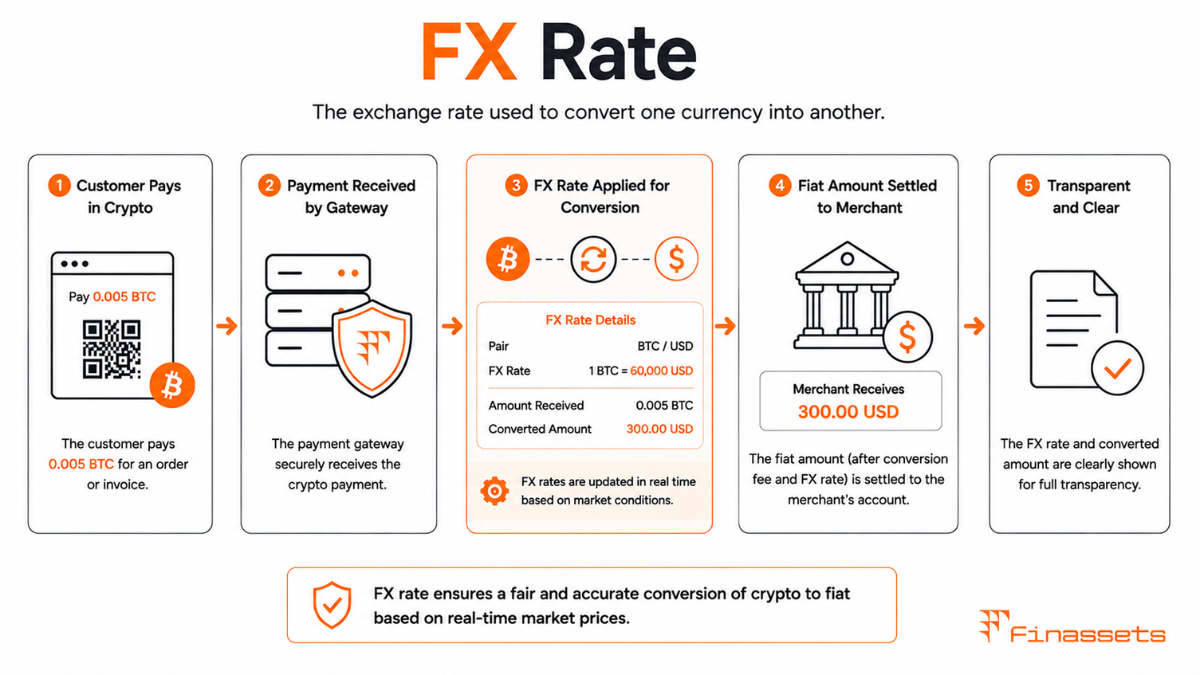
Sources of FX Rate Data for Crypto Gateways
Crypto FX rates — the exchange rates used to convert cryptocurrencies to fiat currencies — are sourced from several types of reference points that differ in methodology and reliability:
● Centralised exchange feeds: Real-time prices from major exchanges (Binance, Coinbase, Kraken, OKX). These are the most liquid reference points for mainstream assets but reflect the market price on a specific venue, which may differ slightly from other venues.
● Aggregated index prices: Volume-weighted average prices (VWAP) calculated across multiple exchanges, such as those published by CoinMarketCap or CoinGecko. More representative of the global market than a single exchange feed but may have a short data lag.
● Liquidity provider quotes: Real-time quotes from the gateway's own market-making or prime brokerage partners. These reflect the actual rates at which the gateway can execute conversions rather than theoretical reference prices.
● OTC reference rates: Published reference rates from OTC desk aggregators or industry organisations (such as the CME CF Bitcoin Reference Rate) used primarily for institutional reporting and derivatives settlement rather than retail payment conversion.
Most payment gateways use a combination: an aggregated index price as the reference point, with the conversion executed at the gateway's liquidity provider rate, and the spread representing the difference between these two.
Market Rate vs. Gateway Rate vs. Mid-Market Rate
These three terms are often used loosely but refer to distinct prices. The mid-market rate is the midpoint between the best available bid and offer prices across major venues — the theoretically 'fair' rate with no buy or sell bias. It is the rate cited by currency conversion tools like XE.com and is the reference used to calculate spreads. The market rate is the actual price at which a trade executes on a specific venue at a specific moment, which may differ from the mid-market rate depending on order book depth. The gateway rate is the mid-market rate minus the gateway's spread — the effective rate at which the merchant's crypto is converted.
The gap between the mid-market rate and the gateway rate is the most meaningful cost metric for merchants. A gateway with a gateway rate 0.5% below mid-market on a €100,000 monthly volume costs €500 per month in FX markup. The same calculation at 1.5% costs €1,500 per month. Understanding this relationship makes it straightforward to compare providers on a like-for-like basis.
Rate Refresh Frequency and Staleness Risk
FX rates for cryptocurrencies change continuously, and the rate displayed or stored at invoice generation time may differ from the rate at payment confirmation time by a meaningful amount during volatile periods. Payment gateways address this through the price lock mechanism, but the rate used for the lock must itself be fresh — a rate that is 60 seconds old during a fast-moving market may already differ by 0.5% or more from the current price.
Professional gateways refresh their reference rates every 1–5 seconds from live market feeds. Gateways relying on APIs that refresh less frequently — some aggregated price sources update every 60 seconds — introduce systematic FX risk that they either absorb into a wider spread or pass to merchants through less accurate conversions. When evaluating a gateway's rate quality, asking about the frequency and sources of rate refreshes is as important as asking about the spread level.
FX Rate Recording for Accounting and Tax Purposes
The FX rate applied at conversion is a required data point for both accounting and tax reporting. For income recognition, the applicable rate determines the functional currency value of the revenue. For capital gains calculation (in jurisdictions where crypto is treated as a capital asset), the cost basis of any crypto retained is established by the FX rate at acquisition. Settlement statements must therefore include not just the converted fiat amount but the exact rate applied to each conversion event, with a timestamp.
Merchants operating in multiple currencies — for example, a business that receives payments in Bitcoin but settles in both EUR and USD for different cost centres — need per-currency FX rate records for each conversion. Gateways that support multi-currency settlement should provide per-currency rate data in their transaction exports, not just the aggregate settled amount.
Exotic Currency Challenges
For merchants settling into currencies outside the major fiat pairs — emerging market currencies like the Brazilian Real (BRL), Nigerian Naira (NGN), or Indonesian Rupiah (IDR) — finding competitive crypto-to-local-currency FX rates is significantly harder. The crypto-to-exotic-currency market is less liquid, spreads are wider (1%–5% is common versus 0.5%–1% for major currency pairs), and settlement may involve multiple conversion steps: crypto to USD, then USD to local currency through the banking system.
Merchants settling into exotic currencies should verify with their gateway whether the quoted FX rate is a direct crypto-to-local-currency rate or a crypto-to-USD-to-local-currency composite, and understand the spread components at each step. Alternative settlement in a USD-pegged stablecoin with local currency conversion handled through a domestic banking partner may offer lower total conversion costs.
Compliance Note: This glossary entry is provided for general educational purposes only and does not constitute financial, investment, legal, or tax advice. Industry terminology may vary across jurisdictions and providers; definitions herein may not directly reflect the specific features, terms, or specifications of Finassets' services. For details on Finassets' offerings, please refer to official product documentation or contact our team directly.