

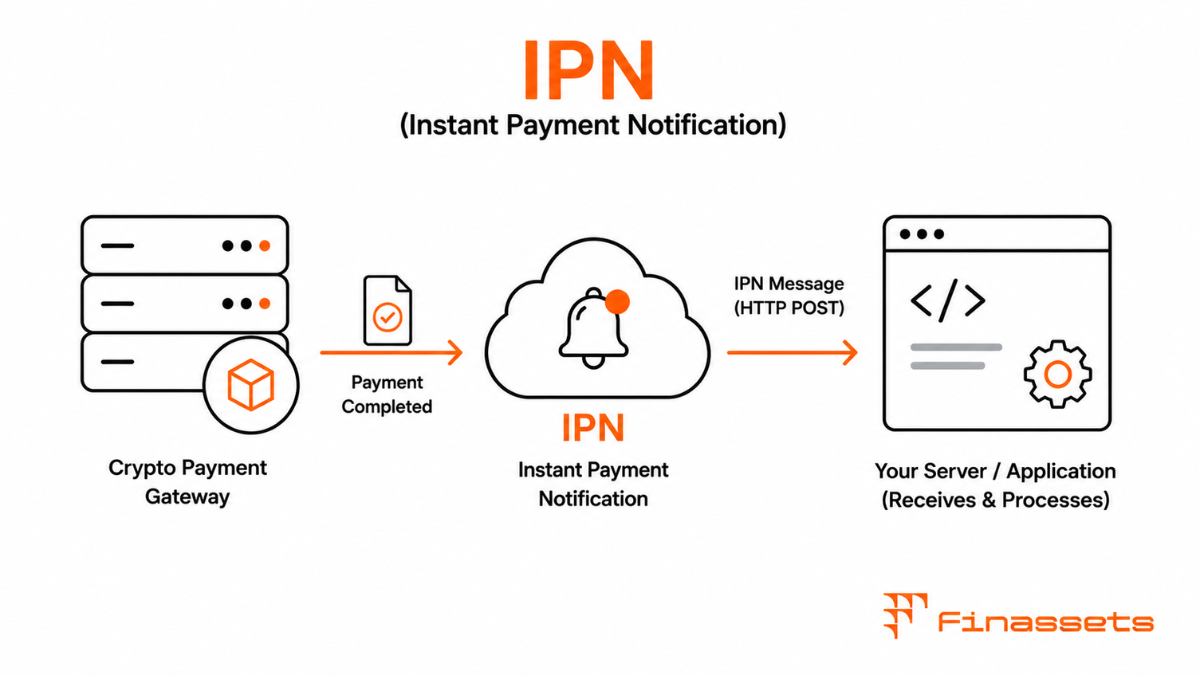
IPN vs. Webhook — Is There a Difference?
In the context of crypto payment gateways, IPN (Instant Payment Notification) and webhook are terms that describe the same fundamental mechanism: an HTTP callback from the payment gateway to the merchant's server when a payment event occurs. The term 'IPN' was popularised by PayPal in the early 2000s and adopted by several early Bitcoin payment processors (notably BitPay and early CoinPayments) as the name for their notification system. Newer gateways and API-first providers predominantly use 'webhook' as the term, reflecting the broader software industry convention.
The practical difference, where one exists, is typically in the payload format and delivery mechanism rather than the underlying concept. Some systems that use the IPN label deliver notifications via HTTP GET requests (appending parameters to the URL query string) rather than HTTP POST with a JSON body, and use different validation mechanisms. Merchants integrating with a gateway that uses the IPN label should read the gateway's specific documentation rather than assuming the implementation is identical to a webhook.
IPN Payload Structure and Validation
A typical IPN payload from a crypto payment gateway contains: the invoice identifier, the merchant identifier, the payment status (pending, confirmed, expired), the amount received in cryptocurrency, the cryptocurrency received, the fiat value at conversion, the conversion rate applied, the TXID of the on-chain transaction, the customer's paying wallet address, and a checksum or signature for validation.
Validation in legacy IPN systems often differs from modern HMAC webhook validation. Some systems require the merchant to make a verification API call back to the gateway — posting the received IPN data to a verification endpoint, which returns a 'VERIFIED' or 'INVALID' response. This two-step verification prevents spoofing but creates a synchronous external dependency in the merchant's IPN handler. Modern HMAC-based systems eliminate this external call by allowing local verification using the shared secret.
Handling IPN Processing Failures
IPN handlers, like webhook handlers, must return an HTTP 200 response to indicate successful receipt. A common implementation mistake is performing database writes, sending confirmation emails, or triggering external API calls synchronously within the IPN handler before returning a response. If any of these operations are slow or fail, the handler may exceed the gateway's timeout and return no response, triggering a retry even though the IPN was already processed.
The correct pattern is to return 200 immediately upon successful signature validation and queue the event for asynchronous processing. A background job or queue worker then processes the business logic — updating order status, triggering fulfilment, sending notifications — independently of the HTTP response lifecycle. This keeps the IPN handler fast, reliable, and safe to retry without risk of double-processing.
Legacy Integrations and IPN Migration
Many merchants who built crypto checkout integrations in 2015–2020 used gateways whose documentation exclusively used the IPN terminology and format. As those gateways have updated their APIs or as merchants have switched providers, they may need to migrate IPN-based integrations to webhook-based ones. The migration typically involves updating the handler URL, switching the validation mechanism from verification API call to HMAC check, adjusting the payload parsing to match the new JSON structure, and updating the event type mappings if the new gateway uses different status labels.
Compliance Note: This glossary entry is provided for general educational purposes only and does not constitute financial, investment, legal, or tax advice. Industry terminology may vary across jurisdictions and providers; definitions herein may not directly reflect the specific features, terms, or specifications of Finassets' services. For details on Finassets' offerings, please refer to official product documentation or contact our team directly.