

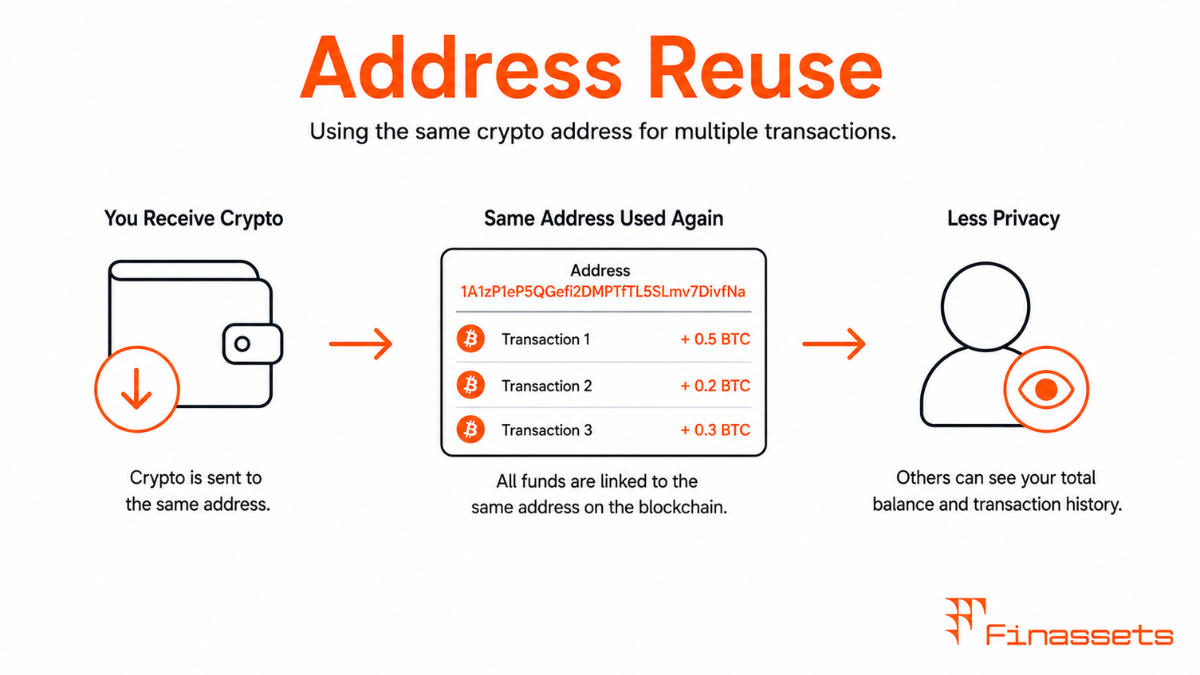
Why Address Reuse Breaks Payment Detection
A payment gateway monitoring blockchain addresses for incoming payments works by watching a specific set of addresses and triggering order updates when new transactions arrive at those addresses. If the same address is used for two different orders simultaneously — or sequentially without clearing between uses — the gateway cannot automatically determine which incoming payment belongs to which order solely from the address. Two customers paying different amounts to the same address at nearly the same time produces two incoming transactions with no routing information distinguishing them.
Gateways that avoid address reuse sidestep this problem entirely: one unique address per invoice means any incoming payment to that address can only belong to one order. Gateways that do reuse addresses must implement secondary matching logic — matching by amount, by timing, by customer identifier — which introduces reconciliation errors, especially when payments arrive out of sequence or in unexpected amounts.
Privacy Implications of Address Reuse
Bitcoin and UTXO-based blockchains are transparent: every transaction to and from an address is publicly visible. Reusing an address means that anyone who has transacted with a merchant once can, using a block explorer, see every other payment ever made to that address — the merchant's total revenue, transaction frequency, and potentially the identities of other customers (if those customers' identities can be linked to their wallet addresses through other means).
For enterprise merchants, this level of on-chain transparency can expose commercially sensitive information: revenue patterns, key business relationships, and payment volumes. Blockchain analytics firms routinely cluster addresses into entity profiles based on co-spending patterns and known address sets. Merchants who reuse payment addresses are easier to identify and profile.
The UTXO Aggregation Risk
In Bitcoin's UTXO model, each incoming payment sits as an unspent output at the receiving address. When the merchant later spends funds from a reused address, the spending transaction reveals that all UTXOs at that address are controlled by the same wallet, linking potentially hundreds of customer payments to a single entity and making the merchant's on-chain footprint easy to trace.
HD wallet infrastructure solves this at scale: by generating a unique derivation-path child address for each invoice, the gateway can still manage funds from a single master key while presenting an entirely separate address to each customer. The on-chain footprint is fragmented across thousands of addresses with no obvious common controller — though blockchain analytics tools can still identify HD wallet clusters through pattern analysis.
When Address Reuse Is Unavoidable
For networks using shared address architectures — XRP, Stellar, Cosmos — address reuse is inherent to the network design. The mitigation is destination tags or memos, which provide the routing information that unique addresses provide on Bitcoin and Ethereum. For these networks, address reuse itself is not problematic as long as the memo/tag is correctly used.
Some merchants choose to publish a static donation address or payment address for brand recognition purposes. This is a deliberate choice with understood privacy trade-offs rather than an operational error. For public donation addresses, privacy is less of a concern, and the address may intentionally be reused to allow supporters to verify aggregate contributions.
Compliance Note: This glossary entry is provided for general educational purposes only and does not constitute financial, investment, legal, or tax advice. Industry terminology may vary across jurisdictions and providers; definitions herein may not directly reflect the specific features, terms, or specifications of Finassets' services. For details on Finassets' offerings, please refer to official product documentation or contact our team directly.